I'm experimenting.
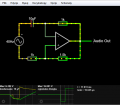
Because the capacitor has a reactance from AC input. So when the negative feedback with resistors has this equation R1/(R1+R2) and positive feedback has R4/(R3+R4) then I thought that when I want to have "dominant" negative feedback I have to increase R1 in this case reactance of this capacitor.
But I don't understand the point "DC operating point" what does it mean? When I don't have the positive feedback I can achieve AC output so as well AC operating point?
Why the negative feedback won't work instead of positive? I know that even positive or negative feedback can work, they can't work at the same time. So I can have a increased AC sygnal or saturated sygnal.
The inputs of an operational amplifier are supposed to be at the same potential. This potential must have a DC path to ground for stability. Without that DC path to ground, the actual potential could be anything. You need to get your head out of the dark space it is occupying.
The inputs of an operational amplifier are supposed to be at the same potential. This potential must have a DC path to ground for stability. Without that DC path to ground, the actual potential could be anything. You need to get your head out of the dark space it is occupying.
I don't understand, why DC path? I'm using here AC. I also have a negative feedback to create this stability. So why positive feedback "dominates" this circuit and makes it saturated.
I'm guessing that understanding circuits will be a problem for you if you cling to that belief. All points in a circuit must be referenced to a specific reference potential. If thye were not and the voltage could be anything with respect to a fixed reference, there would be no such thing as stability.
Every AC signal that you will ever see, besides all the ones you won't, will have a DC component. That DC component can be the same as the ground reference, but it cannot be absent.
I'm guessing that understanding circuits will be a problem for you if you cling to that belief. All points in a circuit must be referenced to a specific reference potential. If thye were not and the voltage could be anything with respect to a fixed reference, there would be no such thing as stability.
Every AC signal that you will ever see, besides all the ones you won't, will have a DC component. That DC component can be the same as the ground reference, but it cannot be absent.
" of the particular Falstad simulation -- the GND is . . . relative to the op amp output (depends how you define it's Vee/Vss/-Vs and Vcc/Vdd/+Vs ) . . . so (in simplified form) the GND comes through to the current source and output impedance of the op amp to the positive feedback chain to the "Common" terminal of your AC source ...
... however you have the near ideal op amp in your hand (means the input bias currents of the op amp are neglible) so it only sees the input voltages which are V.out at +V.in and +V.in + V.ac at the -V.in
your op amp is configured as a voltage comparator with hysteresis
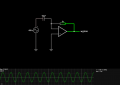
- so the output of the R2R square wave is expected . . .
" of the particular Falstad simulation -- the GND is . . . relative to the op amp output (depends how you define it's Vee/Vss/-Vs and Vcc/Vdd/+Vs ) . . . so (in simplified form) the GND comes through to the current source and output impedance of the op amp to the positive feedback chain to the "Common" terminal of your AC source ...
... however you have the near ideal op amp in your hand (means the input bias currents of the op amp are neglible) so it only sees the input voltages which are V.out at +V.in and +V.in + V.ac at the -V.in
your op amp is configured as a voltage comparator with hysteresis
The signal of interest is not DC, but it has an average value of some DC voltage. For audio, this is the voltage at the zero-crossings. With dual power supplies, the output DC value probably is 0 V; but it doesn't have to be. If you post your circuit, we can discuss how it really operates.
This circuit is a generator.
But I am just thinking about why positive feedback is stronger. And why negative feedback will never be stronger than positive feedback.
The signal of interest is not DC, but it has an average value of some DC voltage. For audio, this is the voltage at the zero-crossings. With dual power supplies, the output DC value probably is 0 V; but it doesn't have to be. If you post your circuit, we can discuss how it really operates.
Yes, they can. But not in a standard amplifier configuration. Having both positive and negative feedback around the same opamp creates a bridge circuit and raises the output impedance. The best case of this is the Howland Current Pump.
Yes, they can. But not in a standard amplifier configuration. Having both positive and negative feedback around the same opamp creates a bridge circuit and raises the output impedance. The best case of this is the Howland Current Pump.
Ok so could you tell me why I can find a definition "DC feedback"? This circuit from the beggining has a positive feedback that is DC feedback and negative feedback that is not DC feedback.
What if I add resistor in parallel with capacitor. Will it make negative feedback a DC feedback?

 Facebook
 Google
 GitHub
 Linkedin