Facebook
 Google
 GitHub
 Linkedin

I'm kinda curious as to how these were done (or if they were) before servo driver ICs became available?
I mean, I know how you could do it with a microcontroller - that's not that complicated.
...and I have some idea how it could be done conceptually with analog electronics (with the exception of the pulse stretcher part).
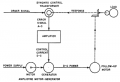
But I haven't found any "contemporary" (ie -1960s) books or magazine articles detailing a circuit design; usually just block diagrams, or more generally, a design is given with an input potentiometer for the position, and an output potentiometer at the end of the gear train to drive the error input to the "summing amplifier" (which drives the h-bridge to turn positing/negative.
I'm wanting to know how the whole circuit could be built from discrete parts plus some basic ICs; I figure that you'd need a op-amp or two, maybe something generating a ramp for the position control, to generate a positive or negative output voltage that would cause the h-bridge to move in the proper direction...
But I've yet to find any kind of articles contemporary to the era around when PPM/PWM hobby servos first popped up on the RC hobby scene; that is, going from certain older control systems (ie, "galloping ghost") to something closer to a modern analog servo? I know that there were servos that had the control electronics "off-servo" - most usually with 5-pin/wire designs, similar to how some of the cheaper RC proportional control cars use as "servos"...
Does anyone have a reference or a schematic of one of these old systems (assuming such a thing exists)?
I mean, I know how you could do it with a microcontroller - that's not that complicated.
...and I have some idea how it could be done conceptually with analog electronics (with the exception of the pulse stretcher part).
But I haven't found any "contemporary" (ie -1960s) books or magazine articles detailing a circuit design; usually just block diagrams, or more generally, a design is given with an input potentiometer for the position, and an output potentiometer at the end of the gear train to drive the error input to the "summing amplifier" (which drives the h-bridge to turn positing/negative.
I'm wanting to know how the whole circuit could be built from discrete parts plus some basic ICs; I figure that you'd need a op-amp or two, maybe something generating a ramp for the position control, to generate a positive or negative output voltage that would cause the h-bridge to move in the proper direction...
But I've yet to find any kind of articles contemporary to the era around when PPM/PWM hobby servos first popped up on the RC hobby scene; that is, going from certain older control systems (ie, "galloping ghost") to something closer to a modern analog servo? I know that there were servos that had the control electronics "off-servo" - most usually with 5-pin/wire designs, similar to how some of the cheaper RC proportional control cars use as "servos"...
Does anyone have a reference or a schematic of one of these old systems (assuming such a thing exists)?