how do we find the period?

Thread Starter

circuit975

Joined Jun 13, 2024
43
1749417693853.png

I salute the entire community on my behalf.

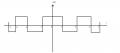
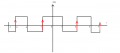
when I was working on square wave on signals and systems, I thought that I sometimes confused the period of the signs.

i find that the period of such a sign is 4. but I'm not sure if I did it by heart or really knowing how it's done.

how do we find the period of a graph of this type in the most accurate and scientific way?

so are we looking at starting from one place and ending from another, what exactly are we looking at?

by the way, I can't help saying: I made the drawing myself , as an example , to Decipher what happened.

in short :
what is the logic of finding a period?
what is the logic of this? if anyone knows, the community will honor him.

Thank you very much!
 

MrChips

Joined Oct 2, 2009
34,818
The period is the time it takes for the cycle to repeat.
Pick any starting point and find the next time that the cycle repeats.

Note: You should draw the graph with equal time steps, for example, 0, 1, 2, 3, 4 ... etc.
The spacing must be the same for each step.
 

Thread Starter

circuit975

Joined Jun 13, 2024
43
The period is the time it takes for the cycle to repeat.
Pick any starting point and find the next time that the cycle repeats.

Note: You should draw the graph with equal time steps, for example, 0, 1, 2, 3, 4 ... etc.
The spacing must be the same for each step.
the chart may not always be as detailed as you say, it is our responsibility to know what we should do in any case
 

Thread Starter

circuit975

Joined Jun 13, 2024
43
what is the time between rising edges?
View attachment 350737


1749449795458.png

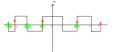
i didn't know that the time between the rising edges was Dec, I was looking at it like this, but I wasn't sure about its accuracy:

the places I have shown with green dots are starting to repeat the same period. there I was actually thinking that the difference between those two points was the period
 

panic mode

Joined Oct 10, 2011
4,992
That is wrong. All of them need to be in phase. But you got two on falling edge, then next two are on the rising edge. You need to pick either and stick with it.
 

BobTPH

Joined Jun 5, 2013
11,521
I think you have confused yourself by making a bad drawing. Looking at the intervals, they appear to all be different, do they show no actual repeated pattern, but the number labels say differently.

Draw it with all the numbers equally spaced and it will be more obvious.
 

Thread Starter

circuit975

Joined Jun 13, 2024
43
That is wrong. All of them need to be in phase. But you got two on falling edge, then next two are on the rising edge. You need to pick either and stick with it.
So, by choosing between the rising edge and the falling edge, and selecting the part in between, we can determine the correct period. Am I understanding you correctly?
 

atferrari

Joined Jan 6, 2004
5,012
In post #2 you got the necessary answers.

Your signal, as shown, is not periodic so no way you can measure frequency.

Show any signal where you can identify a period and then go from there.

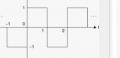
Something like this:

1749502822885.png
or like this

1749502882052.png

or like this

1749502989964.png
 

panic mode

Joined Oct 10, 2011
4,992
Your signal, as shown, is not periodic so no way you can measure frequency.
Signal is periodic and period/frequency can be determined. However this is not easy since graph time axis is nonlinear.

As others have already suggested, draw it to scale so that time is linear and not just monotone.
 

panic mode

Joined Oct 10, 2011
4,992
Just determine time difference between any two points that are in phase. You can use rising or falling edges as those are the only points where time is shown.
 

WBahn

Joined Mar 31, 2012
32,854
View attachment 350735

I salute the entire community on my behalf.

when I was working on square wave on signals and systems, I thought that I sometimes confused the period of the signs.

i find that the period of such a sign is 4. but I'm not sure if I did it by heart or really knowing how it's done.

how do we find the period of a graph of this type in the most accurate and scientific way?

so are we looking at starting from one place and ending from another, what exactly are we looking at?

by the way, I can't help saying: I made the drawing myself , as an example , to Decipher what happened.

in short :
what is the logic of finding a period?
what is the logic of this? if anyone knows, the community will honor him.

Thank you very much!
The basic definition of the period of a waveform is the smallest positive value of T such that

y(t+T) = y(t) for any value of t.

If no such value exists, then the waveform has no period and is said to be "aperiodic". A single pulse would be a simple example.

As has been pointed out, your horizontal scaling is not uniform, which makes your waveform appear aperiodic. But closer examination shows that it is periodic.

Identify the times where there are rising edges. What is the time that separates adjacent rising edges? Is it always the same?

Identify the times where there are falling edges. What is the time that separates adjacent falling edges? Is it always the same?

Is shape of the waveform between one rising edge and the next falling edge always the same?

Is the shape of the waveform between one falling edge and the next rising edge always the same?

If the answers to all of these yes/no questions is Yes, and the answer to the two questions asking for a time are the same, then it is periodic and that time is the period.
 

panic mode

Joined Oct 10, 2011
4,992
amplitude is fixed at some voltage levels Vp and Vn, each space and mark are exactly 2second long. therefore duty cycle is 50%, period is 4sec and f=0.25Hz. distortions of the hand drawn time scale does not change it. and yes it is a periodic signal.
 
Last edited:

MrAl

Joined Jun 17, 2014
13,707
View attachment 350735

I salute the entire community on my behalf.

when I was working on square wave on signals and systems, I thought that I sometimes confused the period of the signs.

i find that the period of such a sign is 4. but I'm not sure if I did it by heart or really knowing how it's done.

how do we find the period of a graph of this type in the most accurate and scientific way?

so are we looking at starting from one place and ending from another, what exactly are we looking at?

by the way, I can't help saying: I made the drawing myself , as an example , to Decipher what happened.

in short :
what is the logic of finding a period?
what is the logic of this? if anyone knows, the community will honor him.

Thank you very much!
The period would be the inverted value of the lowest frequency detected: tp=1/f.
That also means the longest period where the wave pattern repeats.

To find the lowest frequency you could do a Fourier Analysis. That will show you all of the frequencies if possible.
You can then pick the lowest one but it is possible that there is none.
For example, if you have pulses of 1 second each that are spaced 1 second, then 2 seconds, then 1, then 2 , then 1, then 2, etc., it's easy. But if you have 1 second pulses that are spaced 1, 2, 3, 4, 5, ever increasing, then you won't be able to find the lowest frequency because it keeps getting longer and longer.

For your particular signal, I am not sure we are seeing enough of the pattern yet, or if the pattern is drawn carefully enough.
Taken as is, we would have to say that the period is the entire length of the pattern. That would mean we would be assuming also that it repeats forever.
 

Ian0

Joined Aug 7, 2020
13,132
As you've been doing some work on convolution, then you should try correlation.
If you autocorrelate your waveform, the peak in the autocorrelation function is the period.
 

MrAl

Joined Jun 17, 2014
13,707
As you've been doing some work on convolution, then you should try correlation.
If you autocorrelate your waveform, the peak in the autocorrelation function is the period.
Hi,

One of the points I was making was that the measurement could in fact depend on the size of the sample window.
I ran into this when I was trying to find a good way to show a step change in the pure non-imaginary real frequency domain. I don't think there is any way to do that in theory, but in practice we can approximate it to some degree by choosing a window size that is large enough to reduce artifacts.
 
Top