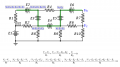
NOTE: I've added polarity markers to your sources so that there is no ambiguity.
You do it just like any other supernode problem.
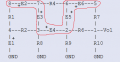
A supernode consists of nodes connected by voltage sources. Here you have two such sets.
{GND, V4} -- but this is trivial and you can just set
V4 = E1.
The other one is shown in red:
-E1 - E2 - E3 - E4
So you have two node equations, one for V1 and one for the supernode.
There are about three main ways to do it, largely depending on your level of comfort with writing the equations down in final form by inspection. The most explicit is to write the equations in terms of the actual nodes involved and then write supplementary equations relating the voltages of the nodes that make up the supernode.
Note that you could include R4 in the supernode since the current in it is strictly determined by the sources within the supernode and it otherwise doesn't interact with anything else outside the supernode. But if you are looking for something like power dissipation, then it is probably best (but not required) not to do this. It's largely a moot point because it will drop out of the equations anyway.
If you are comfortable writing the normal nodeal equations down by inspection, then all you do is pick one of the supernode nodes as the node you want to use as an unknown and write the left hand side just as you would if the entire supernode was the node you picked. Then for the right hand side you do the same to get started, but then you add a term for each source in the supernode and the resistors that have to go through it to get to the chosen node.
Assuming I did these correctly -- and it's been many years since I've done so and I chose to try to do it by inspection here and haven't verified the results -- then these are the two equations in two unknowns.
It actually isn't THAT bad -- two equations in two unknowns. Even solving it symbolically wouldn't be too bad. Solving for actual currents given all the parameters would be almost trivially easy.
One may view a supernode as no different than a regular node and write a node equation for the supernode directly from the circuit diagram just like a regular node. My point is that getting the supernode equation can be made easier by color coding the supernode and annotating the voltage offsets directly on the diagram. When done in this manner the supernode equation will have the same basic form as a regular node equation, thereby making it easier to see when a simple mistake has been made.
But the underlying message in my first reply was: Don't expect to solve this problem by rote manipulation of algebraic formulae.
My point was that if we open circuit the voltage sources and write equations for each node, we then simply ADD the equations that are connected to the source on either side. That's in keeping with the main idea shown for most super node explanations we find around.
-E1 - E2 - E3 - E4
So you have two node equations, one for V1 and one for the supernode.
There are about three main ways to do it, largely depending on your level of comfort with writing the equations down in final form by inspection. The most explicit is to write the equations in terms of the actual nodes involved and then write supplementary equations relating the voltages of the nodes that make up the supernode.
Note that you could include R4 in the supernode since the current in it is strictly determined by the sources within the supernode and it otherwise doesn't interact with anything else outside the supernode. But if you are looking for something like power dissipation, then it is probably best (but not required) not to do this. It's largely a moot point because it will drop out of the equations anyway.
If you are comfortable writing the normal nodeal equations down by inspection, then all you do is pick one of the supernode nodes as the node you want to use as an unknown and write the left hand side just as you would if the entire supernode was the node you picked. Then for the right hand side you do the same to get started, but then you add a term for each source in the supernode and the resistors that have to go through it to get to the chosen node.
Assuming I did these correctly -- and it's been many years since I've done so and I chose to try to do it by inspection here and haven't verified the results -- then these are the two equations in two unknowns.
Well that's ok if you want to add polarities as i forgot to add those. I always default to right hand side positive or up top positive. So vertical sources have positive always on top, and horizontal sources have positive to the right, unless otherwise marked of course.
What other way is there to solve it? What do you think Maple is doing? If ever there was an example of rote manipulation of algebraic formulae, mathematical software is it.
If what you mean is that a human being wouldn't be able to carry out that much algebra by hand without making a mistake, you should say that. That I can certainly agree with.
Is anybody going to give a try at solving for the voltage source currents?
What i would do once i have all the node voltages is compute the current though each resistor and then use the sum of currents entering the node is equal to zero in order to get the source currents. The current through each resistor is of course (v1-v2)/R and polarity differs as needed.
[FONT=Courier New]

Note: There are two E4's both 4v each.

   19--R3---18--R10--17--E4---16
   |        |        |        |
   E2       R8       R15      R23
   |        |        |        |
   15--R4---14--R11--13--R19--1--Vo1
   |        |        |        |
   R2       E3       R16      R23
   |        |        |        |
   11--R5---10--R12--9---E5---8
   |        |        |        |
   E1       R9       R17      R24
   |        |        |        |
   7---R6---6---R13--5---R20--4
   |        |        |        |
   R1       E4       R18      R25
   |        |        |        |
   3---R7---+---R14--2---R21--12
            |
            GND

All source are positive on top or to the right.
E1=1, E2=2, etc., up to E5=5.
R1=1, R2=2, R3=3, etc., up to R25=25.[/FONT]

Note these results are untested and will be tested a little later.
LATER: checked the voltage across R14 based on currents into and out of node 2 and it checks out ok.
v1=491832161662954864/68740236925797235
v2=134649318774076638/68740236925797235
v3=151841554672647728/68740236925797235
v4=325586682968316987/68740236925797235
v5=233055250711944477/68740236925797235
v6=4
v7=173533205340168832/68740236925797235
v8=107248779207635271/13748047385159447
v9=38508542281838036/13748047385159447
v10=174329065263819472/68740236925797235
v11=242273442265966067/68740236925797235
v12=443632752682024899/137480473851594470
v13=350031385792762052/68740236925797235
v14=380549776041211177/68740236925797235
v15=279025246947526877/68740236925797235
v16=619073998077966777/68740236925797235
v17=344113050374777837/68740236925797235
v18=395490031001199337/68740236925797235
v19=416505720799121347/68740236925797235[/FONT]


Note: There are two E4's both 4v each.
To what end? What would setting up the equations for this one show you about applying supernodes that setting up the equations for the prior one failed to?
After we set this one up are you going to post an even more convoluted one?
To what end? What would setting up the equations for this one show you about applying supernodes that setting up the equations for the prior one failed to?
After we set this one up are you going to post an even more convoluted one?
Convoluted? It's an exercise in super nodes so it has four sources that have to be treated as super nodes. Note four of them are floating and that is what really invokes the use of the super node concept. The ones connected to ground dont really require that kind of attention.
If the individual doing the analysis does not want to use the idea of super nodes the way it is usually taught (short out the source) it's not my fault. There are other approaches but if one wishes to show how super nodes work then it should be analyzed with that in mind and that would help someone understand them better.
I could show simpler examples but i thought there may be some out there that really want a challenge. That's about as far out as i probably want to go with this though, a 25 resistor network with 5 sources should be good enough.
But hey, if it's too much for you to handle, that's ok <whistles innocently while looking upward> (har har)
Also, i am trying out some new spice software i wrote myself so i need test networks anyway. I thought i would share some of the results so others would have bigger networks to try to solve and maybe gain some insight.
When I asked the question the second time, MrAl had posted another circuit in post #19 where there are 6 voltage source and 6 unknown currents.
Edit: What I was looking for is equations that give the currents as the solutions for the currents as unknowns, not just calculating individual currents in resistors entering a node by hand and adding them up, as MrAl suggested in post #27.
When I first asked the question I was referring to post #14, where there are 4 voltage sources, hence 4 unknown currents.
Talk is cheap; let's see some actual equations.
When I asked the question the second time, MrAl had posted another circuit in post #19 where there are 6 voltage source and 6 unknown currents.
Edit: What I was looking for is equations that give the currents as the solutions for the currents as unknowns, not just calculating individual currents in resistors entering a node by hand and adding them up, as MrAl suggested in post #27.
Note that these can be simplified significantly by using the results of some as partial solutions to others. But even as they stand, the only two parameters in each equation are V1 and V2.
We already have two equations in the unknowns V1 and V2.
When I first asked the question I was referring to post #14, where there are 4 voltage sources, hence 4 unknown currents.
Talk is cheap; let's see some actual equations.
When I asked the question the second time, MrAl had posted another circuit in post #19 where there are 6 voltage source and 6 unknown currents.
Edit: What I was looking for is equations that give the currents as the solutions for the currents as unknowns, not just calculating individual currents in resistors entering a node by hand and adding them up, as MrAl suggested in post #27.
Note that these can be simplified significantly by using the results of some as partial solutions to others. But even as they stand, the only two parameters in each equation are V1 and V2.
We already have two equations in the unknowns V1 and V2.
Of course it can be done as you have shown, but I was looking for something different. What I was looking for is equations that give the currents as the solutions for the currents as unknowns, not just calculating individual currents in resistors entering a node by hand and adding them up, as MrAl suggested in post #27.
Since there's a lot of algebra to be done here, and most likely a computer math program will be used, there's no reason to try to minimize the equation set. When a computer is doing all the work we can make things more convenient for ourselves even if that means more work for the computer.
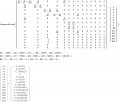
So we can set things up so we get all 8 node voltages directly, rather than just get two and derive the rest by adding and subtracting offsets. And since expanding the calculations are no more work for us, let's also calculate the 6 voltage source currents at the same time.
We don't need to use the supernode concept if we just use modified nodal analysis (MNA). This problem can be set up as 14 equations in 14 unknows; the coefficients of the equations are quite trivial. Then the system is solved directly for all unknowns. No need to add and subtract various combinations of offset voltages to get all node voltages and source currents:
The symbolic solution was the initial result of the LinearSolve command before I gave the resistors and sources numerical values, but it's very unwieldy; it would take many pages to print.
Of course it can be done as you have shown, but I was looking for something different. What I was looking for is equations that give the currents as the solutions for the currents as unknowns, not just calculating individual currents in resistors entering a node by hand and adding them up, as MrAl suggested in post #27.
Since there's a lot of algebra to be done here, and most likely a computer math program will be used, there's no reason to try to minimize the equation set. When a computer is doing all the work we can make things more convenient for ourselves even if that means more work for the computer.
So we can set things up so we get all 8 node voltages directly, rather than just get two and derive the rest by adding and subtracting offsets. And since expanding the calculations are no more work for us, let's also calculate the 6 voltage source currents at the same time.
We don't need to use the supernode concept if we just use modified nodal analysis (MNA). This problem can be set up as 14 equations in 14 unknows; the coefficients of the equations are quite trivial. Then the system is solved directly for all unknowns. No need to add and subtract various combinations of offset voltages to get all node voltages and source currents:
The symbolic solution was the initial result of the LinearSolve command before I gave the resistors and sources numerical values, but it's very unwieldy; it would take many pages to print.

 Facebook
 Google
 GitHub
 Linkedin