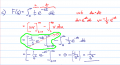
Maybe because we see a "minus s" in the exponent, not a "plus s" which would be a bit more ambiguous. I think the minus s (-s and not just s which is positive) means that 's' itself must be positive, or at least the real part of 's' must be positive (so that it is negative in the exponent due to the minus sign present in the definition).
Thus we end up with zero rather than infinity or something we cant define.
In fact, if we dont assume that then we cant solve this without some doubt as to if we did it right or not.
There may be other ways to explain this too.
To illustrate just a little...
e^(-s)=e^(-(a+bj))
and for the limit a must be positive and b does not matter as usual, but more direct 's' must be positive.
To contrast, if we had:
e^(s)=e^(a+bj)
then it looks like there is no enforcement of what the sign of 'a' should be.
So by placing the minus sign in front of 's' we indicate that we need either 's' to be positive or 'a' to be positive. Otherwise we'd need a foot note.
Small point but worth mentioning i think. For one thing, if we didnt assume something then we could not understand how the limit of that one part can be zero for all cases.

 Facebook
 Google
 GitHub
 Linkedin