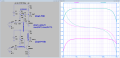
As a quick analysis, assume emitter and collector currents are the same. As the emitter resistor 830 has no bypass capacitor, there will be a signal voltage across it. This voltage will be very nearly the same as the input voltage (like an emitter follower) so the voltage gain is 10k/830 or 12. Increase the 830 to 1K.- or simulate it or do the circuit analysis.
Am i missing something here?
I see a 1uf cap from output to ground, (in series with a DC voltage source which does nothing for AC really).
That second 1uf cap has some serious side effects, such as swamping down the output AC voltage level.
The reactance at 1kHz is around 159 Ohms so we will see some serious gain decrease from the DC approximation of 10000/830 (with B infinite). I will take a guess, 159/830 which is a gain of around 0.19 or even lower like around 0.12 or so.
Am i missing something here?
I see a 1uf cap from output to ground, (in series with a DC voltage source which does nothing for AC really).
That second 1uf cap has some serious side effects, such as swamping down the output AC voltage level.
The reactance at 1kHz is around 159 Ohms so we will see some serious gain decrease from the DC approximation of 10000/830 (with B infinite). I will take a guess, 159/830 which is a gain of around 0.19 or even lower like around 0.12 or so.
Well Yes! That's a voltmeter on the output you are looking at with one side grounded. I breadboarded this circuit back in post #4, the voltage gain is 10 at 1Khz with no load. Yes there is some loss through the input coupling cap which explains the lower gain I am getting, 10 vs 12.
SG
Well Yes! That's a voltmeter on the output you are looking at with one side grounded. I breadboarded this circuit back in post #4, the voltage gain is 10 at 1Khz with no load. Yes there is some loss through the input coupling cap which explains the lower gain I am getting, 10 vs 12.
SG
Ohhhhh, he he he, thanks for explaining that. We have different simulators and they all represent things differently so if we dont use a particular one, we may confuse element types now and then.
A voltmeter would explain why there is a series cap, to eliminate the DC component of the signal at the collector. That's perfect
I'll have to go over this again without that cap and check the gain.
BTW, what are you allowed to assume for the base emitter voltage drop?
I ask because with a beta of 100 the output DC level with be low with Vbe(DC)=0.7 as usual, although not zero.
BTW, what are you allowed to assume for the base emitter voltage drop?
I ask because with a beta of 100 the output DC level with be low with Vbe(DC)=0.7 as usual, although not zero.
Actually i meant what are you allowed to use for the base emitter voltage, not the base voltage.
The base emitter voltage is the drop across the base emitter junction. That tells me what operating point we can establish, given the approximations allowed not really the spice model approximations. Usually in these questions you are given a base emitter voltage or else some spec's on the diode itself. For example, 0.7v or maybe 0.65 or it could be other than that too.
If you dont have that, then we might assume something like 0.7, but this is necessary because for example with a Beta of 100 the transistor collector would drop to something like -5v with the bias network shown, and that would be impossible so it would saturate to zero and that would mean zero gain (zero output for any input). To get the output biased to 1/2 Vcc, we'd need a drop of over 1v i think but that's not mandatory.
Maybe you were given a Beta too? If it was lower that would explain a lot also.
with a Beta of 100 the transistor collector would drop to something like -5v with the bias network shown, and that would be impossible so it would saturate to zero and that would mean zero gain (zero output for any input). To get the output biased to 1/2 Vcc, we'd need a drop of over 1v i think but that's not mandatory. Maybe you were given a Beta too? If it was lower that would explain a lot also.
Only if the emitter was grounded. The voltages given in post #9 are from the actual circuit not a simulation. The circuit as shown is over biased using a 2N3904 but no transistor was listed in the original post. Changing the 15K to a 22K will set the collector voltage to about 6.5 volts providing a much better output.
SG
Only if the emitter was grounded. The voltages given in post #9 are from the actual circuit not a simulation. The circuit as shown is over biased using a 2N3904 but no transistor was listed in the original post. Changing the 15K to a 22K will set the collector voltage to about 6.5 volts providing a much better output.
SG
You still are not answering the question, what is the base emitter voltage.
So you are allowed to change the 15k to 22k also? That could help a lot, but you never said you can do that
In order to figure this out, we need more exact specs of how the circuit is set up and what the variables are, and what the base emitter voltage assumption is, if any. I do not need the base to ground voltage right now which apparently is 1.54v.
MrAL I think you are over analyzing this, but here goes.
First of all I didn't start this thread, it's not my circuit posted in #1. I breadboarded the circuit as shown using a 2N3904 transistor because no transistor was listed and posted some voltage readings in #7
The base-emitter voltage is appx .7 volt, same as all NPN transistor give or take a little you know that.
Beta? I don't know from the specs of a 2N3904 could be anywhere from 100 to 400 depending on the circuit parameters.
Can you change the component values? I assume so since the thread is titled " how can this circuit be adjust to achieve gain of 10"
Did I miss anything?
SG
I'll go back to my original post. Yes, I agree, the biasing is off. But the circuit is just an emitter degenerative amplifier. This is an example of negative feedback by way of the emitter resistor having no bypass capacitor. So, unless it is very low the transistor beta does not. matter.
MrAL I think you are over analyzing this, but here goes.
First of all I didn't start this thread, it's not my circuit posted in #1. I breadboarded the circuit as shown using a 2N3904 transistor because no transistor was listed and posted some voltage readings in #7
The base-emitter voltage is appx .7 volt, same as all NPN transistor give or take a little you know that.
Beta? I don't know from the specs of a 2N3904 could be anywhere from 100 to 400 depending on the circuit parameters.
Can you change the component values? I assume so since the thread is titled " how can this circuit be adjust to achieve gain of 10"
Did I miss anything?
SG
OH i must apologize then, maybe i did not interpret your intent correctly. I thought you were looking into this too, but no problem
Ok what i found was that with Vbe=0.5 and the 22k resistor instead of 15k i get an output close to 6.5 volts DC with a Beta of 11.58, and i round that up to 12 for the AC test and then go to 120 for the second test.
The AC output, assuming a linear circuit as usual, is 11.06vac with a 1vac input, and that means 1.106vac with a 0.1vac input, etc.,
because of the linearity assumption.
That also assumes the meter on the output has a 10 megohm input impedance. With a 100k input impedance the AC voltage comes down a little to 10.96vac.
For the second test B=120 the ac output becomes 11.90vac so there is a little more AC gain that's all (10 megohm meter again).
I did the simple AC tests where Vbe doesnt matter anymore.

 Facebook
 Google
 GitHub
 Linkedin

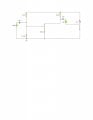


 That's a voltmeter on the output you are looking at with one side grounded. I breadboarded this circuit back in post #4, the voltage gain is 10 at 1Khz with no load. Yes there is some loss through the input coupling cap which explains the lower gain I am getting, 10 vs 12.