How can a board accept AC or DC?

Thread Starter

Sick Haven

Joined May 16, 2020
6
Hello all!
New poster.
So, without giving too much away, right now I’m trying to find out if designing a product is worth the cost to make it workable on either 12 or 24 volt AC or DC.
As a locksmith and an access control technician and installer, I never thought that both were an option.
I’ve now seen multiple products that could accept either 12-24v AC or DC.
Anything goes.
In my field, we prefer DC with limited AC options on the market.
First, for my own information, I’d like to know how some circuit boards can accept either.
I need to know what’s required on a board that can allow that.
From my limited electrical knowledge, and a thousand different searches, I can’t determine how any device can instantly differentiate between the power sources, and act accordingly.
They always output DC, but how are both an option as an input?
 

Thread Starter

Sick Haven

Joined May 16, 2020
6
Eventually you're going to give everything to us. While we provide assistance to your very excellent question just remember it's not magic if you're a magician. Prepare yourself it's about to begin.
Ah, got my hopes up.
That’s not an automated response, is it?
I did think my question was different.
I can’t even figure out a good way to search it.
 

DickCappels

Joined Aug 21, 2008
10,661
Sometimes it takes as while to be answered. This forum is viewed around the world and some of us are still sleeping!

The simplest method to be compatible two distinctly different power sources is to have two inputs and circuitry inside to switch between them.

The right answers depend of the details of exactly what you want to do.
 

Thread Starter

Sick Haven

Joined May 16, 2020
6
Sometimes it takes as while to be answered. This forum is viewed around the world and some of us are still sleeping!

The simplest method to be compatible two distinctly different power sources is to have two inputs and circuitry inside to switch between them.

The right answers depend of the details of exactly what you want to do.
I’m sorry, more details would help, but I’m protective at the moment.
I’ve been... all over the internet.
If this product is successful, well... yeah.
I want a pre-programmed sound device that will run off... minimally 12 or 24 volt DC.
That’s it.
I have, have used, have installed, and don’t understand how a board can accept either on the same connectors.
 

Thread Starter

Sick Haven

Joined May 16, 2020
6
I’m sorry, more details would help, but I’m protective at the moment.
I’ve been... all over the internet.
If this product is successful, well... yeah.
I want a pre-programmed sound device that will run off... minimally 12 or 24 volt DC.
That’s it.
I have, have used, have installed, and don’t understand how a board can accept either on the same connectors.
“Give me 12-24 volts of AC or DC and I will function.”
What makes that happen?
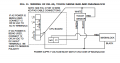
A specific example is the Securitron DK-26.
 
Last edited:

SamR

Joined Mar 19, 2019
5,491
Hint. Electronic systems that use AC inputs instead of DC inputs rectify the AC into DC. So if you just supply it with DC it takes fewer parts...
 

Analog Ground

Joined Apr 24, 2019
460
“Give me 12-24 volts of AC or DC and I will function.”
What makes that happen?
A specific example is the Securitron DK-26.
The DK-26 has one power connector but a separate pair of connections for AC and one for DC. The AC connection uses a "diode bridge" to convert AC to DC. Then, the two DC circuits can be combined with two diodes to form one DC power source. Sometimes a backup battery is added which adds a third potential source of power. Again, diodes can be used to combine all the sources into one DC source.
 

Analog Ground

Joined Apr 24, 2019
460
I’m sorry, more details would help, but I’m protective at the moment.
FYI, if the DK-26 is similar to the circuitry you are thinking about, there is nothing special. It looks like the DK-26 has some power circuitry, a keypad, microcontroller and circuits to drive solenoids or relays. This is pretty simple stuff and nothing is proprietary. In other words, there is no reason to be secretive. Adding audio output would also be pretty conventional. Your APPLICATION could be special and deserve secrecy but probably not the circuitry.
 

MisterBill2

Joined Jan 23, 2018
27,568
Stick a Bridge rectifier on the input..
Indeed! Use either a bridge rectifier or simply a series diode, if it is acceptable for a circuit to simply not function at all if the polarity is wrong. Next, to function in a similar manner when the power supplied is AC, an adequate filter capacitor is required. The value of capacitance will be determined by the current required by the load, we have no need for more details than load voltage and current. Finally, to provide consistent operation with different supply voltages, a regulator in series will be needed.
So there you have all of the requirements and questions and all that we really need in order to give a complete solution is the required voltage and current of the mystery load section of the product.
 

MaxHeadRoom

Joined Jul 18, 2013
30,672
+1 on @Dodgydave bridge.
One of the last machines I commissioned, the hydraulic valves had a bridge rectifier fitted on the input, this not only allowed AC or DC supply, but guaranteed the correct polarity for the LED indicators.
Generally no capacitor is required. IOW only a bridge is normally required.
Max.
 

Tonyr1084

Joined Sep 24, 2015
9,744
AC can easily be converted into DC. The difference between AC and DC is that AC has zero crossing moments whereas DC is steady. Using a bridge rectifier (BR) as others have mentioned simply means you're converting AC into DC. If you use pure DC then you're only using two of the four diodes in a BR. Regardless of which polarity you connect it - the BR will change it into the correct polarity. The ONLY downside of using a BR is the use of diodes and their associated voltage drop, which is typically 0.6 to 0.7 per diode. (1.2 to 1.4 volts dropped) In the BR there are always two diodes in use. With AC, first you use two, then the other two as the AC changes back and forth.

From there you can design the board to do anything you want. Just make sure you consider power consumption and power dissipation (heat), otherwise you could build a tiny watch circuit and attempt to launch the space shuttle. Not going to work.

Regardless of what you're designing / engineering, use of AC and/or DC as an input with a DC output means considering the source. Whether it's constant current (DC - one direction only) or the product of a sine wave (AC - switching direction constantly), the supporting circuitry will need to be able to handle either.

With AC, you get what's referred to as RMS (Root Mean Square) which is about 0.7071 of the full DC equivalent. So with a 12 volt AC source, rectified and filtered, you're going to see (1.414 times) about 16 volts. (If you've checked the math you find I'm off by about a volt. That's because two diodes in the BR drop some of the voltage. So your design needs to be able to safely deal with that level of voltage. 24 volts would be about 33 volts. Your components, most typically capacitors, will need to be rated at least 1 and 1/2 times higher a voltage than what's planned for. Better yet - twice the voltage rating minimum and you're good and safe.

With DC, you get what you put in. Less the forward voltage drops of the diodes in the BR.
 
Top