Hour Meter for Engine

Irving

Joined Jan 30, 2016
5,122
The layout looks fine, but one thing concerns me and that it appears that the copper strips on the back of the board are running up & down, when they should be running left & right? Or is that just shadows I'm seeing (as viewed through the board)?

Also, I wouldn't push the 2N3906 right down on the board; space it off a 1/4" so it doesn't get too hot when soldering - if you can clamp a pair of long-nose pliers across all 3 legs on the front side while soldering on the back side of the board that will help protect it too. Try to keep the heating time to less than 2 or 3 seconds per leg.
 
Last edited:

Thread Starter

TKC100

Joined Feb 4, 2012
20
The strips are running horizontally left to right.
I have a pair of forceps I use as a heat sink while soldering. The tip is small and they lock
The PC817 has very short leads and I don't know if I will be able to clip the forceps in place.
However I am pretty adept at soldering so if momentary heat is not a problem then it will be OK.
 

Irving

Joined Jan 30, 2016
5,122
The strips are running horizontally left to right.
Good, the vertical shadows are just an optical illusion then.
I have a pair of forceps I use as a heat sink while soldering. The tip is small and they lock
Perfect, exactly what I use.

The PC817 has very short leads and I don't know if I will be able to clip the forceps in place
Should be ok without. Just tack one corner then solder the others, giving a short wait for it to cool between each pin. Don't forget to cut the strips under the PC817.

However I am pretty adept at soldering so if momentary heat is not a problem then it will be OK.
Glad to hear it, I'm sure you'll be fine. Make sure everything is free of grease and use extra flux if you have some. I prefer a fine old-school rosin-cored leaded solder for small jobs like this.
 

Thread Starter

TKC100

Joined Feb 4, 2012
20
Assembled everything and double checked it all. Decided to bench test this creation before installing it (refer to attached file).
I am feeling pretty stupid right now. It is such a simple circuit and yet something isn't right.
Helpo_O
 

Attachments

Irving

Joined Jan 30, 2016
5,122
In the words of a famous British sitcom "Don't panic!" :)

Hmm... If the input is grounded (switch closed = no oil pressure) the output should be 0v. If the input is open, the output should be near to the supply voltage. As long as the supply is at least 10v. Below that the output will be some voltage between 0 and supply depending on what current the hour meter demands, but that's an abnormal situation that should never exist in the car, and I've not checked what it could be at a supply voltage of 1.5v.

Can you post hi-res pictures of both sides of the board please.
 

Thread Starter

TKC100

Joined Feb 4, 2012
20
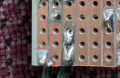
Being a person who can be a bit OCD I am a little bit embarrassed by how the board looks.
In fact, I considered reordering the parts and starting all over again. My hands are not as steady as they once were, and I had to make some accommodations. After soldering a couple of pieces, it got much easier.
I originally bench tested the board with 1.5 volts because I had an old C battery and I just soldered test leads to it. It was easier than getting a 12-volt DC supply.
This morning, I tested it with a 12-volt DC power source. And you can see the results pictured in the attachment.
I checked and rechecked the placement of all the components. All of the soldered connections to the board test good. I know there is a couple that look suspect, but they tested good.
I combined everything into one PDF file instead of 5 jpegs because I do not know what limitations your server may have.

On page 1 you can see the 12-volt test and the results
With the battery disconnected you can see the resistance readings.
The two diodes are quite different.
The two separate readings reflect switching the probes from positive to negative.
D1 & D2 are quite different
D1 performs the way I would expect a diode to act
D2?
Both resistors tested OK
817 you can see the resistance reading I got

Six parts and a dozen connections, how difficult can it be but something is amiss.
 

Attachments

Alec_t

Joined Sep 17, 2013
15,119
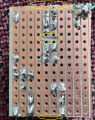
At the bottom of the last pic in the pdf you appear to have a blob of solder bridging the two left-most traces, hence shorting the base-emitter junction connections.
 

Irving

Joined Jan 30, 2016
5,122
At the bottom of the last pic in the pdf you appear to have a blob of solder bridging the two left-most traces, hence shorting the base-emitter junction connections.
Good call

1750365677254.png

When you've dealt with that, hopefully all will work. If not, measure the voltage at the pins of the PC817 when powered up both with the oil_sw line disconnected and when it is grounded. You should get the following:

When:Pin 1Pin 2Pin 3Pin 4
oil_sw disconnected12v11v approx11.3v approx12v
oil_sw grounded9v approx8.2v approx11.8v approx12v
 

Thread Starter

TKC100

Joined Feb 4, 2012
20
It's alive!
It's been said, more than once, that I have the ability to look right at something and not see it. Something that when it's brought to my attention is like, Oh Duh. I thought I did a pretty thorough job of checking the board out for continuity and any shorts between the different strips, but I sure missed that little tiny bead of solder. Good eye mate.
Thank you for being so patient with me.:)

Now to get it installed in the car. I located the ECU. It's behind and to the right of the glove box. There are three separate modules there, including the ECU. They are all stacked one on top of another and bolted into place between the outside wall of the car and the air conditioning evaporator box. Once I gain access, and that's looks to be no small task, to the ECU all the wires (connections) necessary should be there.
 

Attachments

Top