Hour Meter for Engine

Irving

Joined Jan 30, 2016
5,123
That's a very generic description about a number of alternative ways an hour meter might work, and doesn't give much confidence it's related to this specific product, but 10-30mA is fine, if true. Do you have a link to the actual product itself?

Do you think assembling this on a breadboard would be the best approach.

I could enclose the completed breadboard within a box or encapsulated in epoxy if none of the components generate heat.
A small piece of stripboard is fine for this. It generates a few tens of mW of heat, so a small project box would be perfect.
 
Last edited:

Thread Starter

TKC100

Joined Feb 4, 2012
20
The hour meter is made by a company named Aimilar
From China of course
DC 6-80V Mechanical Hour Meter AY1025
Amazon Item model number ‏: ‎ 4350402313
Aimilar has a presence on the web
https://www.aimilar.com/product_view.asp?id=90
But I can only find these specifications
Max Display: 99999.9 hours
-Timing Accuracy: 0.1 hours
-Voltage Supply: DC 6-80 Volt
-Storage and Operating: -20℃ to +65℃
-Material Type: ABS
-Product Size: 54mm×32mm×71.7mm
-Net Weight: 45g
There is an Aimilar Buying Guide
https://gistgear.com/brand/AIMILAR|Automotive
Great pictures but no additional information

The current draw for AIMILAR hour meters is not explicitly specified in the available product documentation. However, based on general characteristics of similar mechanical hour meters, they typically consume less than 1 watt of power, often under 0.5 watts. This translates to a current draw of approximately 4 to 40 milliamps (mA), depending on the operating voltage.
DC-Powered Hour Meters

Current draw: Typically, 1 to 10 milliamps (mA)

The figures are all over the place for the current draw. I wish I could find an exact number but it’s just not out there.

I found it interesting that in all the literature there is no mention of using an hour meter for a car and a slight, sort of side bar mention of trucks.

The reason I am attempting this project is because my little hybrid on occasion spends considerable time without the wheels moving. Also I have been doing oil analysis on this engine and hours are far more accurate than mileage.

I will be buying the meter from Amazon. The price seems to be the same ($13.99) everywhere. Amazon has some pretty pictures but no additional information. I would send the link but it very – very long.
 

Irving

Joined Jan 30, 2016
5,123
Found exactly same part on Amazon UK. Same info. Anything less than 50mA should be OK.

So why not power it directly from the power to the engine injection system?
I guess for the same reason as not from the ignition; as a hybrid there may be many hours powered on but engine not running - injection system will still be powered up though (at least in the case of the one hybrid I had the unfortunate experience to get sucked in to work on).
 

Thread Starter

TKC100

Joined Feb 4, 2012
20
I just ordered the little hour meter from Amazon. They say it will be here tomorrow but because tomorrow is Sunday, I doubt it. However, I expect it to be here early next week.

I will put the thing on the bench, set my multi-meter for Max and let it run for a couple hours.

Then I will be able to tell you exactly how many mA it draws at ≈ 12V.

After measuring the actual voltage and doing a little math we will be able to know the current draw for the normal operation range of a 12V automotive system (13.8V - 14.4V) or at least that is the operational range for the vehicle the hour meter will be installed in.

I know everybody must wonder why I am going to all the trouble of measuring engine hours. Other than the fact I am a bit OCD there are several reasons. I will not get into that as it might get this thread off topic.
 

Thread Starter

TKC100

Joined Feb 4, 2012
20
Alright I am ready to get on with this project. The hour meter came in the mail sometime yesterday and I picked it up this morning. The current draw is rather interesting. When I first put in series with my meter the current reading alternated between 6.01mA and .46mA. It would for ever so brief a moment read 6.01mA and then stay steady a .46mA for a few seconds. It would repeat this pattern over and over again. Voltage was steady at 12.4V.
I set the meter to record the MAX reading and after an hour it was 5.38mA.
Is this the information you needed to give this project your blessing?
 

Irving

Joined Jan 30, 2016
5,123
And that's probably what I would expect if the time per cycle is 5 or 6sec. That's a little electromagnet being pulsed to turn a pawl mechanism, or possibly a tiny stepper motor. Either way that's counting a minute, and that'll be geared down to 6 min or 1/10 hour and then it's just six 10-toothed wheels for the numbers.

That current reading is fine.

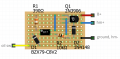
Are you planning to build this on some stripboard or perf board? As an intellectual exercise I put a layout together on a 1" x 2" piece of stripboard (10 strips x 20 holes) which would neatly fit in the back of the meter with some double-sided tape or hot-melt. I'll post it up tomorrow as soon as I can get back on my computer.
 

Irving

Joined Jan 30, 2016
5,123
Here you go.... its actually smaller, 9 strips x 15 holes:

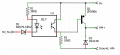
1749219791059.png1749219842078.png

[edit] I forgot to say the two strips under the 817 need to be cut so pins 1 & 2 are not shorted to pins 4 & 3 respectively. And of course the strips are on the BACK of the board not the front!

[edit 2] Corrected to resolve incorrect switching action when driving meter directly. Circuit 2 in post #5 uses the inhibit on the Curtis meter to stop counting when at B+. That's opposite to requirement when driving meter directly. Now, when oil switch closed (= no pressure = engine not running) D1 and LED in U1 conduct (about 6mA) and U1 turns Q1 off. When oil switch open (= oil pressure = engine running), LED is off, Q1 is on and meter is powered from B+, if ignition on.
 
Last edited:

Thread Starter

TKC100

Joined Feb 4, 2012
20
Irving
You are really too much. Thanks for taking the time to help me!
Tomorrow I will go to Digikey and order the parts from the list you provided.
So that I don't spend time looking for something that does not exist.
Is that the trade name "strip board"? Is that what I should look for. What size sheet does it come in?
Do I order it in a sheet and cut it to size or do I purchase 9 strip 15 hole board? I have never worked with strip board before. I have used what I call bread board and I think you call perf board. It looks like the strip board is a big improvement over the perf board.
I no doubt will have several more questions once I start the actual assembly.
Thanks again. I really am looking forward to building this project.
 

Irving

Joined Jan 30, 2016
5,123
EBay or Amazon is your best option for stripboard. Veroboard is the brand name but that tends to be expensive compared to third-party equivalents. Typically comes in 3x2, 5x3 and 6x4 inch sizes easily cut to size with a small hacksaw.

Digikey have a ST1 stripboard, 4526-ST1-ND, 3x2, but you may find it cheaper elsewhere.

eBay: 2.5 x 1 https://www.ebay.com/itm/167074585666
 
Last edited:

Irving

Joined Jan 30, 2016
5,123
I have used what I call bread board and I think you call perf board.
For me, breadboard is the reusable plug-in variety, while perf-board is either one with no copper, or a single pad-per-hole.

Ttraditional Veroboard has full length strips, usually along the larger dimension. Stripboard is similar, but also there are versions with 3 or 5 hole pads which can be useful for complex semi-permanent project where there would otherwise be a lot of track cutting with full strips. Incidentally, you can buy a track-cutter tool which breaks a strip by removing copper around a hole, though a 2.5mm or 3mm drill works fairly well. Or you cut the track, carefully, between holes with a sharp craft-knife or grind it away with a Dremel and burr cutter.
 

wayneh

Joined Sep 9, 2010
18,104
You may want to confirm that the hour meter remembers the stored value thru a power toggle. Mine runs on a small battery and will reset to zero if/when that battery wears out. Same deal with my bike's speedometer. I guess you already know it will run off a 12V system, so that's good.
 

Irving

Joined Jan 30, 2016
5,123
You may want to confirm that the hour meter remembers the stored value thru a power toggle. Mine runs on a small battery and will reset to zero if/when that battery wears out. Same deal with my bike's speedometer. I guess you already know it will run off a 12V system, so that's good.
This one is purely mechanical and has no reset function.
 

animal12

Joined Feb 20, 2018
48
why not put a T in the line where the oil sensor lives & install the sensor to one port on the T & then add a second oil switch wired only for your part of the project in the extra port on the T.
animal
 

Thread Starter

TKC100

Joined Feb 4, 2012
20
Irving
I parts are ordered.
I was able to get everything including the strip board through Digikey.
I made the adjustment and ordered the BZX79-C8V2-ND in place to the 1727-2934-1-ND
You were right, the postage was very near 50% of the total price.

animal12
From what I can make out you are suggesting a plumbing/electrical solution.
I did consider that, if fact there is an oil pressure switch that is made for just such a thing.
It has two contacts one NC with no pressure and another which closes with pressure.
The oil pressure switch on this particular engine is not easily accessed. From what I could make out there would also need to be some sort of a thread adapter and it would require running a wire all the way from the meter to the switch.
With Irving's solution all the wiring is short and on inside of the firewall. The engine control module is under the dash.
I am installing a new head unit and dash cam so I going to have the dash all apart anyway.
 

Thread Starter

TKC100

Joined Feb 4, 2012
20
Irving
I was just looking back over this thread and trying to understand the edit in post #28
I order the part outlined in post #19 with the exception of BZX79-C8V2-ND in place to the 1727-2934-1-ND
Somewhere I thought I there was another post with still yet another correction to R1. Something about you needed to run a simulation on the circuit but for the life of my I can find it
Please help me understand.
It was or should I is my intention to build the circuit in post #28 unless directed to do otherwise.
 

Irving

Joined Jan 30, 2016
5,123
Somewhere I thought I there was another post with still yet another correction to R1. Something about you needed to run a simulation on the circuit but for the life of my I can find it
I PM'd you to let you know about the forthcoming change to post #28 - click on the envelope above...

I order the part outlined in post #19 with the exception of BZX79-C8V2-ND in place to the 1727-2934-1-ND
Same device, different packaging; either is fine.

It was or should I is my intention to build the circuit in post #28 unless directed to do otherwise.
Go for it :)
 

Thread Starter

TKC100

Joined Feb 4, 2012
20
Irving
All the parts are here, and I am getting ready to assemble this project

I do however have 2 questions, or I guess just one about two parts.

PC817 OPTOISOLATOR 5KV 1CH TRANS 4-DIP
2N3906 TRANS PNP 40V 0.2A TO-92

Do either of these parts have a special way they must be installed?
I have looked them both over very carefully and there are no indications of polarity or anything else.

As a bit of a side note, I can now see that my $6 of parts was well worth the $6 of postage. Each of the components were individually wrapped in their own little Baggies, then all those little bags were put into still yet another bag and into a mailer.

I am a bit handicapped because I had cataract surgery a week ago and these parts are pretty small. My eyes are still adjusting, and I am told they will do so for about a month. Luckily I have an illuminated magnifier.

Hope all is well over on your side of the pond
 

Irving

Joined Jan 30, 2016
5,123
4 of the parts are polarity sensitive .

The PC817 pin 1 is indicated by a dot or a dimple on the case adjacent to it, and by a dot on the layout diagram (it's top left of the part).

The 2N3906 casing is D-shaped which gives it's orientation. In the layout diagram the flat side is facing left.

The two diodes will have a band around one end of the case. For both that is the upper end as shown in the layout diagram.

If in doubt post pictures of the parts.
 

Thread Starter

TKC100

Joined Feb 4, 2012
20
Irving
Good afternoon, evening or night
I have all the components loosely mounted on the board. Take a look and see if I have them properly oriented. The makers of the PC 817 sure did not go out of their way to make it obvious.
I started to second guess myself on the oil pressure switch. Everything up to now has been done under the assumption that I knew how to read the schematic. It shows the oil pressure switch closed. After doing a little research I was able to put my mind at rest.
The oil pressure switch is a simple grounding circuit where the switch grounds the warning light when there is no oil pressure
 

Attachments

Top