High Voltage PCB design

Thread Starter

128ITSH

Joined Jul 20, 2017
101
Hello everyone!
This is my first PCB design, which is intended to simply turn on/off a mains 230VAC lamp.
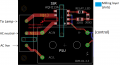
PCB.png
(reference scale - distance between the middle points of the Terminal holes is 7.5mm)
solid state relay
PSU
Terminal
(possible) manufacturer's spec - OSH park
The thing is I don't want anything to fail when it goes to mains stuff, so I have read about creepage and clearance, and used this calculator to find the distances between the traces. But in the calculator I have to choose what "Insulation" I require. So my first question is, what is the difference between "functional" and "reinforced" insulation? Which of these should I choose?
Another thing is, say the calculator gave a result of 5mm creepage. Does this creepage is between live and neutral? or is it between a high voltage trace to a lower one? The distance between N$12 and N$13 is 3.1mm, do I need a slot to increase creepage? or is it OK to leave it like this because there is a lamp between the SSR (N$13) and the AC, which acts like a resistor.
Sorry if I am not clear, but I am confused myself about all of the things that need to get into account when designing such thing.
Your help is appreciated!
 

dendad

Joined Feb 20, 2016
4,637
I would add the slot. It may not really be needed, but it won't hurt.
And the tracks could be a bit wider too. Overkill is good when switching high voltages and currents. Make it tougher than needed if you can.
One way to increase the copper, as it is a double sided board, run the power tracks on top and bottom together.
 

Thread Starter

128ITSH

Joined Jul 20, 2017
101
I would add the slot. It may not really be needed, but it won't hurt.
And the tracks could be a bit wider too. Overkill is good when switching high voltages and currents. Make it tougher than needed if you can.
One way to increase the copper, as it is a double sided board, run the power tracks on top and bottom together.
Thank's for the help!
I increased the width off the traces. the issue with eagle is when I draw a trace at the bottom after it is already present at the top, the top trace is removed and the bottom trace is drawn there instead. Anyway, the SSR is SMD so I can't do this with it.
About the slot - Should I draw it so it connects to the slot below the SSR (forming a T-looking connection), or should I have them separated like how I draw the slot in the picture? the OSH park link I gave doesn't mention connection between two slots, but maybe you know the whether or not the standard PCB manufacturing process allows this.
 

dendad

Joined Feb 20, 2016
4,637
The slots can be connected if you want. There is no excess mechanical load that is weakened by that on your board.
What a problem, that you cannot draw tracks to pan bottom with Eagle! I've not used that one myself. Another way to have more current is to leave most of the solder resist off the tracks in question so extra solder can be applied. You may have noticed that trick on some boards.
 

AnalogKid

Joined Aug 1, 2013
12,128
What is the three-contact rectangle at the left edge of the board? If it is a connector, does that mean that you are switching the neutral to the lamp? If so, then one side of the lamp is connected to the line even when the lamp is off. That is bad. Always switch the line to a load, so when the load appears to be off it is in fact not dangerous.

ak
 

Thread Starter

128ITSH

Joined Jul 20, 2017
101
What is the three-contact rectangle at the left edge of the board? If it is a connector, does that mean that you are switching the neutral to the lamp? If so, then one side of the lamp is connected to the line even when the lamp is off. That is bad. Always switch the line to a load, so when the load appears to be off it is in fact not dangerous.

ak
Yes, this is a terminal connector and I did intended to switch the neutral side, so thanks! that's a really important point! The question is whether or not the PSU will care if I flip the live and neutral wires (i.e. connect live to neutral input and neutral to live input), or should I now flip the design so they will match?
 

kubeek

Joined Sep 20, 2005
5,796
PSU doesn´t care, and depending on your socket and type of lead you use you might even not be able to assure which one is live and which one is neutral. Don´t forget you need double or reinforced insulation betweem the live parts and any human accesible conductors (connectors, potentiometers, battery terminals etc.)
 

Thread Starter

128ITSH

Joined Jul 20, 2017
101
PSU doesn´t care, and depending on your socket and type of lead you use you might even not be able to assure which one is live and which one is neutral. Don´t forget you need double or reinforced insulation betweem the live parts and any human accesible conductors (connectors, potentiometers, battery terminals etc.)
Thank you. This board will not be accessible to humans, it will only have a connector to a PIR motion sensor to trigger it.
The way I will assure which of the wires is live is by using a "Tester" screwdriver, which has a lamp that lights when you touch the live wire with it and put your finger on the other side.
 

AnalogKid

Joined Aug 1, 2013
12,128
You need reinforced insulation between any high voltage mains point and any low voltage control point. In your circuit, all of those are between the SSR input pins and output pins.

Basic insulation between/among the various mains side pins and traces.

Swapping the ps input pins should not matter.

ak
 

Thread Starter

128ITSH

Joined Jul 20, 2017
101
You need reinforced insulation between any high voltage mains point and any low voltage control point. In your circuit, all of those are between the SSR input pins and output pins.

Basic insulation between/among the various mains side pins and traces.

Swapping the ps input pins should not matter.

ak
So according to what you say, I don't need any slot except the one below the SSR? Adding these slots make the board as safe as possible on one hand, but weaken it's mechanical strength on the other. Which hand wins here?
 

AnalogKid

Joined Aug 1, 2013
12,128
Air cannot hold conductive particulate contaminants, so a little air gap goes a log way. Note that even though your air gap breaks up the creepage distance across the pc board between the SSR input and output sides, there still is a parallel path across the underside of the IC package. That is what determines which kind of insulation rating you end up with. A milled slot is an expensive manufacturing step with its own setup charges. Can the financial constraints for the project afford it?

If the board is not going into an environment with a defined shock/vibration requirement, such as those in MIL-STD-810, then a small slot should have no ill effects. What is the router bit diameter?

1 gold star for linking the components in post #1. Missed them on my tablet.

ak
 
Top