High Voltage Detection device

Thread Starter

dhosinski

Joined Dec 6, 2007
40
Hello, I am working on a new project and we need to know when High Voltage is present and when it's safe to operate. Our current supply is 400VDC (for a BEV project). Upon "key-off" the supply is suppose to bleed down in a matter of about 20 secs. We want to confirm that the voltage has infact come down which will tell us our resistor is good at the traction motor controller.

Since it's high voltage I believe the circuit is going to be more complex than just a couple of diodes and transistor. Any suggestions?

Thanks
 

R!f@@

Joined Apr 2, 2009
10,004
U need a discharge circuit to discharge the out put caps ( if used any ) or the filter caps if mains are used.
It can be automatic like when the power is off it will activate and discharge what ever u need to discharge to a safe value.
Simple.
 

Thread Starter

dhosinski

Joined Dec 6, 2007
40
U need a discharge circuit to discharge the out put caps ( if used any ) or the filter caps if mains are used.
It can be automatic like when the power is off it will activate and discharge what ever u need to discharge to a safe value.
Simple.
A discharge resistor is already in place to draw the caps down, but we want to be able to identify if the voltage (60volts or better) still exists. That's why I'd like to have a detection system in place.
 

PRS

Joined Aug 24, 2008
989
Could it be that you might use a high voltage rotary relay with an indicator dial on its shaft? Experimentally find the place where the indicator points to, say, 35 volts, and mark it?
 

Thread Starter

dhosinski

Joined Dec 6, 2007
40
Could it be that you might use a high voltage rotary relay with an indicator dial on its shaft? Experimentally find the place where the indicator points to, say, 35 volts, and mark it?
We'd like to have something that's not going to put a continuous draw on our traction battery. I only need to know when the high voltage is present. It would be nice to be able to say when it's safe to work on the vehicle.
 
How about a voltage divider run into a comparator. It compares your divided down voltage to a set point to indicate the transition between high and low. The comparator drives the LED.
 

tkng211

Joined Jan 4, 2008
65
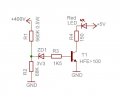
You may try the attached simple circuit. Change the value of R2 or the zener voltage to get the satisfied indication if required.
The listed values of the parts may result in lighting up the red LED when the high voltage is above 40V.
 

Attachments

Last edited:

CDRIVE

Joined Jul 1, 2008
2,219
Can I get a meter that is cheap? If I can design some type of LED circuit that will identify the presence of HV, then I can build that at a fraction of the cost.
Is there a low voltage suppy (like 12V) available in your traction motor system? If not, are you willing to add a dry cell to your monitoring circuit?
 

DickCappels

Joined Aug 21, 2008
10,661
How about just using a diode and a resistor. Connect the cathode of the diode (with appropriate PIV rating) to the supply output you want to monitor. Use a pull-up resistor (to whatever voltage you want, for example, to +5 volts) and connect it to the anode of diode and a high impedance logic input. You may want to add a capacitor from the anode to ground if your power supply has a fast rise time.
 

Thread Starter

dhosinski

Joined Dec 6, 2007
40
How about just using a diode and a resistor. Connect the cathode of the diode (with appropriate PIV rating) to the supply output you want to monitor. Use a pull-up resistor (to whatever voltage you want, for example, to +5 volts) and connect it to the anode of diode and a high impedance logic input. You may want to add a capacitor from the anode to ground if your power supply has a fast rise time.
That sounds close to what I am looking for. The voltage divider is also interesting. The goal is to notify the user that HV is present. We do have a discharge resistor inside of our controller (motor) to discharge the CAPS, but if for some reason the resistor isn't working we'd like know that the high voltage is present.
 
Top