High Side Gate Driver for Power MOSFET

Thread Starter

combover1961

Joined May 20, 2024
22
If switching the Ground-side is not practical for your application,
use a Photo-Voltaic-Gate-Driver as shown below.
This works with High-Side, or Low-Side, Control equally well, no P-Channel required.
But, the Photo-Voltaic-type-Gate-Drivers can not be used for "High-Speed-Switching"
as they are somewhat "slow", ( several Milli-Seconds, depending upon the specs of the FET used ).
.
.
.
View attachment 324158.
So, this circuit diagram shows a resistor to protect the input LED. Does it also need a resistor to protect the output LED?
 

Thread Starter

combover1961

Joined May 20, 2024
22
The input LED needs a resistor like any LED.
On the output side (Gate) needs no resistor.
Many opto-isolators have an IR LED and a photo transistor. In this isolator the receiver is not a photo transistor but more like a solar panel that turns light into voltage.
The bench-tests went well ... circuit worked well at all Voltages, +12, 24, 48 and 20 Amps. Vgs stayed a consistent 7 Vdc. Such a very good simple solution. Thank you kindly for all of the detailed assistance )
 

Thread Starter

combover1961

Joined May 20, 2024
22
You can lead a horse to water, but You can't make him drink.
.
.
.
The bench-tests went well ... circuit worked well at all Voltages, +12, 24, 48 and 20 Amps. Vgs stayed a consistent 7 Vdc. Such a very good simple solution. Thank you kindly for all of the detailed assistance ). NAH NAH
 

LowQCab

Joined Nov 6, 2012
5,101
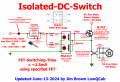
Schematic Updated with more Part-Numbers and Component-Prices.

Limiting the Gate Turn-On-Current with a Resistor will make the Switching-Time excessively long,
this will generate tremendous amounts of Heat in an extremely short period of time.

Remember that a FET-Gate has Capacitance,
and if You install a Resistor going into that Capacitance, You have created a "Delay-Timer".
The more "TIME" that a FET remains in it's Linear-Region, the more HEAT will be generated.
HEAT is the Enemy.
It is advantageous to "Switch" the FET as fast as possible to prevent this Heat generation.

The FDA215 Gate-Driver is a "Dual" Device,
this means that You can wire both Outputs in parallel to double the Output-Current and
cut the Switching-Time in half.
This may allow using a much smaller Heat-Sink for the FET,
since almost all the Heat that will be generated, will be generated during the delay in
getting the Gate-Voltage ( Gate-Capacitance ) charged-up from zero, to around ~8-plus-Volts.
At ~8-Volts and above, the FET will look like an extremely low-value Resistor, ( see the Rds-On Specs ),
and therefore, it will generate very little Heat when continuously and fully turned "On".
But, during the Time that the Gate-Voltage is rising,
the FET will have a substantial amount of Resistance,
and this will generate a lot of Heat for a very short period of Time,
this "Switching-Time" needs to be kept as short as possible to prevent smoking the FET.

Putting the Outputs in parallel will mean that the Input-LEDs must both be driven.
The Input-LEDs must must be driven hard enough to create at least ~5mA each.
Since You have ~12-Volts, or more, to work with, this is easy to accomplish.

The Switching-Time for the below Schematic, with the Components specified,
will be somewhere in the range of ~1.5 Milli-Seconds, which is very reasonable,
and will not generate a lot of Heat when Switching "On".
Switch-Off-Time is roughly one tenth of that Time, so it is not a concern.

However, care should be taken to insure that the Switching-Input-Voltage is always "Clean and Fast",
with no chance of the Input-Voltage having a "Slow-Rise-Time".
If the Input-Voltage spends any significant amount of Time around the ~2 to ~3-Volts-Level,
the FET could be smoked within Seconds.
The Input-Control-Voltage must always be either,
below ~1-Volt, or in excess of ~4-Volts,
any wandering Voltages between those above could cause the FET to be smoked within Seconds.
This applies to virtually all FETs controlling a Heavy-Load.

.
.
.
Isolated DC FET Switch .png
.
 

Attachments

Last edited:

Thread Starter

combover1961

Joined May 20, 2024
22
Limiting the Gate Turn-On-Current with a Resistor will make the Switching-Time excessively long,
this will generate tremendous amounts of Heat in an extremely short period of time.

Remember that a FET-Gate has Capacitance,
and if You install a Resistor going into that Capacitance, You have created a "Delay-Timer".
The more "TIME" that a FET remains in it's Linear-Region, the more HEAT will be generated.
HEAT is the Enemy.
It is advantageous to "Switch" the FET as fast as possible to prevent this Heat generation.

The FDA215 Gate-Driver is a "Dual" Device,
this means that You can wire both Outputs in parallel to double the Output-Current and
cut the Switching-Time in half.
This may allow using a much smaller Heat-Sink for the FET,
since almost all the Heat that will be generated, will be generated during the delay in
getting the Gate-Voltage ( Gate-Capacitance ) charged-up from zero, to around ~8-plus-Volts.
At ~8-Volts and above, the FET will look like an extremely low-value Resistor, ( see the Rds-On Specs ),
and therefore, it will generate very little Heat when continuously and fully turned "On".
But, during the Time that the Gate-Voltage is rising,
the FET will have a substantial amount of Resistance,
and this will generate a lot of Heat for a very short period of Time,
this "Switching-Time" needs to be kept as short as possible to prevent smoking the FET.

Putting the Outputs in parallel will mean that the Input-LEDs must both be driven.
The Input-LEDs must must be driven hard enough to create at least ~5mA each.
Since You have ~12-Volts, or more, to work with, this is easy to accomplish.

The Switching-Time for the below Schematic, with the Components specified,
will be somewhere in the range of ~1.5 Milli-Seconds, which is very reasonable,
and will not generate a lot of Heat when Switching "On".
Switch-Off-Time is roughly one tenth of that Time, so it is not a concern.

However, care should be taken to insure that the Switching-Input-Voltage is always "Clean and Fast",
with no chance of the Input-Voltage having a "Slow-Rise-Time".
If the Input-Voltage spends any significant amount of Time around the ~2 to ~3-Volts-Level,
the FET could be smoked within Seconds.
The Input-Control-Voltage must always be either,
below ~1-Volt, or in excess of ~4-Volts,
any wandering Voltages between those above could cause the FET to be smoked within Seconds.
This applies to virtually all FETs controlling a Heavy-Load.
.
.
.

View attachment 324545
.
Thank you kindly for excellent content … glad that you signed your work ). When my dad made me wood bowls, I insisted that he sign his art )
 

dmac21

Joined Jun 7, 2024
2
Schematic Updated with more Part-Numbers and Component-Prices.

Limiting the Gate Turn-On-Current with a Resistor will make the Switching-Time excessively long,
this will generate tremendous amounts of Heat in an extremely short period of time.

Remember that a FET-Gate has Capacitance,
and if You install a Resistor going into that Capacitance, You have created a "Delay-Timer".
The more "TIME" that a FET remains in it's Linear-Region, the more HEAT will be generated.
HEAT is the Enemy.
It is advantageous to "Switch" the FET as fast as possible to prevent this Heat generation.

The FDA215 Gate-Driver is a "Dual" Device,
this means that You can wire both Outputs in parallel to double the Output-Current and
cut the Switching-Time in half.
This may allow using a much smaller Heat-Sink for the FET,
since almost all the Heat that will be generated, will be generated during the delay in
getting the Gate-Voltage ( Gate-Capacitance ) charged-up from zero, to around ~8-plus-Volts.
At ~8-Volts and above, the FET will look like an extremely low-value Resistor, ( see the Rds-On Specs ),
and therefore, it will generate very little Heat when continuously and fully turned "On".
But, during the Time that the Gate-Voltage is rising,
the FET will have a substantial amount of Resistance,
and this will generate a lot of Heat for a very short period of Time,
this "Switching-Time" needs to be kept as short as possible to prevent smoking the FET.

Putting the Outputs in parallel will mean that the Input-LEDs must both be driven.
The Input-LEDs must must be driven hard enough to create at least ~5mA each.
Since You have ~12-Volts, or more, to work with, this is easy to accomplish.

The Switching-Time for the below Schematic, with the Components specified,
will be somewhere in the range of ~1.5 Milli-Seconds, which is very reasonable,
and will not generate a lot of Heat when Switching "On".
Switch-Off-Time is roughly one tenth of that Time, so it is not a concern.

However, care should be taken to insure that the Switching-Input-Voltage is always "Clean and Fast",
with no chance of the Input-Voltage having a "Slow-Rise-Time".
If the Input-Voltage spends any significant amount of Time around the ~2 to ~3-Volts-Level,
the FET could be smoked within Seconds.
The Input-Control-Voltage must always be either,
below ~1-Volt, or in excess of ~4-Volts,
any wandering Voltages between those above could cause the FET to be smoked within Seconds.
This applies to virtually all FETs controlling a Heavy-Load.

.
.
.
View attachment 324561
.
Hello, I am working on a very similar problem and was going to see if you could help me modify your solution for my problem. I am needing to design a DC Switch that can handle 800V and around 1.5-2 Amps (1300 Watts). The load is a purely resistive load, and this application does not require high frequency switching. (More of a relay switching case)

One of my main questions is how is the N-FET getting turned on and then maintaining its closed position in your example? I thought the Vge > Vth (lets say 4V)? When the LED's get turned on from the control side, it must induce a enough voltage to open the gate. But in order to open the Gate faster, you must have put both of the dual channels feeding the gate in order to double the amount of current being supplied.

After the IGBT closes and starts allowing current to flow through it, I am assuming that the voltage feeds back through the Photo Diodes and adds to the voltage that is being induced by the Photo Diodes, Making Vge > Vth, even though Ve is approximately equal to Vc?

Thank you for help!!
 

LowQCab

Joined Nov 6, 2012
5,101
"" Hello, I am working on a very similar problem and was going to see if you could help me modify your solution for my problem. ""
The only modifications required are careful selection of a more appropriate FET,
and removing the Filtering-Components that are sometimes required on Motor-Loads.
A Heating-Element-type-Load ( "purely-Resistive" ), will not require any Filtering.
............................................................................................................................................................................................................

"" One of my main questions is how is the N-FET getting turned on and then maintaining its closed position in your example? ""
You are throwing in some "zingers" when referring to an IGBT instead of a MOSFET.
I have no "hands-on" experience with IGBTs, only some occasional Spec-Sheet perusals,
which I didn't find particularly advantageous for the application I was working on at the time.
If You already have an IGBT in mind, all of the usual calculations will have to be studied,
and You need to provide the Spec-Sheet as an attachment to your next Post.

The Photo-Voltaic-Gate-Drivers deliver a continuous Voltage for as long as the LEDs are powered.

The Photo-Voltaic-Gate-Drivers will reliably, ( albeit eventually ), produce roughly 8-plus-Volts of Output.
They are NOT suitable for high-speed switching arrangements.
This may, or may not be, enough Voltage for your chosen IGBT-Gate to be fully "enhanced".
The way around this lies in the fact that the Photo-Voltaic-Gate-Drivers can be stacked-up
in series to achieve ~16-Volts-Output, instead of ~8-Volts,
and more can be placed in parallel to increase the provided Current if necessary.
...........................................................................................................................................................................................................

"" After the IGBT closes and starts allowing current to flow through it, I am assuming that the voltage feeds back through the Photo Diodes and adds to the voltage that is being induced by the Photo Diodes, Making Vge > Vth, even though Ve is approximately equal to Vc? ""

I have no idea of what You are referring to ............
The Gate of an IGBT has almost infinite Resistance,
just like the Gate of a MOSFET.
There is no external "Voltage" being applied, or "feeding-back", except by way of
the various Capacitances inherent to the IGBT-Gate-structure.

I am not familiar with the switching "interactions" going on inside an IGBT.

Somebody here please correct me if i'm off base,
but I'm pretty sure that an IGBT always drops at least ~0.7-Volts when fully enhanced.
But, this will have zero effect on the Voltage driving the Gate,
or affect the Voltage/Charging-Current requirements of the Gate.
............................................................................................................................................................................................................
.
.
.
 
Last edited:

dmac21

Joined Jun 7, 2024
2
LowQCab, Thank you for your response!

I am just trying to understand how the photovoltaic drivers in a "High Side" switch configuration work.

Maybe I can do a better job on explaining my thought process to see if I am understanding it correctly:

Let's just assume we are using a MOSFET instead of a IGBT since you are more familiar with them. Also lets assume a N-Channel MOSFET.

  1. In order for the MOSFET to allow current to flow from Drain to Source, the voltage between it's Gate and Source (Vgs) must be greater than or equal to the threshold voltage (Vth).
  2. In a high side switch configuration, when Gate Voltage is 0V (the photo LED's are not being triggered yet), the Voltage at the Source of the MOSFET is approximately 0V because the MOSFET isn't conducting and the other side of the load is connected to ground.
  3. When the LED's are triggered through the control side of PhotoVoltaic driver, it induces a voltage, let's call it V(diodes), and let's assume V(diodes) >Vth (plenty to allow conduction between Drain and Source)
  4. The Source voltage (Vs) then starts to rise up to the Supply Voltage (ignoring a small voltage drop caused by Rds)
  5. Because of the configuration in your figure that you provided, I am assuming that as Vs rises, so does Vg. I assume that Vg= V(diodes)+Vs.
  6. This will always ensure that Vgs > Vth, ensuring that the the MOSFET will continue to conduct while the LED's are powered
  7. When the LED's turn off, then V(diodes) = 0, resulting in Vg = Vs, or Vgs = 0, which means Vgs<Vth, therefore "opening" the MOSFET and not allowing current to conduct across Drain and Source
 

LowQCab

Joined Nov 6, 2012
5,101
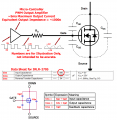
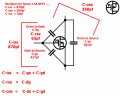
The Gate of a MOSFET, ( or an IGBT ), should be "modeled-as", or "thought-of-as", 2 small Capacitors.

One Capacitor is connected to the Source, and one is connected to the Drain.

And, just like any high-quality Capacitor,
virtually zero Current flows into, or out-of, the Gate-Pin,
except for the Current required to change the Voltage across either of the Capacitors.

If You set the Gate-Voltage at any given Voltage, lets say ~8-Volts,
and then disconnect the Gate-Pin,
the Voltage may remain at ~8-Volts for several days. if not indefinitely.

The Capacitance from the Drain to Gate is much smaller than
the Capacitance from the Source to Gate.

The Drain to Gate Capacitance may usually be ignored in a low-Voltage switching arrangement,
but with very high-Voltages, such as the ones You propose,
the Drain to Gate Capacitance will play a very significant role,
because it will be actively "fighting" against any change in Gate-Voltage.
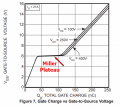
This is specifically what causes what is known as the "Miller-Plateau", which could be a significant problem at ~800-Volts.
I have not modeled this type of situation to determine if the Photo-Voltaic-Gate-Drivers will be a practical Gate-Driving solution.
This situation certainly must be investigated before committing to a Circuit design.

The Miller-Plateau directly affects the amount of TIME required for full enhancement.
Excessive TIME equals Heat build-up, excessive Heat build-up could equal the dreaded BLUE-SMOKE !!!!


The Photo-Voltaic-Gate-Drivers contain special-circuitry specifically designed to
force the Gate-Voltage to Ground when the activating LED is not being driven,
and consequently, is not illuminating the Photo-Diode-Array.
.
.
Miller Plateau .png
.
.
FET Cap Diagram 2 .PNG.
Fet Capacitance Model Small NFET .png.
.
.
 
Last edited:
Top