It looks like a high-pass filter by examining the impedance values when the frequency is changed. However, this circuit should also have a resonant frequency in such a configuration.
Does a resonance happen at the band-pass filters only?
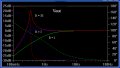
Since it has an inductor and a capacitor there will be a peak or resonant response. This response is damped by the resistor. As you can see in the image, the higher the resistor value, the less damping, and the more peaked the response is at the resonant frequency.
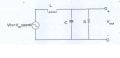
You can see why this happens by shorting the voltage source and the circuit is then seen as a parallel LC circuit.
The concept of damping by the source and load impedance is critical to understanding the response of filter circuits.
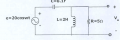
I am trying to calculate the cut-off freqency, wc, for the low-pass filter below. Could someone help review my calculation below and see if it makes sense? I am wondering if my approach makes sense as it looks too complicated to obtain the final answer.
The frequency where the reatances are equal is the resonance frequency. The cutoff frequency occurs when the magnitude of H(s) is equal to 1/√2 of H(max).
I am trying to calculate the cut-off freqency, wc, for the low-pass filter below. Could someone help review my calculation below and see if it makes sense? I am wondering if my approach makes sense as it looks too complicated to obtain the final answer.
You're missing a 'C' in the 3rd last line in the w^2 term. It should be '-2LC' instead of '-2L'.
The tricky bit is that depending on the values of R, L, and C, there will be a different resonant frequency. With the fix mentioned above, you can go about finding that frequency but it wont be pretty as you are dealing with resonance.
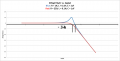
Take a look at the image I provided. The peak shifts the -3dB frequency to a larger value. The math won't be pretty is all I am saying.
You're missing a 'C' in the 3rd last line in the w^2 term. It should be '-2LC' instead of '-2L'.
The tricky bit is that depending on the values of R, L, and C, there will be a different resonant frequency. With the fix mentioned above, you can go about finding that frequency but it wont be pretty as you are dealing with resonance.
Take a look at the image I provided. The peak shifts the -3dB frequency to a larger value. The math won't be pretty is all I am saying.
I am trying to calculate the cut-off freqency, wc, for the low-pass filter below. Could someone help review my calculation below and see if it makes sense? I am wondering if my approach makes sense as it looks too complicated to obtain the final answer.
You need to get in the habit of always (and I mean ALWAYS) checking your units. Most of the mistakes you make (most, not all) will affect the units. If the units don't work out, you KNOW the answer is wrong.
So look at your final line and you see that each term must have units of ω^4. Since ω has units of 1/s, each term must have units of 1/s^4. The units of LC are H*F. The units of Henry can be gotten from V=L(di/dt), so L has units of Vs/A. The units of Farad can be gotten from V=∫idt/C, so that C has units of As/V. Thus, LC has units of s^2. So your middle term needs the factor in parens to have units of 1/s^2. RC has units of seconds (R has units of V/A), so the first term in this factor is fine. But the second term has units of 1/[(L)(C^2)], which is clearly not 1/s^2. So you know this is wrong.
Looking back three lines you have two terms that have to be dimensionless (since the righthand side is '2', which is dimensionless). The first term is fine and the second term, (ωL/R)^2, is fine because L/R has units of (Vs/A)/(V/A) which leaves seconds, which cancels the seconds due to ω. But now look at the next line. You have (L^2/R^2 - 2L). The L/R is seconds, so the first term is s^2. But you know that 2L definitely does NOT have units of s^2. So you know there is an error going between these two lines.
If you get in the habit of verifying that the units work out every few lines as well as after any significant manipulation, then you will catch the majority of errors you make almost immediately. With a bit of practice you will start doing it without thinking about it and will actually have a hard time forcing your way through expressions in which the units have not been properly managed.
Sadly, this is the case with many text books, and I tend to believe that is because many textbook authors have little to know real-world engineering experience and haven't learned the lesson that errors that go uncaught have the very real potential of getting people killed. People are fully aware that if a doctor makes a mistake it can cost someone their life. But doctors usually kill people one at a time, while engineers do it in job lots.
Is it not the case that the corner frequency of an LC circuit is the same as the resonance frequency?
If you substitute the expression for omega into H(s) don't you get the appropriate answer?

 Facebook
 Google
 GitHub
 Linkedin
 49.6 KB Views: 73