High frequency square waves through a standard rectifier, how to test functionality?

DickCappels

Joined Aug 21, 2008
10,661
Out of curiosity I searched around for Schottky bridges a couple of months ago -nothing turned up. That might be because switching power supply designers prefer a dual Schottky on a center tapped winding. That probably has lower losses than with a bridge (only one diode drop at a time).
 

Ian0

Joined Aug 7, 2020
13,132
The transformer is not double the size if you use a split-phase circuit with just 2 diodes. The diodes do need twice the voltage rating.
 

Papabravo

Joined Feb 24, 2006
22,082
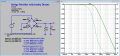
It seems there might be an advantage to a discrete Schottky bridge. As you can tell from the measurements on the transient responses they appear to be about 0.6 Volts less loss and don't appear to have much if any impact on the AC response. The AC response appears to be dominated by the output capacitance that the bridge rectifier sees out to 1 MHz. at least.

1652903354328.png
 

Thread Starter

LikeTheSandwich

Joined Feb 22, 2021
206
The transformer is not double the size if you use a split-phase circuit with just 2 diodes. The diodes do need twice the voltage rating.
If you have a center-tap transformer, then isn't only half the transformer being used at a time? So for the same kVA rating, using half at a time, wouldn't you need twice the size? How would it work with center tap to not have to double the voltage?
 

Ian0

Joined Aug 7, 2020
13,132
If you have a center-tap transformer, then isn't only half the transformer being used at a time? So for the same kVA rating, using half at a time, wouldn't you need twice the size? How would it work with center tap to not have to double the voltage?
Only half the secondary is being used at any time. The primary is just the same. In most transformers the losses are distributed equally between copper and iron losses and the copper losses equally distributed between primary and secondary losses, so the secondary accounts for about a quarter of the losses.
The half of the secondary that is not being used doesn't dissipate any power.
If it is a switched-mode transformer, then there is probably room for two secondary windings of the same thickness as the original secondary, so there might be no extra dissipation.
 

Papabravo

Joined Feb 24, 2006
22,082
If you have a center-tap transformer, then isn't only half the transformer being used at a time? So for the same kVA rating, using half at a time, wouldn't you need twice the size? How would it work with center tap to not have to double the voltage?
I don't think so. Having a center tap does not imply that only half of the transformer is being used at a time. There is mutual coupling between ALL of the windings.
 
Top