Help with Op-Amp Voltage Follower

Thread Starter

whitehaired novice

Joined Jul 15, 2017
289
I have a lovely 3 wire 5 digit 0-4.0000 volt meter. At some point over 4 volts it switches to a 0-33 volt meter, but I am not using that aspect of it. Unfortunately, the input impedance is only about 350k Ohms and I need at least a Megohm, preferably 3.5.

While I have never worked with op amps, I know about the voltage follower which seems like an ideal solution for me, so I read quite a bit of op amp theory and bread-boarded a simple voltage follower. I used a zif socket so I could swap ics easily.

Though I have not worked with op amps, I have a few each of 741s, LM11Cs and LM355Js, probably from purchases of “assortments.” I set the circuit up so I could vary the input from low milla-volts to 3.9 volts using a ten turn pot. Power supply was + and – 9 volts. I switched the meter between reading input voltage and output voltage so there would be no error introduced by two meters.

I took a LOT of readings and found this to be universally the case:
At inputs around 0.03 volts the output was sometimes 10 or 30 micro-volts above or below the input.
Around 0.3 volts the output was always 70 to 100 micro-volts above the input.
Around 3 volts the output was always 1,300 to 1,500 micro-volts about the input.

Interestingly, the grand-daddy of op amps, the 741, was the best of the lot. Also, it was the only one which showed any effect with the null adjustment.

OK, that's a long intro. My question—it that the nature of op amps or are there newer, better ones which will minimize the input output differential? Which ones? I can live with 100 micro-volts difference, but more than that won't do.

If I switch to a more complex circuit will I get better results? Advice on which circuit?
 

AlbertHall

Joined Jun 4, 2014
12,626
Please show the actual circuit you are using including the supply voltages - there should not be such errors (except possibly near zero).
 

ebp

Joined Feb 8, 2018
2,332
How were you reading voltages to resolution of better than 100 microvolts? Your meter doesn't do that.

There are op amps that use additional circuitry to automatically null the input offset voltage. The are known by various names depending on who makes them. Analog Devices calls some of theirs "Zero Drift." TI, Microchip and Maxim have similar parts. If you search for terms like "auto-zero", "chopper stabilized" you should find some parts.

When you need to produce accurate outputs near zero volts, you are pretty much stuck with using a dual power supply. Single supply amps will get to within a few millivolts of zero but not right to zero. Sometimes you can get reasonable performance by adding a resistor from the output to "ground" to force the amp to always "source" current into the output, but this may not be 100% effective and it wastes power. Charge pump circuits can be useful for producing negative supplies but you need to be careful about noise.

Input impedance can easily be in the hundreds of megohm range with many modern amps.

Microvolt levels are very difficult because thermoelectric sources (thermocouples) that produce microvolts are all over the place and cannot be eliminated. Any joint between dissimilar metals (e.g. solder and copper) will make a thermocouple. Great care is required to "balance" them so that one created in one place has an equal and opposite one in a place in the circuit such that the null each other. This only works, however, if the members of such pairs are kept at the same temperature, which can require shielding against air currents and care to avoid asymmetric heating from outside sources.
 
Last edited:

danadak

Joined Mar 10, 2018
4,057
As simple as they look, the idealized picture of a G element with simple
inputs and outputs, they are full of warts. The technology has gotten
better over time, and branched out in a wider offering of special types
with tailored capabilities.

This may be tedious, but take a look at this. Many real world observations
about how to apply OpAmps and various considerations.

http://www.tij.co.jp/analog/docs/li...Number=slyt701&docCategoryId=11&familyId=1562

What does your schematic look like ?

There are OpAmps that will actually sense outside their supply rails,
but not by much, typical ~ 100 mV.

Attached an ap note on precision basics. Then there is the Keithley
handbook -

https://download.tek.com/document/LowLevelHandbook_7Ed.pdf

Regards, Dana.
 

Attachments

Last edited:

Thread Starter

whitehaired novice

Joined Jul 15, 2017
289
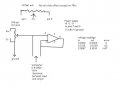
I'm attaching my schematic. Note that I am using dual + & - 9 volt supplies, so getting to 0 or even lower should not be a problem.

My meter is 5 digits—volts; .1 volts (aka 100 millivolts); .01 volts (aka 10 millivolts);
.001 volts (aka 1 millivolts); .0001 volts (aka 100 microvolts). I think I mistakenly listed my microvolt readings off by a factor of 10 in my first post. That is a low error was in the fifth digit, a medium error in the fourth digit and an unacceptable error in the third digit.

I am aware of the various problems mentioned such as thermal voltage being induced but in my case the readings are always steady over minutes at a time, so I don't think they are the problem.

I know I can't get the full 5 digit accuracy over the full range of this meter but I am hoping for 4 digit accuracy. I will settle for three digits if I have to but my breadboard circuits don't give me that.

Now, if my results are really out of the normal range then I can assume my op amps are bad—after all, I got them in cheap “assortments.” I'm willing to buy new, current model op amps if you will identify those you would use if you needed to raise the impedance of a meter.

Dana--thanks for the links. I'll study them with care this evening.

voltage follower.jpg
 

AlbertHall

Joined Jun 4, 2014
12,626
Rather than switching the meter between input and output you could connect the meter between the input and output which will directly read the offset.
 

AnalogKid

Joined Aug 1, 2013
12,143
Without knowing more about your test setup, it looks like most of the errors are input offset voltage errors. Newer devices have much better performance. For DC measurements, there are opamps with internal automatic offset correcting circuits that reduce offset errors to a few microvolts.

ak
 

ebp

Joined Feb 8, 2018
2,332
I think the problem is exactly why you are doing the experiments in the first place - the meter input resistance is loading the output voltage from the pot when you measure the input voltage. Then when you move the meter to the output of the amp, the amp's input voltage rises.

If you use spreadsheets, they are a handy way to do the calculations for the voltage divider formed by the two "sides" of the pot and the input resistance of the meter. I used to do (started far later than I should have) a lot of my calculations, even quite simple ones, with a spreadsheet. It can save a lot of work if you do something like changing a component or power supply voltage or ...

A work-around for this is to use another op amp to buffer the output of the pot. This will produce a low impedance over the full test voltage range. You don't need to fuss about the offset or accuracy of the amp that buffers the pot since you will be adjusting to the voltage you want. The only thing that is important is that the errors due to that amplifier remain constant while you are making the two measurements, which shouldn't be a problem.

EDIT - if I didn't botch my manual calc, if you set the pot for 3.00 V with the meter out of circuit (i.e. 2.5k "above the wiper", 7.5k "below"") then connected the meter, the voltage would drop to 2.984 V - about 16 mV difference, which is very close to what you are seeing
 
Last edited:

Thread Starter

whitehaired novice

Joined Jul 15, 2017
289
OMG! You nailed it ebp! It seemed to me that 350k wouldn't affect 7.5k but it does!
I'll do further tests.
Meanwhile--won't anyone give me a current, widely available op amp number. I'm embarrassed to use a 741 for more than testing concepts.
 

PeteHL

Joined Dec 17, 2014
580
Your schematic, post # 5 indicates connecting -9V of the power supply to pin 3 of the op amp. The -9V should be connected to pin 4 if the op amp is 741 or a large number of other single op amps. This is probably only a slip in your schematic diagram and I would guess that in fact you have the -9V connected to pin 4.
 

MisterBill2

Joined Jan 23, 2018
27,574
I have always wondered why that much resolution is required, and so I am asking "why" at this point.
Analog Devices offers a lot of definite purpose IC devices and this seems like a great application for a high input impedance buffer device.
 

Thread Starter

whitehaired novice

Joined Jul 15, 2017
289
MisterBill2 Well, I think I have been seduced by the elegance of that 5 digit meter! I don't really need that range, but it would be nice.
Could you point me to "a high input impedance buffer device."

I'm pretty busy this morning but maybe this afternoon or tomorrow I'll start a new thread asking that same question.

Thanks for your help and thanks to ebp who taught me what was wrong.
I'm playing with these circuits to learn something rather than make a specific thing.
 

ebp

Joined Feb 8, 2018
2,332
All the precision amps I used in my final years of doing design were surface mount parts and some quite expensive. All of the recent introductions that have good specs and aren't too pricey are in surface mount packages.
I used to use LT1013 and 1014 which are fairly good, operate over a wide supply range and can be had in DIP. The "A" suffix versions are better, but even the non-A are expensive. Microchip has some low-cost amps with quite good input offset voltage specs, but they are limited to 5.5 V power supply (total, not ±5 V), which makes them marginal for 4 V use when a small negative supply is required to assure swing to ground. The might work OK with a Schottky diode used like a zener for the negative supply with 5 or 5.5 V total (so about -0.6 V and +4.4 V with 5 V supply, which should be OK for 0.000 V to 4.000 V input and output with the rail-to-rail parts as long as output current is small).

Here's a Digi-Key search for through-hole amps from Mircochip, sorted by ascending input offset voltage. I didn't double-check, but Digi-Key used to use "typical" input offset and with some amps typical is considerably better than worst-case.
https://www.digikey.com/products/en/integrated-circuits-ics/linear-amplifiers-instrumentation-op-amps-buffer-amps/687?FV=ffe002af,fffc0096,1c0006,1140050,1f140000&quantity=0&ColumnSort=975&page=1&k=amplifier&pageSize=25&pkeyword=amplifier
I'm no particular fan of Microchip, but they do have some quite nice low-cost op amps, including some that run on ultra-low power (and have ultra-low bandwidth, as I realized after design-in without paying enough attention to the data; fortunately I required a bandwidth of about zero).

There haven't been many op amps with offset trim introduced in recent years. You can get to very low input offset voltage with trimming, but you can also have a situation where the drift with temperature undoes good intentions.

There are things you can do with adding then subtracting offset voltages to get around issues of input and output voltage swings, but they can get rather complex and messy and usually aren't worth it. If you are making a buffer for the input of an ADC that is read by a microprocessor, adding an analog offset and subtracting it digitally can be quite useful to get around the "not quite zero" problem.
 

ebeowulf17

Joined Aug 12, 2014
3,307
All the precision amps I used in my final years of doing design were surface mount parts and some quite expensive. All of the recent introductions that have good specs and aren't too pricey are in surface mount packages.
I used to use LT1013 and 1014 which are fairly good, operate over a wide supply range and can be had in DIP. The "A" suffix versions are better, but even the non-A are expensive. Microchip has some low-cost amps with quite good input offset voltage specs, but they are limited to 5.5 V power supply (total, not ±5 V), which makes them marginal for 4 V use when a small negative supply is required to assure swing to ground. The might work OK with a Schottky diode used like a zener for the negative supply with 5 or 5.5 V total (so about -0.6 V and +4.4 V with 5 V supply, which should be OK for 0.000 V to 4.000 V input and output with the rail-to-rail parts as long as output current is small).

Here's a Digi-Key search for through-hole amps from Mircochip, sorted by ascending input offset voltage. I didn't double-check, but Digi-Key used to use "typical" input offset and with some amps typical is considerably better than worst-case.
https://www.digikey.com/products/en/integrated-circuits-ics/linear-amplifiers-instrumentation-op-amps-buffer-amps/687?FV=ffe002af,fffc0096,1c0006,1140050,1f140000&quantity=0&ColumnSort=975&page=1&k=amplifier&pageSize=25&pkeyword=amplifier
I'm no particular fan of Microchip, but they do have some quite nice low-cost op amps, including some that run on ultra-low power (and have ultra-low bandwidth, as I realized after design-in without paying enough attention to the data; fortunately I required a bandwidth of about zero).

There haven't been many op amps with offset trim introduced in recent years. You can get to very low input offset voltage with trimming, but you can also have a situation where the drift with temperature undoes good intentions.

There are things you can do with adding then subtracting offset voltages to get around issues of input and output voltage swings, but they can get rather complex and messy and usually aren't worth it. If you are making a buffer for the input of an ADC that is read by a microprocessor, adding an analog offset and subtracting it digitally can be quite useful to get around the "not quite zero" problem.
I guess "precision" is all relative, but I remember a while back you recommended the LMC6484 to me for hall effect project I was working on where op amp offset was proving troublesome. In my situation, it was an amazing improvement. I don't remember the numbers right now, but I don't think I was attempting this level of resolution, so it may not be a good choice here, but I thought I'd check. It's my favorite op amp (until I realize I need something better.)
 

ebp

Joined Feb 8, 2018
2,332
I'd forgotten about that one. It isn't spectacular in terms of worst-case input offset voltage, but it comparable to the LT1013/14 and somewhat cheaper and can be had in a through-hole package.The CMOS input means really low bias current, though the supply current isn't especially low.
 

Thread Starter

whitehaired novice

Joined Jul 15, 2017
289
I have, unfortunately, concluded that my initial circuit--putting 0.1 mA constant current through an unknown resistance and reading the ohms by measuring the voltage across it cannot really be made to work. The internal impedance of the voltmeter would have to be better than 100 times the resistance being read. Thus I'd need a meter with a resistance of better than 40 megs!

Well, my time was well spent since my intention was to learn something new and I did.

Can anyone explain to me how cheap DVMs read up to 2000 kohms or should I start a new thread?

This forum is really great. Thanks from an old man.
 

MisterBill2

Joined Jan 23, 2018
27,574
I have, unfortunately, concluded that my initial circuit--putting 0.1 mA constant current through an unknown resistance and reading the ohms by measuring the voltage across it cannot really be made to work. The internal impedance of the voltmeter would have to be better than 100 times the resistance being read. Thus I'd need a meter with a resistance of better than 40 megs!

Well, my time was well spent since my intention was to learn something new and I did.

Can anyone explain to me how cheap DVMs read up to 2000 kohms or should I start a new thread?

This forum is really great. Thanks from an old man.
As a matter of facts, I made a great deal of money for one employer by creating an ohm meter that worked exactly that way. It used 4 wires, a true "Kelvin Connection" and the beauty was that it could be perfectly reliable in detecting an unplugged fiel injector in a parallel set of 4 injectors, each one about 1r2 ohms. The measuring system ran 100 milliamps through the set of injectors and the digital meter was nominally 2 volts full scale. The inconvenience of there having to be two wires up to each test connection was offset by never needing to adjust the calibration, which the previous scheme that cost a lot more needed daily calibrations. And the really great part was that the constant current source went on an accessory PCB inside the Analogic digital panel meter that would read the voltage.
 

ebp

Joined Feb 8, 2018
2,332
JFET-input or CMOS-input op amps can easily achieve input DC resistance of hundreds of megohms to many gigohms. The specification of interest is the "input bias current." This is the current into or out of an input.

The one ebeowulf mentioned is a CMOS type with an input bias current of 4 picoamps maximum under any temperature conditions (depending on temp range spec for the part). At moderate temperature, the current is typically around 20 femtoamps. 4 pA from 100 µA is an error of 0.000004%.
20 fA from 100 µA is a whole lot of zeros. You need to be very careful in circuit board design and board cleaning to keep the current that low. The input bias current of the 741, for comparison, is typically 80 nanoamps and worst case 1.5 µA.

Reduction in input bias current is one of the areas of substantial improvement in new designs. Amplifiers with very high bandwidth still typically have moderately high input bias current, though Linear Tech has a FET input one with spectacular specs. Very fast comparators generally require pretty substantial input current.
 

Thread Starter

whitehaired novice

Joined Jul 15, 2017
289
Thanks to both of you again. I have a good mind to buy a couple of LMC6484s but if there is a single amp with similar specs it would make a cleaner board. And since I don't need speed I don't need bandwidth
I have tried to browse op amps on Digikey but there is so much info and so little help I just get lost. There must be data from manufacturers describing their amps which don't require the user to know the number in advance.
 

ebeowulf17

Joined Aug 12, 2014
3,307
Thanks to both of you again. I have a good mind to buy a couple of LMC6484s but if there is a single amp with similar specs it would make a cleaner board. And since I don't need speed I don't need bandwidth
I have tried to browse op amps on Digikey but there is so much info and so little help I just get lost. There must be data from manufacturers describing their amps which don't require the user to know the number in advance.
I believe there's a 6482, which is dual instead of quad with (l think) the same specs. I'm not aware of a single.
 
Top