Help with electrode contact sensing

Thread Starter

anishkgt

Joined Mar 21, 2017
549
hello all,

I am trying to sense when the electrodes of a spot weld makes contact. I've got part of the schematic but not sure if this would be the best way to go. I am not sure how to connect terminal 1 and 2. The terminal are 1AWG cables that carry several thousands of current at max 2vac.

Appreciate if somebody could advise.
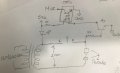
sch.jpg
 

LesJones

Joined Jan 8, 2017
4,511
I think it would be much easier to sence the rise of current on the transformer primary side. Another solution would be a current transformer between 1 and 2 but your detection circuit would have to be on the secondary side of the current transformer

Les.
 

dendad

Joined Feb 20, 2016
4,635
Yes, a current transformer will be a good way to do it. rectify the output and feed it to a comparator to set the threshold as there will be some current sensed when powered if you put it in the primary side.
 

Reloadron

Joined Jan 15, 2015
7,867
The 2 VAC you are showing is likely the arc voltage or the voltage across the arc once the arc has been struck. Prior to the arc voltage there should be an open circuit voltage which is much higher. Just as an example using a DC arc voltage control the arc voltage drop might be around 10 to maybe 13 volts but before the arc is struck the open circuit voltage can be 60 to 80 volts depending on the system. I doubt 2 VAC is your open circuit voltage maybe the AC arc voltage but not the open circuit voltage.

Should that be true the way I have seen this done is rectify your voltage across the electrodes to get a DC level. Then use a comparator so when the open circuit voltage across the electrodes drops to the actual arc voltage the comparator changes states. A Google of "comparator circuits with hysteresis" should get you started. If you want to measure the weld current I would use a current transformer to monitor the arc current. I am not saying using a CT to detect the touch point of the electrodes is a bad idea, merely that I would look for the drop between open circuit and weld voltage across the electrodes.

The use of a current transformer is likely the more economical approach, using for example a 2000:5 CT since you mention 2 KA. With that in mind you may also want to consider that 1.0 AWG welding cable has a max current up to a 100 foot run of only 250 Amps and 1/0 (or 1 ought) has a max capacity of 300 Amps. When you start drawing current like a few thousand amps cable like 4/0 with parallel multiple runs are generally used. You also need to take a long look at your cable length and resistivity as your I*R drop starts to figure into things real quick. The voltage you start with is not what you will see at your electrodes during the actual weld. Welders delivering this type of current are seldom powered by 120 or 240 volts, typically 480 volts, in some industrial applications.

Note: I just noticed this is a spot weld which changes everything about my post. Maybe I should have read the question in more detail.

Doesn't the jaws close and once clamped a pulse is sent? The jaws close during a squeeze time period and once the correct pressure in present a pulse of power is sent to the weld head. So I guess what I am asking would there be a brief dwell time between when the jaws touch until the power is sent? My bad on all the prior and sorry about that.

Ron
 
Last edited:

ebp

Joined Feb 8, 2018
2,332
Is the requirement here the detection that the secondary circuit is closed (electrode clamp engaged) before any significant secondary current is allowed? Do you need some quantitative measure of circuit resistance so you don't fire unless it is low enough, or will you just assume that any reasonable continuity is sufficient?


[EDIT] I don't think this would work. The inductance of the secondary of the main transformer is going to be very low and distinguishing the change in current from the small transformer due to the electrodes being closed would likely be difficult.
I'd have to think about it some more, but my first impression is that probably the easiest thing to do is use a separate very small transformer with a low voltage winding (say 4 or 5 volts), with a resistor somewhere in the circuit, possibly on the primary side, and use it to sense or measure contact resistance. If your main transformer is wound so it can't produce more than 2 volts (higher is OK too, as long as the maximum is well known), then there is no harm in driving the small transformer "backwards" by applying the voltage from the secondary of your main transformer to the secondary of the small transformer. With a resistor in the circuit, the current will not be excessive. Assuming you are controlling the main transformer, you could also control the small transformer to disconnect it before firing the main xfmr, but you probably don't have to. Unless you are running a fast repetition rate for welding, a relay for the small transformer would probably be quite acceptable.
 
Last edited:
Top