Help with deciding voltage regulator style

Thread Starter

ColdToba

Joined Jan 6, 2025
2
I'm looking to make a custom pcb that would be very similar to a teensy 4.0. My biggest problem right now is deciding what style of voltage regulator to use. I have done a bunch of reading but still don't know which style would be best. I'm looking at either a LDO or switching regulator. My input voltage will be anywhere from 11VDC to 28VDC. From what I have read LDO's don't do well on a wide input voltage range where the switching regulators work well with a wide input range but tend to generate more noise.

The production teensy 4.0 that is sold uses a texas instruments TLV75733P LDO but the input voltage range is very narrow as it's designed to work off of 5V from USB.

I was looking at using a STMicro LD1086DT33TR for my project as I will be powering a tft display with backlight and a GPS receiver. I just don't know if I will run in to issues with having the wide input voltage range.

I'm a hobbyist who has learnt by reading forums so my knowledge is limited. Any input would be appreciated.
 

crutschow

Joined Mar 14, 2008
38,322
A switching regulator is desirable for significant load currents at a high input to output voltage ratio, since its loss is much lower as compared to any type of linear regulator, such as an LDO type.
The switching noise is not usually a problem unless you are working with low level analog signals.
 

LowQCab

Joined Nov 6, 2012
5,101
Most Switching Regulators will offer and additional Filtering-Stage in their recommended
Circuits in their Spec-Sheet.
With a 4th-Order-Filter You are not likely to have enough noise for it to be worth measuring.
.
.
.
 

be80be

Joined Jul 5, 2008
2,394
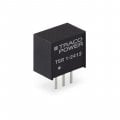
TSR1-2433 is 3.3 volt

The TSR 1 series step-down switching regulators are drop-in replacement for inefficient 78xx linear regulators. A high efficiency up to 96% allows full load operation up to +60°C ambient temperature without the need of any heat-sink or forced cooling. The TSR 1 switching regulators provide other significant features over linear regulators, i.e. better output accuracy (±2%), lower standby current of 2 mA and no requirement of external capacitors. The high efficiency and low standby power consumption makes these regulators an ideal solution for many battery powered applications.
 
Last edited:

schmitt trigger

Joined Jul 12, 2010
2,027
With the low cost, small footprint and ease of use of these tiny modules which be80be suggested, this is the approach that I suggest and have followed for all of my latest projects.

They are *almost* as easy to use as an LDO, only requiring a pi-filter to reduce noise if powering sensitive circuits.
 

be80be

Joined Jul 5, 2008
2,394
I put one in a $7000 dollar mat valve board that uses a Arm® Cortex®-M0 to tell which valve to open it had a very small foot print switcher on the space of about a dime.
I replaced it with a TSR1-2450. The uC is using ADC to read current not had a problem. It seems to be uC friendly
 

Jon Chandler

Joined Jun 12, 2008
1,560
A key points about ALL linear regulators.

The excess voltage is converted to heat.

Pd = (Vin – Vout) × i

Where

Pd = Power dissipation in watts
Vin = input voltage
Vout = output voltage
I = current in watts

If you're dropping 24 volts to 5v or 3.3v, it doesn't take much current to generate watts of heat.
 

Ian0

Joined Aug 7, 2020
13,097
Use a LMR38010 to give 5V. It will work from any input voltage from 8V to 70V. Then use a linear regulator with good PSRR to give a clean 3.3V supply.
You will probably find that the 5V supply is useful for things like RS485, CAN etc.
 

Thread Starter

ColdToba

Joined Jan 6, 2025
2
Thanks everyone for the input.

Output voltage is 3.3. For current demand I should be under 500ma. I'm thinking I will be around 200-250ma once it's powered up and operating.

I'll have a closer look at the suggestions that were made.
 
For almost 10 times decrease (28 to 3v3) and 500mA I wouldn’t use even a buck converter because of too low duty, needles to say a LDO.

I would go a transformer flyback step-down converter way.
 

Ian0

Joined Aug 7, 2020
13,097
For almost 10 times decrease (28 to 3v3) and 500mA I wouldn’t use even a buck converter because of too low duty, needles to say a LDO.

I would go a transformer flyback step-down converter way.
A flyback would be hard pressed to beat the efficiency of a synchronous buck such as the LMR38010 even at that step-down ratio, the complexity would be much greater, and the output ripple would be worse. A buck regulator has a continuous current output, and a flyback doesn't - it would need extra filtering.
 
Top