Help with Controller for ventilation system

Thread Starter

Cicatrix

Joined Aug 22, 2024
9
Hey everyone,

right now i am tackling the challenge to smartify my dumb house ventilation system, as the original controller is a closed system and often looses connection between master and slave fans. The fans are working in pushing and pulling mode so they can suck air into the house or push it out.

I want to be able to control the 3-pin 24V DC Motors that are used in the ventilation system and add them controllable into my home assistant system (preferred would be an ESP32 approach). Of course the space is a bit limitted to pack everything into the vents housing.

What i already found out is that the fans run with 24V DC between VCC and GND all the time and the third pin is used for controlling the fans speed. The oscilloscope showed its not using a PWM signal. Its getting just various DC voltages according to the mode push/pull.

While pushing the signal pin operates between 2-4V and while pulling its operating between 6-8V. In the pushing phase 2V gives the highest speed and 4V the lowest, in the pulling phase its reverse so 8V is highest fan speed and 6V lowest.

When the fans change between pushing and pulling the voltage drop to 0V on the signal and VCC. So what i understood is that i somehow can use an ESP32 PWM Signal with a low-pass filter to control a mosfet (like IRLZ 44N) to use my 24V and convert it to 2-8V usable on the signal pin. A second mosfet or relay will be needed to cutout the voltage between VCC/GND to make the fan go in reverse mode.

To power the ESP32 a buck converter will be needed as well to drop the 24V to its 5V operating voltage.

Hopefully that wasnt to confusing and im kinda on the right track with my assumptions.
 

wayneh

Joined Sep 9, 2010
18,104
Are you sure the fans are powered by 24VDC? That's normal for the control system but it's more typical for the fans to connect to mains power. It takes quite a bit of power to move a significant amount of air, for instance a 1/2-HP motor. That would require about 15A at 24V, and that requires fat wires.
 

Thread Starter

Cicatrix

Joined Aug 22, 2024
9
Are you sure the fans are powered by 24VDC? That's normal for the control system but it's more typical for the fans to connect to mains power. It takes quite a bit of power to move a significant amount of air, for instance a 1/2-HP motor. That would require about 15A at 24V, and that requires fat wires.
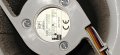
I tought thats unusual too but they are definetly powered by 24V DC.

IMG20240820202004.jpg
 

Ya’akov

Joined Jan 27, 2019
10,235
I am thats one of the reasons i wrote esp32 as microcontroller is preferred.

Until now i Just used ready to go stuff, where the components have been sorted out already by someone else.
OK, I would just be sure that the control signal you have measured is definitely not PWM. Yes, a scope would show a PWM signal—if properly set—but it would also show a DC signal if it wasn’t.

So before going too far double check your measurement on the scope. Don’t rely on the auto function, adjust the time base manually through 100Hz to. 1KHz and see if there is any sign of PWM.

If not, then with a variable power supply carefully give the motor the correct voltage for supply (the 24V) and then apply what you think is the correct control voltage with current limiting turned on to avoid letting out the magic smoke.

Of course you can and should still use PWM from the µC to provide the control voltage(s). I am not sure why you suggest you need an LPF, though. Could you explain that?

Also can you get a manufacturer and part number from the fan, and for that matter the whole device? (EDIT: found your photo of the fan)
 

Thread Starter

Cicatrix

Joined Aug 22, 2024
9
OK, I would just be sure that the control signal you have measured is definitely not PWM. Yes, a scope would show a PWM signal—if properly set—but it would also show a DC signal if it wasn’t.

So before going too far double check your measurement on the scope. Don’t rely on the auto function, adjust the time base manually through 100Hz to. 1KHz and see if there is any sign of PWM.

If not, then with a variable power supply carefully give the motor the correct voltage for supply (the 24V) and then apply what you think is the correct control voltage with current limiting turned on to avoid letting out the magic smoke.

Of course you can and should still use PWM from the µC to provide the control voltage(s). I am not sure why you suggest you need an LPF, though. Could you explain that?

Also can you get a manufacturer and part number from the fan, and for that matter the whole device? (EDIT: found your photo of the fan)
I tried that already with the oscilloscope and just getting DC voltage without any sign of PWM. Double checked it with a Multimeter and i get clear reading of a DC voltage without fluctuation as well.

I had the LPF to flatten the PWM Signal from the esp32 and get a constant dc voltage.

For testing purposes i need to get a variable Power supply as i dont have one right now.
 

Ya’akov

Joined Jan 27, 2019
10,235
I tried that already with the oscilloscope and just getting DC voltage without any sign of PWM. Double checked it with a Multimeter and i get clear reading of a DC voltage without fluctuation as well.

I had the LPF to flatten the PWM Signal from the esp32 and get a constant dc voltage.

For testing purposes i need to get a variable Power supply as i dont have one right now.
So, the PWM signal will look like a DC voltage with a value equal to the average power. A DMM will see what it thinks is DC, and if the scope is set to a low frequency it will also see DC rather than the true waveform. That’s why I suggesting revisiting the scope measurement and manually sweeping the time base from 100Hz to 1KHz to see if there is any suggestion of a waveform—there may not be, but if there is it’s important to the design because in that case a DC voltage probably won’t work.

The test with a bench supply will show if a DC voltage can work, and it would also be helpful to measure the current of the control signal as it is originally applied. The more you know to start the less likely you are to make a design decision that turns out unworkable.
 

Thread Starter

Cicatrix

Joined Aug 22, 2024
9
So, the PWM signal will look like a DC voltage with a value equal to the average power. A DMM will see what it thinks is DC, and if the scope is set to a low frequency it will also see DC rather than the true waveform. That’s why I suggesting revisiting the scope measurement and manually sweeping the time base from 100Hz to 1KHz to see if there is any suggestion of a waveform—there may not be, but if there is it’s important to the design because in that case a DC voltage probably won’t work.

The test with a bench supply will show if a DC voltage can work, and it would also be helpful to measure the current of the control signal as it is originally applied. The more you know to start the less likely you are to make a design decision that turns out unworkable.
I retried going through the requested sample rate, still no Waveform.

I will try to get a power supply to Check If i can directly use the DC voltage as Signal.
 

Thread Starter

Cicatrix

Joined Aug 22, 2024
9
@Ya’akov Got my bench supply today and the fans are running Like a Charm with a voltage from 1-4V in push mode and 6-9V pulling air.

What i saw, is that changing direction doesnt necessarily need a cutoff from VCC. The fans stop somewhere around 4-6V and start spinning when the voltage range is fitting again.

So the cutoff is probably for safety reasons and should be kept i think.

Sorry for the confusion with the LPF that was left in my brain when i still tought the output voltage from the esp32 could be directly used as signal voltage.

So do you think my circuit idea with an esp32 Mini, two mosfets, a buck converter and a fly diode could work out?
 

Thread Starter

Cicatrix

Joined Aug 22, 2024
9
A MOSFET should work fine. Calibration will take a bit of working out…
Yeah the calibration will be critical, at least i can sort that out with the bench supply and the circuit sitting on my desk.

Would you say such a BOM should work out?

1x 1N 5819 Schottkydiode
2x IRLZ44N Mosfet
1x ESP32 D1 Mini

For testing i have a few LM2596 buck converter that should work fine. Could you recommend something way smaller for the final Prototype?
 

Thread Starter

Cicatrix

Joined Aug 22, 2024
9
@Ya’akov Could you give me a hint on the schematics. I try to run the mosftet for the variable signal voltage with a pwm pin from the esp32. 24V input voltage goes on the drain and signal voltage from the source to the signal pin of the fan. Is that correct?
 
Top