Help with analyzing a DC circuit

Thread Starter

mapisto

Joined Dec 25, 2009
36
Hi,
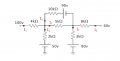
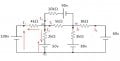
I've got a circuit to analize and i'm not sure if i'm doing it right.

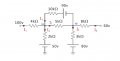
First, I'm asked to write how many equations do i need for finding all the currents. my answer is 6 independent equations, because i've got 6 variables. is that right?

Second, I'm required to find those equations by using ohm's law and kirchoff's current and voltage law:
well, i've got only one loop in which i can use the KVL, and then 2 nodes where i can use KCL, but then i'm not realy sure about something.
I think I could build another 4 equations by using Ohm's law on the 2K,3K,4K,8K resistors, but i'm not sure about the voltage. it made me a little confused, i don't know if I can just say that the voltage on each one is the voltage given near it. And if I can, why?!

For example, is the voltage upon the 2k resistor 50v ?

I know this is long, but I wanted to write to you what i'm thinking and to know if it's right.

Please help,
thanks!
 

Attachments

Jony130

Joined Feb 17, 2009
5,599
Do you know nodal analysis?
http://en.wikipedia.org/wiki/Nodal_analysis
Because by applying nodal analysis you need to write only two equations.
For two unknowns nodal voltage V1 , V2

I1 + I2 + I3 + I4 = 0 ( for V1)
I3 + I4 + I5 + I6 = 0 (For V2)

So we have for V1

\(\frac{100V - V1}{4K}+\frac{50V - V1}{2K}+\frac{V2 - V1}{5K}+\frac{(V2+90) - V1}{10K}=0\)

And for V2

\(\frac{V2 - V1}{5K}+ \frac{(V2+90) - V1}{10K}+\frac{V2 - 80V}{3K}+\frac{V2 - 60V}{8K}=0\)

And if I solve for V1 and V2

http://www.wolframalpha.com/input/?...+(V2+-+80)/3+++(V2+-+60)/8+=0&incParTime=true

I get this result
V1 = 74.0412979V
V2 = 62.4778761V
 

Attachments

Thread Starter

mapisto

Joined Dec 25, 2009
36
Do you know nodal analysis?
http://en.wikipedia.org/wiki/Nodal_analysis
Because by applying nodal analysis you need to write only two equations.
For two unknowns nodal voltage V1 , V2

I1 + I2 + I3 + I4 = 0 ( for V1)
I3 + I4 + I5 + I6 = 0 (For V2)

So we have for V1

\(\frac{100V - V1}{4K}+\frac{50V - V1}{2K}+\frac{V2 - V1}{5K}+\frac{(V2+90) - V1}{10K}=0\)

And for V2

\(\frac{V2 - V1}{5K}+ \frac{(V2+90) - V1}{10K}+\frac{V2 - 80V}{3K}+\frac{V2 - 60V}{8K}=0\)

And if I solve for V1 and V2

http://www.wolframalpha.com/input/?...+(V2+-+80)/3+++(V2+-+60)/8+=0&incParTime=true

I get this result
V1 = 74.0412979V
V2 = 62.4778761V

Hi,
Thank you for your help, but my tutor won't let us use anything we haven't learnt yet...

So i must use KVL, KCL and Ohm's law only.
 

Thread Starter

mapisto

Joined Dec 25, 2009
36
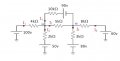
No, there is no "open part" because we always can add this 100V and 60 V voltage sources to the diagram

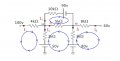
Ok, I guess I've got the picture all wrong, because my tutor always told us to use a -closed- loop for KVL.. so how exactly am i supposed to do KVL on the "open part" ? can i close the loop and it will stay the same? I feel i've got a huge hole in my understanding : \ please fill it up :|

and btw, if i wanted to use Ohm's law on the 4kΩ resistor, could i just say that the voltage on it is 100v ? i have the feeling i'm being stupid o_O

thank you for your patience!
 

Jony130

Joined Feb 17, 2009
5,599
so how exactly am i supposed to do KVL on the "open part" ? can i close the loop and it will stay the same?
Yes, close the loop with the additional voltage source.
And now you have four KVL loops.

and btw, if i wanted to use Ohm's law on the 4kΩ resistor, could i just say that the voltage on it is 100v ?
No, the voltage across 4kΩ resistor is not equal 100V.
And we use capital "V" for Voltage
 

Attachments

Thread Starter

mapisto

Joined Dec 25, 2009
36
Yes, close the loop with the additional voltage source.
And now you have four KVL loops.


No, the voltage across 4kΩ resistor is not equal 100V.
And we use capital "V" for Voltage
Now i can see the point at last... Thank you!

i've just read this explanation also:
http://www.allaboutcircuits.com/vol_1/chpt_6/2.html

but still, I'm not sure, so tell me if I'm wrong.
The reason i'm allowed to consider this a close loop is because i'm taking the potential differences between the 2 spots?

I understand what i need to do to solve the problem, but I won't be able to rest until I understand exactly why I'm allowed to do it. :rolleyes:
 

Jony130

Joined Feb 17, 2009
5,599
The reason I'm allowed to consider this a close loop is because i'm taking the potential differences between the 2 spots?
Yes, you have 100V potential differences between two points.
And one of this points is common for the whole circuit.
And we measure all the voltage respect to this common spot (reference point), also known as a "ground" (GND). And we assume that GND have zero voltage.
 

Thread Starter

mapisto

Joined Dec 25, 2009
36
Yes, you have 100V potential differences between two points.
And one of this points is common for the whole circuit.
And we measure all the voltage respect to this common spot (reference point), also known as a "ground" (GND). And we assume that GND have zero voltage.
I see,
I think i've got it now.

Thank you very much! you have no idea how grateful i am :)
 
Top