Help verifying a emp detector circuit viabilty.

Thread Starter

pmawhorter

Joined Sep 4, 2017
10
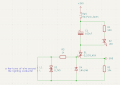
I am working on trying to build a simple circuit that turns on and latches an Led when a lightning rod gets struck by lightning. This is what I have come up with so far. The idea with the circuit is that I will have a coil of wire around the lighting conductor, so that when there is a strike there will be an induced current in the coil that is clamped down to 5-6v by the tvs diode which then turns on the SCR and latches, turning the LED on. The circuit can then be reset by the normally closed push button. Does this look like a viable idea? Also the values are all temporary so please feel free to suggest different ones. ThanksScreenshot From 2026-07-24 20-59-19.png
 

sghioto

Joined Dec 31, 2017
8,729
The coil will definitely need to be insulated from the rod.
Normally the coil would be on the down cable not directly on the rod from a brief research on the subject.
 
Last edited:

Pyrex

Joined Feb 16, 2022
523
Add a small capacitor in parallel with D4 so the device is less sensitive to interference.
Remove NC switch SW1. Add NO switch in parallel to the SCR. A NO switch is much more reliable, especially at low supply voltages.
 

Thread Starter

pmawhorter

Joined Sep 4, 2017
10
Add a small capacitor in parallel with D4 so the device is less sensitive to interference.
Remove NC switch SW1. Add NO switch in parallel to the SCR. A NO switch is much more reliable, especially at low supply voltages.
Do you mean put the NO switch between the anode and the gate of the SCR?
 
Interesting subject. Some 40 years ago a company I was working for scrapped a project. Among the tossed stuff were digital counters. Also quite a few Photo Transistors, I think they were 2N2222 type. For some unknown reason I decided to connect the emitter and collector across the two points on the counter where normally a switch would have gone. I put one in the refrigerator to see how many times in a day the refrigerator door was opened. I don't remember the number but one evening one was sitting on the table when there was a flash of lightning. I looked at the counter and the number had greatly increased. So I hit the reset button on the counter and stuck it in the window. With the next flash of lightning it counted something like 35 pulses during that single flash event. Other flashes had far higher numbers. Of course this was done in the evening.

I share this because I'm wondering why the need to detect lightning. Back in my teenage years I worked at a church camp. We had the CB radio going for communication between the main lodge and where we were working on the property. With any AM radio you can hear lightning strikes some distance off. I can't tell you how far away from the receiver the lightning was but it was far enough that when you heard the static from the lightning you wouldn't hear the thunder.
 

Thread Starter

pmawhorter

Joined Sep 4, 2017
10
Interesting subject. Some 40 years ago a company I was working for scrapped a project. Among the tossed stuff were digital counters. Also quite a few Photo Transistors, I think they were 2N2222 type. For some unknown reason I decided to connect the emitter and collector across the two points on the counter where normally a switch would have gone. I put one in the refrigerator to see how many times in a day the refrigerator door was opened. I don't remember the number but one evening one was sitting on the table when there was a flash of lightning. I looked at the counter and the number had greatly increased. So I hit the reset button on the counter and stuck it in the window. With the next flash of lightning it counted something like 35 pulses during that single flash event. Other flashes had far higher numbers. Of course this was done in the evening.

I share this because I'm wondering why the need to detect lightning. Back in my teenage years I worked at a church camp. We had the CB radio going for communication between the main lodge and where we were working on the property. With any AM radio you can hear lightning strikes some distance off. I can't tell you how far away from the receiver the lightning was but it was far enough that when you heard the static from the lightning you wouldn't hear the thunder.
The reason I am making this project is that I live off grid at the peak of a mountain and my house and land gets struck by lightning at least once a year. I have a radio tower with some antennas on it and a lightning rod at the top. I have been trying to ground everything and protect it from lightning damage and since grounding everything I have had several very close lightning strikes. The thing is I don't know if my tower was struck or if it was just somewhere nearby. If I know the tower was actually struck I can have a bit more confidence in the grounding I have already done
 
I've seen documentaries on lightning. What I saw was that cloud to ground lightning begins to excite the ions in the air and ground. Fingers reach up from the ground while downward traveling fingers reach toward the ground. When one of the fingers find a pathway to another finger the lightning strikes. Only one pathway gets completed. People who've been struck by lightning and lived have likely been involved in these fingers, the ones that didn't connect. Their injuries can be significant but they haven't been hit by the full force of the lightning. I suppose this would qualify as well to know if there was an event whereby grounding saved the day.

One afternoon during a lightning storm I was standing on the shipping dock, not out in the rain. I heard crackling sounds coming from the water cooling tower. I think it was those fingers causing that. However, lightning found a path to ground via a different route because about 1 or 2 seconds after the fizzling sound there was a flash of lightning. A few seconds later we heard the thunder. Lightning was less than a mile away but the thunder wasn't instantaneous.
 
The way to protect equipment from an actual lightning strike is to disconnect it. If your ground system has one ohm of resistance , then ay 100 amps you will have 100 volts across that resistance. BUT lightning current is much greater, AND the much faster rise time is affected by series impedance, as well. A LIGHTNING STRIKE, YEARS AGO, on my 18 pipe foot mast supporting my wire antenna, blistered the paint, and damaged a number of items inside the house.

An adequate antenna to detect a lightning strike nearby is a ten foot wire within a hundred feet of the strike.
 
Last edited:
Several years ago I was watching one of those educational channels. On one episode they were launching rockets into a storm trailing a wire trying to coax lightning to strike down along that wire. If I recall correctly they had some sort of big plastic pill mounted on an axel perpendicular to the length of this device. I imagine there was a coil of wire in there and connected to each side of the axel. This pill rotated at a slow rate, probably around once a second. Given the changing orientation to the sky - with the presence of electrostatic charge building up - the pill generated a current. When the level of charge detected reached a given point they would launch the rocket. If the timing was right the rocket would bring down the lightning to the base where the rocket launched from. Launch control was done via air pressure to activate a remote switch in order to keep the researchers safe from the lightning.

I'm wondering if something like that can be built to detect when lightning is about to strike. I would have to guess they may have had a few to several seconds before the strike occurred. Such a device could be used to switch your antenna cable from the radials to ground, providing a pathway for the lightning, should it strike the radials, to ground. Since you have a grounding rod above your radials perhaps a relay or heavy duty contactor could switch the radio from the antenna and ground the antenna before the strike. Once activated the system could also disconnect power from the radio to prevent accidental attempts to broadcast with a disconnected antenna.

While looking for that documentary I came across this on YouTube. It's designed to disconnect the LAN from the computers. But maybe it could be used to disconnect a lot of other things as well. It all depends on how much stuff you want to isolate the lightning from.
I'll keep searching to see if I can find the video I'm looking for. Meanwhile, this is food for thought.
 
I've seen documentaries on lightning. What I saw was that cloud to ground lightning begins to excite the ions in the air and ground. Fingers reach up from the ground while downward traveling fingers reach toward the ground. When one of the fingers find a pathway to another finger the lightning strikes. Only one pathway gets completed. People who've been struck by lightning and lived have likely been involved in these fingers, the ones that didn't connect. Their injuries can be significant but they haven't been hit by the full force of the lightning. I suppose this would qualify as well to know if there was an event whereby grounding saved the day.

One afternoon during a lightning storm I was standing on the shipping dock, not out in the rain. I heard crackling sounds coming from the water cooling tower. I think it was those fingers causing that. However, lightning found a path to ground via a different route because about 1 or 2 seconds after the fizzling sound there was a flash of lightning. A few seconds later we heard the thunder. Lightning was less than a mile away but the thunder wasn't instantaneous.
If you are in a car which is somewhat of a Faraday cage you can feel the lightning just before it hits your car and gets shuttled to ground. Just don't be touching anything metallic connected to the body of the car. I will never forget that experience almost like someone bringing a static charged balloon close to your arm but everywhere. Then a bright flash of light and such a loud bang.
 

Rf300

Joined Apr 18, 2025
102
One very important hint concerning your circuit: Don't underestimate the power of a lightning! If a lightning really hits your lightning rod, there will be induced so much voltage in your sensing coil that your input circuit will be immediatly converted to magic smoke. You need at least an additional gas discharge tube and a varistor between the coil and the TVS.

On the other hand: If a lightning strikes into the earth somewhere near to the lightning rod, it will act as an antenna and will also induce a voltage in your sensing coil which will be high enogh to trigger your circuit.
 
Last edited:
Top