Help to use transistor mosfet

Thread Starter

hakraf

Joined Jun 29, 2018
11
Hi,
I'm new with you here and this my first thread, and i'm beginner in electronics, i'm doing some works and tests, i used a transistor mosfet BSS138L as a switch to power an relay, after reading the datasheet the Gate−Source Threshold Voltage is Min 0.85v and the Max is 1.5v and that's what i want, but when i try to power it, it need 3v to achieve the voltage i want (VDS)
this is the circuit schematic
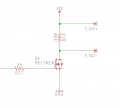
Screen Shot 2018-11-22 at 19.42.44.png

VCC : 12v

I want to power this transistor with 2.5v as max voltage that i can provide because it is a PMW signal.
Thanks in advance.
 

AlbertHall

Joined Jun 4, 2014
12,625
Which MOSFET are you actually using?
The BSS138L, from the datasheet, has a resistance of 10Ω maximum at 200mA with a gate source voltage of 2.75V.
 

wayneh

Joined Sep 9, 2010
18,104
... the datasheet the Gate−Source Threshold Voltage is Min 0.85v and the Max is 1.5v and that's what i want...
You may be misunderstanding what that spec means: It means the max threshold voltage is 1.5V. That doesn't mean the MOSFET will be full conducting at 1.5V, it means it is just starting to conduct. It will not be fully on (below 2Ω) until the gate reaches about 4V or so.
 

Thread Starter

hakraf

Joined Jun 29, 2018
11
You may be misunderstanding what that spec means: It means the max threshold voltage is 1.5V. That doesn't mean the MOSFET will be full conducting at 1.5V, it means it is just starting to conduct. It will not be fully on (below 2Ω) until the gate reaches about 4V or so.
I am understood now, thanks for explanation, so my question now is there some transistor or something i can do to achieve full conducting at 2.5v as maximum voltage at the gate?
 

wayneh

Joined Sep 9, 2010
18,104
I am understood now, thanks for explanation, so my question now is there some transistor or something i can do to achieve full conducting at 2.5v as maximum voltage at the gate?
You might use a BJT to drive the gate of the MOSFET. The BJT turns fully on at 0.7V. The MOSFET is still useful to avoid the BJT’s base current requirement if you are switching a “big” load. If the load is small, you might just use BJT alone.
 

cmartinez

Joined Jan 17, 2007
8,759
Hi,
I'm new with you here and this my first thread, and i'm beginner in electronics, i'm doing some works and tests, i used a transistor mosfet BSS138L as a switch to power an relay, after reading the datasheet the Gate−Source Threshold Voltage is Min 0.85v and the Max is 1.5v and that's what i want, but when i try to power it, it need 3v to achieve the voltage i want (VDS)
this is the circuit schematic

View attachment 164276

VCC : 12v

I want to power this transistor with 2.5v as max voltage that i can provide because it is a PMW signal.
Thanks in advance.

You don't need a 1k resistor (R17) at the mosfet's gate, since mosfets are voltage-driven (unlike transistors, which are current-driven). The mosfet's gate acts like a capacitor, which stops drawing current after it's fully charged. In fact, R17 is actually hindering the way the mosfet works and it would be much better if you were to simply remove it. Sometimes small resistors are used (in the order of 10 to 50 ohms) at a mosfet's gate when the device is switched at high frequencies (about above 100 kHz or so), but they're there to prevent "ringing", which is a phenomenon that results in the gate's false triggering. At low frequencies, a mosfet does not need a gate resistor whatsoever.
 
Top