Help picking new multimeter

Thread Starter

rpschultz

Joined Nov 23, 2022
808
This may not be the best spot for this, but this is where I hang out. I do analog circuit design and built. DIY hobbyist thru hole stuff. Resistors, caps, pots, transistors, diodes, regulators, IC's. I have a 25 year old Radio Shack MM and a couple super cheap ones. The Radio Shack is great most of the time, but it sucks at reading capacitance and diode checking. Thought maybe one designed in this century would be better. Hoping for <$50-100. Many MM's are designed for electricians, high voltage AC stuff, I don't need that. I'm looking for something better for analog DC stuff.

I was looking at some on Amazon. All the Fluke's are SO expensive. This one is on a lot of internet lists.

Amazon.com: AstroAI Digital Multimeter and Analyzer TRMS 6000 Counts Volt Meter Ohmmeter Auto-Ranging Tester; Accurately Measures Voltage Current Resistance Diodes Continuity Duty-Cycle Capacitance Temperature : Electronics
 

WBahn

Joined Mar 31, 2012
32,777
That's probably as good as any in the price range. Most of these meters are actually the same meter rebranded, so there's not a lot to choose from between them. For hobby-type stuff, it's almost certainly adequate. Don't expect high quality, or expect it to last as long as that decades-old Microntra (Radio Shack) has, but for that price it's hard to go too wrong. Having said that, you can find similar meters (probably not True-RMS) for half that price with similar specs and quality.
 

Thread Starter

rpschultz

Joined Nov 23, 2022
808
Is True-RMS needed for DC volts? And measuring components?

Also, how important is the counts? 4000? 6000? 10,000? My Radio Shack is a 22-168A, says it's 3.5 digits, is that 3500 counts? Just getting one with auto-range will be SO nice not to have to change the selector every 15 seconds.

1705953752075.png
 

Reloadron

Joined Jan 15, 2015
7,881
Is True-RMS needed for DC volts? And measuring components?
Not at all. True RMS really only comes into play when measuring AC waveforms other than a nice clean sine wave. Years ago you paid a premium for a true RMS DMM but today they are common and only the really inexpensive meters are Average Responding RMS Indicating.

Also, how important is the counts? 4000? 6000? 10,000?
Simply put if we remove the decimal points from ranges what you see is the count. Just as an example if a DMM has a 20 VDC range and counts of 1999 the highest number we can display is 19.99 VDC.

Hand held DMMs have come a long way in what they can measure and the accuracy they have.

Ron
 

Thread Starter

rpschultz

Joined Nov 23, 2022
808
The year was 1997. Just graduated college with a BSME degree. Had no wife and family, just me. That paycheck was huge. I splurged on a $100 multimeter to begin dabbling in hobby electronics. Honestly it still works great for what it is.
 

Thread Starter

rpschultz

Joined Nov 23, 2022
808
I've also have a Fluke 87. How does it compare with the Radio Shack or AstroAI discussed for analog stuff? I honesly haven't used it much.
 

WBahn

Joined Mar 31, 2012
32,777
Is True-RMS needed for DC volts? And measuring components?

Also, how important is the counts? 4000? 6000? 10,000? My Radio Shack is a 22-168A, says it's 3.5 digits, is that 3500 counts? Just getting one with auto-range will be SO nice not to have to change the selector every 15 seconds.
True-RMS is not needed at all for DC measurements. It's needed for non-sinusoidal AC waveforms (or waveforms with a DC offset). There are frequency limits that have to be taken into account in order to rely on the results. I've never needed to make a measurement for which I needed a True-RMS meter (which is not to say that I wouldn't have still liked to have it). In any situation where that would have been needed, I wanted to see an actual scope trace.

3.5 digits is a bit ambiguous as different manufacturer's throw it around meaning different things. Usually, it meant (means?) three full digits plus a leading 1 (since that doesn't involve many display segments), so the max reading would be 1999 (with a decimal point in there somewhere), so 2000 counts. In practice, especially at the hobby level, you will almost never need to know a value to much better than 1%, so 2000 counts is more than sufficient. And more counts doesn't mean more accuracy -- just that a result is displayed to a higher level of resolution regardless of whether the additional digits are meaningful -- need to look at the accuracy specs of the meter to see if those digits mean anything.

If you get an autoranging meter, be sure that you have the ability to override it and force it onto a range. A common problem with autoranging meters is (or at least used to be) that they would get stuck switching back and forth between two ranges and you couldn't get a result at all.
 

WBahn

Joined Mar 31, 2012
32,777
The year was 1997. Just graduated college with a BSME degree. Had no wife and family, just me. That paycheck was huge. I splurged on a $100 multimeter to begin dabbling in hobby electronics. Honestly it still works great for what it is.
My first digital meter was a Radio Shack (Micronta) bought in 1987 and it is still my goto meter. It was $79 IIRC. It has been SERIOUSLY abused, too -- so it owes me absolutely nothing!
 

WBahn

Joined Mar 31, 2012
32,777
I've also have a Fluke 87. How does it compare with the Radio Shack or AstroAI discussed for analog stuff? I honesly haven't used it much.
Probably depends on how old it is. Fluke used to be pretty-much the gold standard in handheld meters and the Fluke 87 was perhaps the most common. Like so many brands, their quality has declined markedly over the years.
 

SamR

Joined Mar 19, 2019
5,476
For bench use, a nicely used Fluke 8050A can be found for ~$40. The cheapo Aneng AN870 "Fluke Killer" is less than $30. Anything more is gonna cost a bit more. I have both an Aneng AN870 and AstroAI AM33D that stay in the drawer along with a Fluke 27. One thing though, almost any Chinese item on Amazon can be had for less by shopping at Ali Express although you have to wait far longer for it to arrive. What you buy with a handheld Fluke meter is Industrial Toughness. Designed to be dropped and abused day after day and come out still working. Also, it's not the counts that matter as much as how fast the meter can resolve and display a value. Some of the chinessium meters are very slow in that regard although the two I have are pretty decent and the little AstroAI is not autoranging so it doesn't have to waste time "thinking" about what range to use and display.
 

R!f@@

Joined Apr 2, 2009
10,004
I would buy a Fluke any day.
They are faster and far more reliable
Costs more but in the long run, it beats all that I came across
 

Ian0

Joined Aug 7, 2020
13,117
The year was 1997. Just graduated college with a BSME degree. Had no wife and family, just me. That paycheck was huge. I splurged on a $100 multimeter to begin dabbling in hobby electronics. Honestly it still works great for what it is.
The year was 1985. Working as a student before starting my degree. I bought a Fluke multimeter with my first paycheck.
I finally retired it in 2022 after 37 years of service (still going, but a few segments of the display not working) I tested it against a calibrated FLuke and it was still in calibration, and its last calibration certificate was 25 years out of date.
Buy the Fluke, it will cost you less in the long run.
 

Chonetage

Joined May 7, 2024
2
Old faithfuls like your Radio Shack MM can sometimes fall short on certain functions. For analog circuit design and DIY hobbyist work, you're right to seek something more up-to-date.
 
Old faithfuls like your Radio Shack MM can sometimes fall short on certain functions. For analog circuit design and DIY hobbyist work, you're right to seek something more up-to-date.
You're spot on about the Flukes being on the pricier side. For your budget, there are definitely options out there. I recently stumbled upon a catalog packed with different Multimeters, and I've been weighing my options too.
From what I've seen, the market's flooded with choices, but not all of them are tailored to our needs. It's a bit of a maze, but I've got my eye on a few contenders. Personally, I'm leaning towards one that strikes a balance between functionality and affordability.
 

panic mode

Joined Oct 10, 2011
4,947
for electronics at home any DMM will do, even the cheap ones. just try it out or check online review before choosing one to make sure it does what you expect...

things i like is speedy response. i am just not patient enough for wait for slow DMM. some of the cheap products are slow as molasses, specially if one uses auto-ranging. in fact i prefer manual ranging as i know what to expect. another thing that is a must for me is a nice and loud continuity tester, something that can be used even in a noisy place. i also insist on one that does not need new battery every couple of months. And the measurements must be reliable even with low battery.

if you have a budget for Fluke, go for it. Flukes are nice (used to be really nice) and have a lot of accessories.
though they are pricey and rather limited when it comes to features.
 

MisterBill2

Joined Jan 23, 2018
27,362
This may not be the best spot for this, but this is where I hang out. I do analog circuit design and built. DIY hobbyist thru hole stuff. Resistors, caps, pots, transistors, diodes, regulators, IC's. I have a 25 year old Radio Shack MM and a couple super cheap ones. The Radio Shack is great most of the time, but it sucks at reading capacitance and diode checking. Thought maybe one designed in this century would be better. Hoping for <$50-100. Many MM's are designed for electricians, high voltage AC stuff, I don't need that. I'm looking for something better for analog DC stuff.

I was looking at some on Amazon. All the Fluke's are SO expensive. This one is on a lot of internet lists.

Amazon.com: AstroAI Digital Multimeter and Analyzer TRMS 6000 Counts Volt Meter Ohmmeter Auto-Ranging Tester; Accurately Measures Voltage Current Resistance Diodes Continuity Duty-Cycle Capacitance Temperature : Electronics
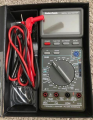
I still use the $30 (at the time of purchase in 1969) analog multimeter . It only reads voltage, current, and resistance. I have not found a need to measure capacitance with a portable meter yet, in all of these years.
I do have a couple of digital multimeters that include a diode-check function that is very useful. Also frequency counters, which are very useful on occasions. The frequency counters are used units purchased for much less than the new price.
Probably the Harbor Freight digital meter will be the best quality NEW meter for the price.
Reading actual RMS AC voltages is seldom a hobby level requirement unless you are trying to determine distortion in a signal.
 
Top