Wow, thats a lot of feedback!
First thank you to all the people here, i am not familiar at all with transistor based amps at all
I had succesufully build the #5 amp and it works just fine, the bass respone is "good" (starts at ~45Hz ), i used a giant heatsink for Q2 and 3 10W 10ohm resistors in parallel with a "cooling system" (myself blowing air with a Hand Fan).
This proyect is just a demostration of BJT-Transistor based AMP, its not for daily use or something like that.
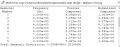
I need a bit more of feedback, when i use my phone as the input(music), in the new desing the volume is kinda limited, i measured succesfully up to 1.5-2Vpp of output from it, but the volume from the function generator set at 1vpp is way higher
And another:
It's a Marleys Amp (invented apparently by someone named Marley).
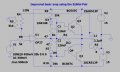
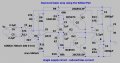
It uses a bootstrap boost to increase the positive output peak voltage, and a transistor PNP differential amp for AC negative feedback to reduce distortion, and DC feedback to stabilize the DC output bias point.
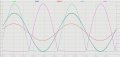
The output total harmonic distortion is fairly low.
The big "benefit" of DC coupling and feedback in an audio amplifier is that a failure of the input transistor can usually destroy one or both output transistors, and any component drift can throw the whole thing off. WE have a recent thread of chasing through a DC coupled amp attempting to locate the failed component. I think it was finally located but it took a whole lot of analysis and comparison with the working channel to eventually find the failed part, I think.
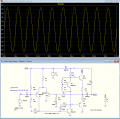
Crossover distortion was not removed until the amplifier in post #20, which had four diodes developing enough base bias on the output stages to keep them in conduction to prevent the crossover distortion. That works because at very low levels, (crossing over zero), the amplifiers are working class "A", while for slightly higher signal levels they run class "B". Amazingly enough, that is why they are called class AB.
That's certainly possible if the power is applied with a V+ switch, rather than turning on the the AC-DC supply which would bring the voltage up more slowly.
If it's the former, a few ohm resistor in series with the diode should prevent it from blowing.
Edit: Using a 1N4001 in place of the 1N4148 should eliminate that as a possible problem since the 1N4001 has a much higher current surge rating.
That's certainly possible if the power is applied with a V+ switch, rather than turning on the the AC-DC supply which would bring the voltage up more slowly.
If it's the former, a few ohm resistor in series with the diode should prevent it from blowing.
Edit: Using a 1N4001 in place of the 1N4148 should eliminate that as a possible problem since the 1N4001 has a much higher current surge rating.
Certainly C is correct about power. Real world power supplies ramp up the output voltage over more than one mains cycle and do it is not instant. And I also think that a 1N4001 diode makes far more sense because of it's current carrying ability. There certainly is a place for signal diodes, and power circuits is not it,

 Facebook
 Google
 GitHub
 Linkedin