Help about varible constant current

Thread Starter

Dzoro

Joined Feb 1, 2019
194
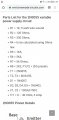
So i found this varible voltage power supply
https://www.homemade-circuits.com/how-to-make-versatile-variable-voltage/#comment-66340 and i built it and it works but the constant current in that circuit works just when overload is sensed by transistor 3 and i want varible constant current at any time at any voltage so can someone please give me some circuit that i can hook up at the output and have varible constant curent.Thanks

Dzoro
 

Alec_t

Joined Sep 17, 2013
15,119
The circuit in the link is a voltage regulator, not a constant-current source. There are plenty of constant-current circuit schematics on the web, which a bit of googling should reveal. Some should be suitable as add-ons for the regulator.
 

Thread Starter

Dzoro

Joined Feb 1, 2019
194

crutschow

Joined Mar 14, 2008
38,506
What's the supply voltage?
Over what range do you want the current to be adjusted?
If you want to go all the way to zero, it becomes more complicated.
 

Thread Starter

Dzoro

Joined Feb 1, 2019
194
What's the supply voltage?
Over what range do you want the current to be adjusted?
If you want to go all the way to zero, it becomes more complicated.
The supply voltage is 25 volts and the range of the current i want is from 100 ma to the max of my psu which is around 3.5-4 A and if it can go to zero than that is what i am going for no mather the difficulty.

Dzoro.
 
Last edited:

crutschow

Joined Mar 14, 2008
38,506
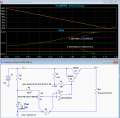
Below is the LTspice simulation of a current limit circuit you can add to your power supply circuit.
It allows adjustment from essentially zero (7mA in the simulation) to the maximum of 4.4A for the component values shown.
It uses a power-on LED, D1, to provide a voltage reference for the constant-current.
R2 can be tweaked to get the maximum current-limit you want.
D1 and shunt R6 should be connected to the left side of the circuit next to the supply negative.

With this the current limit circuit consisting of Q5 and R5 are not needed.

As you can see, the load current is constant once it reaches the set limit as determined by pot U2 (shown for wiper set points of 0%, 10% 25%, 50%, and 100%).

upload_2019-4-7_16-4-53.png
 
Last edited:

Thread Starter

Dzoro

Joined Feb 1, 2019
194
Below is the LTspice simulation of a current limit circuit you can add to your power supply circuit.
It allows adjustment from essentially zero (7mA in the simulation) to the maximum of 4.4A for the component values shown.
It uses a power-on LED, D1, to provide a voltage reference for the constant-current.
R2 can be tweaked to get the maximum current-limit you want.
D1 and shunt R6 should be connected to the left side of the circuit next to the supply negative.

As you can see, the load current is constant once it reaches the set limit as determined by pot U2 (shown for wiper set points of 0%, 10% 25%, 50%, and 100%).

View attachment 174431
It's realy simple but can i use lm358 in place of 339/393 and also can i use different transistor in place of 2n3055.
One more question for that point that says to q2 does that mean that that point is needed to conect to the transistor 2n2222 or that is just like how it is.

Dzoro.
 

crutschow

Joined Mar 14, 2008
38,506
It's realy simple but can i use lm358 in place of 339/393 and also can i use different transistor in place of 2n3055
For fastest response time to a short, you should stick with the 339/393 comparator.
The slower response of the lm358 will put more stress on the output transistor(s) during a sudden short.

Any transistor that will carry the desired current and voltage should be okay.
 

Thread Starter

Dzoro

Joined Feb 1, 2019
194
For fastest response time to a short, you should stick with the 339/393 comparator.
The slower response of the lm358 will put more stress on the output transistor(s) during a sudden short.

Any transistor that will carry the desired current and voltage should be okay.
Thanks but the joint that says to q2 what should i do with it
 

crutschow

Joined Mar 14, 2008
38,506
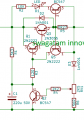
Goes to the collector of Q2 in the circuit below (or whatever your designation is for that transistor).
(R1 and R3 are the same resistor in both circuits).

upload_2019-4-7_16-35-41.png
 
Last edited:

crutschow

Joined Mar 14, 2008
38,506
That circuit doesn't provide enough drive to get 4A at the output, which is why you need to add the 2N2222 as I show, to make a Darlington.

Note that the power dissipated in the 2N3055 with a 4A short to ground will be 100W :eek:, so it needs to be on a healthy heat-sink.
 

Thread Starter

Dzoro

Joined Feb 1, 2019
194
That circuit doesn't provide enough drive to get 4A at the output, which is why you need to add the 2N2222 as I show, to make a Darlington.

Note that the power dissipated in the 2N3055 with a 4A short to ground will be 100W :eek:, so it needs to be on a healthy heat-sink.

But
That circuit doesn't provide enough drive to get 4A at the output, which is why you need to add the 2N2222 as I show, to make a Darlington.

Note that the power dissipated in the 2N3055 with a 4A short to ground will be 100W :eek:, so it needs to be on a healthy heat-sink.
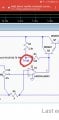
I have made the darlington pair with 2 2n3055 but what do i do with this20190408_020228.jpg
 

crutschow

Joined Mar 14, 2008
38,506
I have made the darlington pair with 2 2n3055 but what do i do with thisView attachment 174438
I explained that in post #10.

But I have noted an oscillation in my simulation due to the U1 comparator not be being compensated.
So change that to the LM358 as you suggested, since that is an op amp, compensated to prevent the oscillation.
It's response should still be fast enough to protect the output transistor.
 
Last edited:

Thread Starter

Dzoro

Joined Feb 1, 2019
194
I explained that in post #10.

But I have noted an oscillation in my simulation due to the U1 comparator not be being compensated.
So change that to the LM358 as you suggested, since that is an op amp, compensated to prevent the oscillation.
It's response should still fast enough to protect the output transistor.[/QUOTE
I explained that in post #10.

But I have noted an oscillation in my simulation due to the U1 comparator not be being compensated.
So change that to the LM358 as you suggested, since that is an op amp, compensated to prevent the oscillation.
It's response should still fast enough to protect the output transistor.
So that is awsome beacose i have lm358 and i don't have lm339 or 393 and also i understand where to put that pin so thanks for the circuit.
Tomorow i will built the circuit and give you a feedback if it is working or not.Thanks a lot.

Dzoro.
 

crutschow

Joined Mar 14, 2008
38,506
Sorry, I just found another glitch. :oops:
The LM358 doesn't pull the output to all the way to zero when the output is shorted, so the current is not limited under those conditions.
Went back to the LM339 with a feedback capacitor and resistor (C2, R7) to stabilize it, as shown below.

upload_2019-4-7_18-20-21.png

Edit: R5 is a 2W resistor.
 
Last edited:

Thread Starter

Dzoro

Joined Feb 1, 2019
194
Could you be a little more specific? :rolleyes:
Post the schematic of the complete circuit you built.
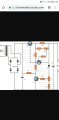
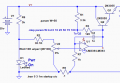
I built this circuitScreenshot_20190408-181312_Chrome.jpgand it's not working and no mather how much i increse the voltage on the output of the circuit is giveing 12 volts and when i conect load to it the led is turning off and there is no current flowing.

And one thing i don't understand is the darlington 2n3055 transistors are they another 2 or those are the ones in the voltage regulator circuit,beacose i built the circuit on bredboard with another 2 transistors
 

crutschow

Joined Mar 14, 2008
38,506
I built this circuit and it's not working and no mather how much i increse the voltage on the output of the circuit is giveing 12 volts and when i conect load to it the led is turning off and there is no current flowing.
If you are referring to just my circuit, yes, the output will be essentially equal to the supply voltage until, the current limit is reached.
Where do you have the current pot set?
If it's set at zero, you will have zero output current.
And one thing i don't understand is the darlington 2n3055 transistors are they another 2 or those are the ones in the voltage regulator circuit,beacose i built the circuit on bredboard with another 2 transistors
No they are not additional transistors.
They are the ones in the voltage regulator circuit.
Sorry I didn't make that clear.
 
Top