Heavy induced interference Suppression techniques?

Thread Starter

Dodgy Geezer

Joined Nov 30, 2009
181
I am a (very!) occasional visitor to this forum - my main interest is in model boating and in particular a specific field-wound model boat motor called the 'Taycol'. This site has, however, enabled me to develop a very sucessful reversing circuit for this motor range, and I'm wondering if it can help with another major problem with operating these motors - that of very heavy interference.

All brushed electric motors spark, and that causes RFI in the 27Mhz range, which used to be the approved frequency for model control. Consequentally, all electric motors on models are usually suppresed with a 0.1-0.2 mfd ceramic either across the brushes or between brushes and case. This seems to work for the majority of canned motors, but seems hopelessly inadequate for the Taycol series.

Taycols are open frame motors with 'agricultural' brushwork, and the field windings seem to produce induced currents all over the place. Uniquely amongst motors, Taycol brushes are required to run in oil; which may limit sparking, but which is rarely maintained, so that a typical surviving vintage Taycol will have poor worn brushes. The brush gaps are large anyway, and so I suspect that HF induced pulses would flow down the power input cables even for a new motor.

The RFI issue seems to be less important now that everyone uses 2.4GHz for a control frequence, but the interference carried by the power wireing plays merry hell with modern electronics. Radio Control motors are usually controlled by an Elextronic Speed Controller (ESC) which takes the place of a servo, and usually has a Battery Eliminator Circuit (BEC) built in so that the receiver and all other radio electronics are driven from this central source. When that source is swamped with interference, the radio system fails to function completely.

The usual suppression techniques for this problem involve caps across the brushes (not much use if the problem is induced pulses from the commutator switching), frame earthing (of limited use on a model boat) and RF chokes/ferrite beads in the power lines to absorb RF peaks. These do not cut the mustard! So I am wondering if there are any other specialist techniques which might be used to address the problem? Feeding the rest of the electronics through a separate battery is one approach, but the ESC still has to be attached to the motor and the receiver, providing a path for the pulses.

Are there any out-of-the-box ideas that I can try?
 
Last edited:

DickCappels

Joined Aug 21, 2008
10,661
Your first step should be to figure out how the interference gets from the motor to the circuit being interfered with (the RC receiver?).

It is either radiated through space or conducted through the wiring.

For radiated interference, your best bet is to shield the motor assembly. Alternatively, you can try putting loops of wire (shorted turns if you will) around the motor to generate counter emf - to keep the interference from getting past the shorted turns.

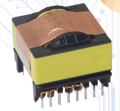
Notice the copper tape around the transformer in the photo below. It provides shielding against radiated magnetic fields. It electric fields are also a problem the copper tape can be grounded for some (but not great) help.
1743080794206.png

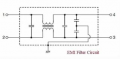
For electric fields getting into your receiver you might want to add some filtering to the wire going to the motor. This EMI filter (below) is a good example).
1743080994628.png

I find that sometimes it is enough to just clamp a ferrite bead to the power lead and ground return to the motor such as illustrated with the "transformer" in the schematic above. Sometimes I have to add a series inductor between the motor and the filter.

It is just a matter of experimenting to find the minimum mass solution that provides acceptable results.
 

nsaspook

Joined Aug 27, 2009
16,250

Pretty neat but, Yes, a EMI/RFI nightmare.

Building a fully shielded enclosure with EMI filtered power terminals connected to shielded power cable (with filters at the power connection end) is the best bet. Start at the source for the best possible reduction and then work the remaining noise down in steps. Nothing will be out of the box for that vintage setup.
 

crutschow

Joined Mar 14, 2008
38,316
A common-mode choke connected directly to the motor right after the capacitor, as well as a larger capacitor may also help.
 

Thread Starter

Dodgy Geezer

Joined Nov 30, 2009
181
Thanks, everybody, for the responses!

The problem is almost certainly coming through the motor leads. 27MHz radios were susceptible to Motor RFI, but you can run a 2.4GHz radio next to a working Taycol with no problems. The issue comes when you plug in the ESC. A radio can be run on seperate batteries, but to control the ESC you must have at least a ground and a signal connection. This is just as well, as vintage modellers like to show off the solid brass, copper and paxolin the motors are made of.

I will experiment with commercial EMI filters to see if there's a simple answer...

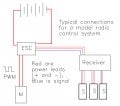
TAYDRAW.jpg
 

Hymie

Joined Mar 30, 2018
1,347
You might think the larger the capacitor the better; after all (in theory) any voltage spikes would have to have the energy to charge the large value capacitance.

But often a small value capacitor (say 10nF) can reduce high frequency noise much better than a large value capacitor (due to the parasitic effects [resistance/inductance etc]) reducing the efficacy of the larger capacitor.
 

nsaspook

Joined Aug 27, 2009
16,250
Thanks, everybody, for the responses!

The problem is almost certainly coming through the motor leads. 27MHz radios were susceptible to Motor RFI, but you can run a 2.4GHz radio next to a working Taycol with no problems. The issue comes when you plug in the ESC. A radio can be run on seperate batteries, but to control the ESC you must have at least a ground and a signal connection. This is just as well, as vintage modellers like to show off the solid brass, copper and paxolin the motors are made of.

I will experiment with commercial EMI filters to see if there's a simple answer...

View attachment 345508
That nice motor sound is from abrupt flux changes in the rotor and stator causing the entire frame to vibrate. Those same abrupt flux changes are also generating magnetic induction fields that can't easily be cured with just terminal filters (to reduce conducted noise) because the source is the motor coils and leaky flux paths inside the motor frame are blasting EMI/RFI radiated energy too at high levels.

Does this affect the other modelers boat controllers near yours that use normal ESC controllers with regular brushless or brushed motors or does it only affect your model boat?
 

Thread Starter

Dodgy Geezer

Joined Nov 30, 2009
181
Does this affect the other modelers boat controllers near yours that use normal ESC controllers with regular brushless or brushed motors or does it only affect your model boat?

No - amd it does not affect my radio if the radio has no physical connection to the motor power leads' If the radio is placed next to a running motor - no problem. It is only if the radio is connected to the motor via the ESC that the problem arises, so I guess that the issue is EMI down the power leads.

If we assume that a motor is doing an average 5000 RPM, that means that there are going to be 5000 x 3 breaks in the commutator current. But worse - the ESC will provide a PWM signal of, let us say, 10k Hz, so the field coil is being energised and collapsed at that frequency, which must put some quite heavy induction transient spikes back down the power leads.

A Taycol is series wound, and I don't want to change that. But you can see the complexity of trying to get modern logic circuits working with 1950s machinery....
 

schmitt trigger

Joined Jul 12, 2010
2,027
EMI comes in two flavors: radiated and conducted.
For the first, use a metallic shield as suggested by Dick. Aluminum is easy to work with, inexpensive and lightweight.
For the conducted, use a CM choke and capacitors as suggested in the choke’s datasheet. Tightly twist together the supply leads.
 

nsaspook

Joined Aug 27, 2009
16,250
Does this affect the other modelers boat controllers near yours that use normal ESC controllers with regular brushless or brushed motors or does it only affect your model boat?

No - amd it does not affect my radio if the radio has no physical connection to the motor power leads' If the radio is placed next to a running motor - no problem. It is only if the radio is connected to the motor via the ESC that the problem arises, so I guess that the issue is EMI down the power leads.

If we assume that a motor is doing an average 5000 RPM, that means that there are going to be 5000 x 3 breaks in the commutator current. But worse - the ESC will provide a PWM signal of, let us say, 10k Hz, so the field coil is being energised and collapsed at that frequency, which must put some quite heavy induction transient spikes back down the power leads.

A Taycol is series wound, and I don't want to change that. But you can see the complexity of trying to get modern logic circuits working with 1950s machinery....
What exact model of ESC are you using? It sounds more like the ESC is the generator of your radio problems than the motor. Have you tried shielding the ESC and adding filtering the ESC power leads, motor leads and the PWM control signals that come from the radio? The motor drive currents (high peaks and abrupt changes) might be causing excessive EMI/RFI generation from the motor controller.
 

LowQCab

Joined Nov 6, 2012
5,101
"ESC" is being used as a generic term.
ESCs for 3-Phase-Motors, and ESCs for DC-Motors, are totally different animals.

An ESC for a DC-Motor is quite likely to have a PWM-Output, similar to a Buck-Converter,
and it may be running at a ridiculously High-Frequency for better Efficiency, and smaller physical-size.
It's possible that additional Filtering close to the ESC may be of some benefit,
in addition to extra Filtering near the Motor.

It may also be beneficial to place small Capacitors directly across the Brushes of the Motor,
rather than the "Motor-Leads".
If the Rotor-Windings are accessible, I would even suggest trying to place 3-small Capacitors
directly across the 3-Windings, using Epoxy to keep them in place.

Electrolytic-Capacitors could be of little or no use for controlling very High-Frequencies,
it's possible that they could even make conditions worse.
Stick with Ceramic-Capacitors.
.
.
.
 

Thread Starter

Dodgy Geezer

Joined Nov 30, 2009
181
What exact model of ESC are you using? It sounds more like the ESC is the generator of your radio problems than the motor. Have you tried shielding the ESC and adding filtering the ESC power leads, motor leads and the PWM control signals that come from the radio? The motor drive currents (high peaks and abrupt changes) might be causing excessive EMI/RFI generation from the motor controller.

Typically cheap Chinese - Simon is a name I have sometimes found on the unit. But mostly it just says 30A ...

I have no problems with these ESCs running brushless or small brushed motors - typically Johnson cans. The only problems I get are with Taycols, so that would appear to be the source. Taycols are often reported to be difficult to suppress, so I was looking for an over-the-top solution which would handle extreme EMI...
 

nsaspook

Joined Aug 27, 2009
16,250
What exact model of ESC are you using? It sounds more like the ESC is the generator of your radio problems than the motor. Have you tried shielding the ESC and adding filtering the ESC power leads, motor leads and the PWM control signals that come from the radio? The motor drive currents (high peaks and abrupt changes) might be causing excessive EMI/RFI generation from the motor controller.

Typically cheap Chinese - Simon is a name I have sometimes found on the unit. But mostly it just says 30A ...

I have no problems with these ESCs running brushless or small brushed motors - typically Johnson cans. The only problems I get are with Taycols, so that would appear to be the source. Taycols are often reported to be difficult to suppress, so I was looking for an over-the-top solution which would handle extreme EMI...
The Taycols likely have current drive requirements that the cheap PWM brushed motor ESC is barfing (causing EMI) on. The Taycol is the trigger but likely not the root cause of the EMI. The ESC you are using was likely designed (I use that word loosely for the cheap Chinese models) for typical and expected loads.
https://emaxmodel.com/collections/simon-series-esc
https://www.electroschematics.com/brushed-esc/

I would love to see oscope shots of the current (across a low side shunt resistor) and voltage waveforms at the motor terminal and at the ESC outputs.
 

MisterBill2

Joined Jan 23, 2018
27,164
An Interesting problem indeed. I suggest using a BIFILAR filter choke of adequate wire size for the motor current. This would be in series with both power leads directly out of the motor. Probably a ferrite core to improve the higher frequency blocking. Also shielding of both the motor power wires and also the speed controller wires back to the radio. In addition, a separate battery pack to keep motor noise away from the radio system. Shielding the control wires should work. Those shields would tie to the common of the control section power source.
"Grounding" in a boat without a metal hull is meaningless.
 

MaxHeadRoom

Joined Jul 18, 2013
30,557
It is a very crude form of series field motor, the fact that the ;brushes' are copper braid does not help[ matters.
Vintage, so made before the advent of modern electronics.!
 

MisterBill2

Joined Jan 23, 2018
27,164
REALLY, unless the goal is to restore a classic item, there is undoubtedly a more modern permanent magnet motor that will deliver much more torque at whatever RPM with greater efficiency and much less noise.
 

nsaspook

Joined Aug 27, 2009
16,250
@MaxHeadRoom would sprinkling a little graphite powder (as used to lubricate locks) onto the brushes help the situation?
That sparking is mainly caused by over and under commutation (if we assume the brushes and contact surfaces are clean and working) where the reversing currents have not completely stopped before the brushes move off the coil contacts, causing the residual coil magnetic energy to transform to high voltage electric field energy, breaking down the air and jumping the gap to dissipate that energy.
The sparks usually happens at the gaps.

The graphite powder IMO will just burn and make a mess.

 
Last edited:

MisterBill2

Joined Jan 23, 2018
27,164
I agree with "n", that graphite powder will certainly make a mess and not help. THAT is part of why taking care of a brushed motor includes cleaning off the carbon dust.
 
Top