Heat transfer questions

Thread Starter

PsySc0rpi0n

Joined Mar 4, 2014
1,786
htc is the heat transfer coefficient. It is 1/Rt.
Q_in should be W. I think the auto-complete feature of excel was trying to help me again.
Ok, tat's actually a nice table.
You used time with which goal? The same as mine? Trying to figure out how much time to heat up initially the room?
I think I'm ignoring that part for now, after discussions with @MrAl.
 

hrs

Joined Jun 13, 2014
530
The first column assumes the temperature differential increases in steps of 1 K.
The second column calculates the heat flux out of the box. Q_out = htc * A * dT.
The third column calculates the heat flux that is left to heat the box. dQ = Q_in - Q_out.
The fourth column calculates the time needed the heat the box by 1 K. dt = Cp*m/dQ. The sum of this column is the total time.
The fifth column calculates the heat lost in each time step. The sum of this column is the total heat lost.
 

MrAl

Joined Jun 17, 2014
13,702
Hello again,

I am not sure how much this will help because it's just one kind of analogy.
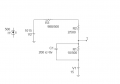
I went with the standard setup for this instead of a short cut using a current source. That may show a bit more to this but may also confuse. The temperature of the coil of the space heater (assuming it is that type) is shown as 1015 degrees and that is sort of a very rough estimate of that temperature, but it is not that important to get the perfect for this.
Shown in the diagram is R1 which would be the room, and R2 the losses. Unfortunately, in this analogy we can only show the temperature loss not the energy loss. The loss is 2 degrees at 500 watts, which puts it at 0.004 degrees C per watt.
The room is shown to require 500 watts at 10 degrees rise, which is 0.020 degrees per watt. That means to go from 15 degrees to 25 degrees we needed 500 watts.
C thermal capacitance. That has to 'charge' up in order to get to the final temperature shown as 25 degrees.
The resistance R3 is fictitious, that is just to show how the equilibrium works out. In reality, this would be a switched system where R3 is replaced with a smaller value and a switch and the switch of course would shut off at 25 degrees C. The difference that would make is that the room would actually heat up faster because we would be overdriving it.

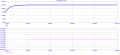
The plot shows the way the room temperature changes. It's an exponential curve, but then levels off at 25 degrees C.
The time constant (around 4 seconds or 4 minutes or 4 hours, etc.) is due to the cap and the thermal resistance values. After 20 units of time (five time constants) the room is almost at the final temperature.

What this analogy does not show is the watts lost, but this analogy is not really for that it's equivalent to something like a heat sink where we just need the final temperature. That's like a room being heated anyway except with a heatsink on say a transistor we do not usually want to regulate the temperature of the heat sink using an on/off PWM we just want to get rid of that heat as best as possible.

Oh, BTW, the current is set to be 500 amps, which is analogous to 500 watts. The current source shown to the right could be used instead of the voltage source of 1015 degrees.
The voltage source V1 has its voltage set at 15 volts for the initial temperature of 15 degrees C.
"T" is the temperature of the room.

A better analogy would be a buck circuit where the switch opens and closes to regulate the output voltage (temperature). That would mean the temperature of the room would ramp up and down slightly after the initial heating.
 

Attachments

Thread Starter

PsySc0rpi0n

Joined Mar 4, 2014
1,786
Ok, I think I get the point of the analogy. This seems exactly the same as the characteristic curve of a charging capacitor!

But my goal here is rather to, not exactly understand the values I'm getting out of my calculations, but to try to make sense of them to see if I would be getting close to a real scenario. I'm expecting to run some testing in a near future and I wanted to see if my calcs were anywhere near the real case scenario.

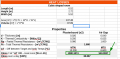
I mean, for instance, in my spreadsheet, I have calculated the initial energy needed to heat up the space in kWh, dividing the sum of the two values above by 3.6MJ.
1713951541924.png

Then, I calculated te heat losses in Watts

1713951652049.png

Then and as you suggested, I subtracted these losses to the rated power of the heating device.
The 880W you see in the screenshot below is the (2500W - Losses) from the screenshot above.
1713951804429.png

1713951719524.png

I'm not paying attention now to the calculation of time, because as you suggested, it's not of big importance, taking into account that the time I run the device and the time needed to heat up the space initaly are very different values, meaning the time to initially heat up the space can be neglected both in terms of time and costs.

Does these values and approach makes sense to you? I mean, I need someone with solid knowledge on this because this is not my field and I will probably have to discuss these values with someone more knowledgeable than me in this field, so I want to take some solid knowledge with me to that discussion... :))

Now, the next step I want to take, is about costs.
If the above approach seems reasonable, I'll be more than happy bcause next step will be only to check how much this energy spending will cost over a day or a month...
 

MrAl

Joined Jun 17, 2014
13,702
Ok, I think I get the point of the analogy. This seems exactly the same as the characteristic curve of a charging capacitor!

But my goal here is rather to, not exactly understand the values I'm getting out of my calculations, but to try to make sense of them to see if I would be getting close to a real scenario. I'm expecting to run some testing in a near future and I wanted to see if my calcs were anywhere near the real case scenario.

I mean, for instance, in my spreadsheet, I have calculated the initial energy needed to heat up the space in kWh, dividing the sum of the two values above by 3.6MJ.
View attachment 320622

Then, I calculated te heat losses in Watts

View attachment 320623

Then and as you suggested, I subtracted these losses to the rated power of the heating device.
The 880W you see in the screenshot below is the (2500W - Losses) from the screenshot above.
View attachment 320625

View attachment 320624

I'm not paying attention now to the calculation of time, because as you suggested, it's not of big importance, taking into account that the time I run the device and the time needed to heat up the space initaly are very different values, meaning the time to initially heat up the space can be neglected both in terms of time and costs.

Does these values and approach makes sense to you? I mean, I need someone with solid knowledge on this because this is not my field and I will probably have to discuss these values with someone more knowledgeable than me in this field, so I want to take some solid knowledge with me to that discussion... :))

Now, the next step I want to take, is about costs.
If the above approach seems reasonable, I'll be more than happy bcause next step will be only to check how much this energy spending will cost over a day or a month...
Hello again,

This is not my area of expertise either, but from what I have seen in the past this is not the way they do it for home heating. They use R values or U values and stuff like that, and established methods for doing these estimates. It becomes a simple matter of knowing what type of insulation is being used and how thick it is, and what the square footage is for each wall and ceiling and possibly floor. This means you should probably check out the procedures you might find on the web and hopefully they will help with a different way of calculating all this.
If it is a critical issue it is always best to check with an expert in the field. You get the years of experience and insights that someone who worked with the stuff has learned, and there are a lot of tricks that come up in various fields that a newcomer would have no idea about.

One thing that is still missing is the air leakage. The cracks in window frames and door frames and under the door will come into play probably in a big way. That would make any estimate without those factors produce a completely way off result. It could go from say $10 a day to $20 a day to heat.

BTW electric space heaters are expensive to run, but if you install permanent electric heaters some electric companies give a break on the electric costs. Well, that was some time ago though not sure who does it anymore or actually if anyone does so you'd have to check with the local electric company. Everything pertaining to energy usage has changed over the years.
 
Top