I'll see your cute little pennies and raise you machined graphite fins.
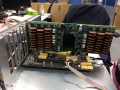
IIRC, diamond has the highest thermal conductivity. We did some high-power, 6U VPX projects with conduction-cooling-to-air, pressed-fin heat exchangers we made in-house. Graphite fins pressed into machined slots in an aluminum plates. The slots had a small bead of thermally-conductive epoxy in them for the fins to squish into. Very close tolerances resulted in very thin epoxy layers. Expensive, but excellent thermal performance thanks to duct covers and screaming fans. The system cooled so well that we were able to change to aluminum fins.
For best radiation the heatsink should be black in the infrared, where most of the heat radiation occurs.
It may not necessarily be black to visible light.
Below shows the emissivity of various Al anodized colors.
Green and red have the highest emissivity by a small factor.
Even clear is not much below the best.
Note how low it is with no anodizing (Plain).
At almost all times, for a given heat sink, forced air will remove more heat energy than natural convection will remove, if the forced air mass flow is greater than the natural convection air flow. Usually that is the case.
At almost all times, for a given heat sink, forced air will remove more heat energy than natural convection will remove, if the forced air mass flow is greater than the natural convection air flow. Usually that is the case.
Oh yes, and there are different air flows too. Faster air flow usually means better cooling, but I think the curve flattens at some point (haven't looked this up in a long time now).
One little side point is that if a design is made to work with a fan included then it is usually part of the thermal system, so if anything goes wrong with the fan, the device will overheat. That would mean a temperature sensor should also be used to check if the fan is running and shut everything down if it stalls. Fans are a sort of weak point of a thermal design, unfortunately, so some care if required. Today we have some nice high reliability fans too which is nice.
Also, the higher the flow rate the higher the cost usually.
I do not think we have talked about surface texture yet.
A heat sink with a very rough surface texture will dissipate heat better than with a smooth surface when there is no active air flow. When there is a fan however, the heat sink dissipation can decrease, and I can only think this is because of some turbulent air flow near the surface due to the uneven surface.
With no fan and a very rough surface, it is no doubt that the surface area increases significantly, and surface area is one of the biggest factors in heat sink dissipation capabilities. If you could double the (effective) surface area, you could almost halve the temperature rise, with no forced air that is and everything else equal.

 Facebook
 Google
 GitHub
 Linkedin