Heat Sinks

Thread Starter

engr_david_ee

Joined Mar 10, 2023
361
I was wondering about the heat sinks that we usually put on the devices that dissipate more heat.

Aluminum heat sink are very common.

But if we look at the thermal conductivity of Aluminum and compare with Copper, Silver and Gold than we get.

Heat Conductivity: Silver>Copper>Gold>Aluminum.

This means that Copper is better then Aluminum. And Silver is better then Copper.

Any reason we can't use Silver as heat sink ?
 

Thread Starter

engr_david_ee

Joined Mar 10, 2023
361
Thanks I get some numbers regarding weights of these metals.

Density of Gold: 19.3 g/cm³
Density of Silver: 10.49 g/cm³
Density of Copper: 8.96 g/cm³
Density of Aluminum: 2.7 g/cm³

How expansive in Silver compared to Aluminum ?

Does it make sense to use Silver heat sink of smaller size on the hot devices and then put Aluminum cold plate on the top of the all the Silver heat sinks ?
 

Beau Schwabe

Joined Nov 7, 2019
186
Another thing to consider is if the Aluminum (or other metal) has been anodized. I had a boss once that physically showed me a bare aluminum heat sink vs. an anodized heat sink in operation. The difference was significant, I couldn't believe how much of a difference there was. .... And black anodized aluminum is better than white anodized aluminum.
 

Ian0

Joined Aug 7, 2020
13,112
How expansive in Silver compared to Aluminum ?
24 × 10 –6/K for Aluminium
19 × 10 –6/K for Silver
Does it make sense to use Silver heat sink of smaller size on the hot devices and then put Aluminum cold plate on the top of the all the Silver heat sinks ?
Heatsinks rely on surface area, not weight, so a silver heatsink would weigh 3.9 times as much as an aluminium heatsink the same size and shape, although the silver heatsink would be 1.7 times as good as a pure metal, but as @Beau Schwabe points out surface finish makes a big difference.
Aluminium costs £2500 per tonne, silver costs £22 per troy ounce (31g) or £709000 per tonne, 284 times as much.
 

Thread Starter

engr_david_ee

Joined Mar 10, 2023
361
We also have used several years ago Anodized Aluminum case/box for the whole instrument in which we have several electronics boards and cables. I don't remember if that was black Anodized Aluminum or white Anodized Aluminum. We did that in the lab.

How is black Anodized Aluminum is better than white Anodized Aluminum ? in terms of thermal conductivity ?
 

Sensacell

Joined Jun 19, 2012
3,778
We also have used several years ago Anodized Aluminum case/box for the whole instrument in which we have several electronics boards and cables. I don't remember if that was black Anodized Aluminum or white Anodized Aluminum. We did that in the lab.

How is black Anodized Aluminum is better than white Anodized Aluminum ? in terms of thermal conductivity ?
Heatsinks lose heat via three mechanisms:

Convection- transfer to air in motion
Radiation - emission of infrared energy - anodizing increases the emissivity, the ability to radiate this energy.
Conduction - direct contact with colder materials.
 

MrAl

Joined Jun 17, 2014
13,680
We also have used several years ago Anodized Aluminum case/box for the whole instrument in which we have several electronics boards and cables. I don't remember if that was black Anodized Aluminum or white Anodized Aluminum. We did that in the lab.

How is black Anodized Aluminum is better than white Anodized Aluminum ? in terms of thermal conductivity ?
Darker colors have better radiant efficacy. How much that actually helps in a real-world application may vary with other conditions.

BTW, there is also forced air cooling which is a little different than natural convection.
 

crutschow

Joined Mar 14, 2008
38,401
For best radiation the heatsink should be black in the infrared, where most of the heat radiation occurs.
It may not necessarily be black to visible light.
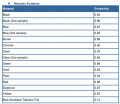
Below shows the emissivity of various Al anodized colors.
Green and red have the highest emissivity by a small factor.
Even clear is not much below the best.
Note how low it is with no anodizing (Plain).

1715172243637.png
 

Ian0

Joined Aug 7, 2020
13,112
It seems weird that adding a coating of Alumina, which is an insulator, improves the emissivity.

Do I remember correctly that it makes much less difference if the heatsink is fan-cooled than if it is in free air?
 

crutschow

Joined Mar 14, 2008
38,401
It seems weird that adding a coating of Alumina, which is an insulator, improves the emissivity.
Emissivity has nothing to do with the electrical conductivity of a material.
For example, some paint coatings have a very high emissivity.
Do I remember correctly that it makes much less difference if the heatsink is fan-cooled than if it is in free air?
Yes.
That's simply because the radiative cooling is not affected by air flow, but it greatly increases convection cooling, so the radiative part becomes a much smaller percentage of the total power dissipated.
 

Ian0

Joined Aug 7, 2020
13,112
Emissivity has nothing to do with the electrical conductivity of a material.
For example, some paint coatings have a very high emissivity.
I suppose a lot depends on the thickness of the coating. If the heat has to flow through a significant thickness of material with poor conductivity before it gets to the surface from which it is emitted as radiation it will reduce its efficacy.

I remember doing some experiments with black powder coated heatsinks, which weren‘t anywhere near as bad as we thought they might be.
(we were dealing with a dim witted metalwork supplier who read “anodised” and thought powder coat would look just as good and cost less)
 

nsaspook

Joined Aug 27, 2009
16,271
At the simple electrical level, the darkness means a broad-band impedance match at the surface structure boundary (metal/air) zone. The impedance is mainly symmetrical at thermal energy frequencies so energy flows (heat) can move both in and out easily. Shiny conductive metallic surface boundaries are impedance mismatched, causing energy reflections both in and out.
 

crutschow

Joined Mar 14, 2008
38,401
Interestingly, for keeping things cool in sunlight you want a surface with high reflectivity (low emissivity) to sunlight including near IR (up to around 1 micron wavelength), and will high emissivity to far IR (around 10 micron wavelength).
The have developed some coatings now that do that quite efficiently, keeping the coating surface below ambient temperature in direct sunlight.
 

hrs

Joined Jun 13, 2014
523
The heat sink material doesn't matter that much as long as it's a 'decent' heat conductor. The bottle neck will be the heat transfer through the air boundary layer at the outer surface of the heat sink.

It is sometimes stated that a black radiator is better than a white radiator. While this is technically true, radiation becomes significant compared to convection at such temperatures that the chip probably is long burnt.

Anodized aluminium is probably worse that non-anodized because likely it insulates more than it helps radiation at reasonable temperatures.
 

crutschow

Joined Mar 14, 2008
38,401
Anodized aluminium is probably worse that non-anodized because likely it insulates more than it helps radiation at reasonable temperatures.
The anodized layer is so thin (≤100µm) that it's thermal resistance would be negligible, so I expect there to be a net reduction in thermal resistance with anodizing due to the much better emissivity.
 

Janis59

Joined Aug 21, 2017
1,894
What good gives the better conductivity if the only existing problem comes from metal to air dissipation factor? Except some very exotic cases like Peltier, where indeed not a power but power density instead makes a problem, but it have a excellent solution namely Heatpipe.
 

jeffkrol

Joined Dec 8, 2015
56
It seems weird that adding a coating of Alumina, which is an insulator, improves the emissivity.

Do I remember correctly that it makes much less difference if the heatsink is fan-cooled than if it is in free air?
No need to use anodized for a fan cooled heat sink. Convection will override radiative cooling

Anodized is radiative, fans are convective.
Anodizing increases the surface area.
Same with a power coat.

Oh and diamond would be the best material for a heatsink .

https://www.msesupplies.com/products/diamond-heat-sink-thermal-conductivity-1500w-m-k

Comparisons.
The thermal conductivity, known as it’s K value, is a measure of how readily temperature will flow through a particular material. It is measured in units of W/m/k. The value for pure copper is 401, for pure silver 406, for nickel 91 and for stainless steels around 16.
Oh and different alloys of Aluminum are different.
Pure being the best but hard to work with.
 
Last edited:
Top