H-Bridge Project Examples

Thread Starter

Woxer

Joined Apr 11, 2025
10
Hello guys, maybe someone has a 12V, 100A H-bridge project they’ve built from scratch and would be willing to share? I’m working on a project with a winch motor up to 80A current at full load and need guidance or examples for designing a reliable system. Any schematics, component suggestions, or general advice would be appreciated!
 

mehmetbey

Joined Apr 10, 2025
11
Hello.
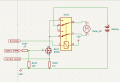
I applied the diagram below and made it work.
However, I have not tested it with such a high current.

If you install the mosfets in a large aluminum cooler, I'm sure it will work.

You should also select mosfets at the appropriate current.
IRLB3034 will be suitable.
I dont use CD4013, i use directly with mcu.


MisterBill2

Joined Jan 23, 2018
27,193
What sort of winch application??? Does it really require fine speed speed control?? Most winches are forward/stopped/ reversed.
OR use two SPDT contactors for direction selection and one mosfet PWM array for speed control and make it a lot simpler. OR
Is this winch for doing helicopter rescue work??
 

Thread Starter

Woxer

Joined Apr 11, 2025
10
What sort of winch application??? Does it really require fine speed speed control?? Most winches are forward/stopped/ reversed.
OR use two SPDT contactors for direction selection and one mosfet PWM array for speed control and make it a lot simpler. OR
Is this winch for doing helicopter rescue work??
This winch is for driving mini ATV which weights about 60-70 kilos. Its only for show off and no one gonna sit on it. Its a college project.
 

MisterBill2

Joined Jan 23, 2018
27,193
OK, then using a single PWM driver and two relays for direction selection could be a rational option.
Unless the purpose of the project is engineering a high current motor driver.
 

Thread Starter

Woxer

Joined Apr 11, 2025
10
OK, then using a single PWM driver and two relays for direction selection could be a rational option.
Unless the purpose of the project is engineering a high current motor driver.
The purpose of the project is to control speed of Brushed DC motor, thats it. Maybe you could share some projects of PWM drivers/Half bridges?
 

MisterBill2

Joined Jan 23, 2018
27,193
The purpose of the project is to control speed of Brushed DC motor, thats it. Maybe you could share some projects of PWM drivers/Half bridges?
If two relays, or contactors, are used for direction control, then there is no need for either a full "H" bridge , nor a half bridge, because the direction reversal is totally controlled by the relay action. This means that there is more flexibility available in the speed control scheme.
There have been quite a few successful PWM drivers in these threads over the years, and so a search should reveal what you seek.
Alternatively, there is also the "SCHEMATICEFORFREE" website that has quite a collection of power control circuits, although without any online support. In that aspect, support, you get what you pay for: Free circuit schematics.
 

Thread Starter

Woxer

Joined Apr 11, 2025
10
If two relays, or contactors, are used for direction control, then there is no need for either a full "H" bridge , nor a half bridge, because the direction reversal is totally controlled by the relay action. This means that there is more flexibility available in the speed control scheme.
There have been quite a few successful PWM drivers in these threads over the years, and so a search should reveal what you seek.
Alternatively, there is also the "SCHEMATICEFORFREE" website that has quite a collection of power control circuits, although without any online support. In that aspect, support, you get what you pay for: Free circuit schematics.
But you cant control speed of winch motor with relay? You must use half bridge to apply PWM signal.
 

Irving

Joined Jan 30, 2016
5,002
No, you don't need a 1/2-bridge. Here's how it's done...

Relay sets direction. PWM sets speed. Current sense gives feedback on what's going on (0.01ohm gives 1v @ 100A) or use 100A hall-effect device. Just don't change direction while running....

1744557247324.png
 

Thread Starter

Woxer

Joined Apr 11, 2025
10
No, you don't need a 1/2-bridge. Here's how it's done...

Relay sets direction. PWM sets speed. Current sense gives feedback on what's going on (0.01ohm gives 1v @ 100A) or use 100A hall-effect device. Just don't change direction while running....

View attachment 346802
Thank you in advance. Can I make PCB out of this scheme? Do you have to add anything here or give tips?
 

Irving

Joined Jan 30, 2016
5,002
DPDT relay for 100A may need some searching. Alternately could use 2 x SPDT or 4 x SPST automotive relays to achieve same. I wouldn't try putting 100A on a PCB. Correct MOSFET selection is important, you might consider two or more in parallel as 100A is close to physical limit for a single pin. Choose something in a TO247 or 247Plus package, say a couple of Infineon HEXFET devices are quite cheap and reliable and you shouldn't need a huge heatsink if you switch it effectively so look at proper MOSFET drivers, don't try to drive them from an MCU pin directly.
 

LowQCab

Joined Nov 6, 2012
5,101
"" The purpose of the project is to control speed of Brushed DC motor, that's it. ""

If this is truly all there is to the requirements,
then save yourself a lot of money and headaches, by utilizing a MUCH smaller Motor .

It's not really practical to attempt to push ~100-Amps through a PCB.
The Wiring needs to be at least ~4-gauge-Wire so that You don't start a FIRE.

I would suggest starting-out with a Windshield-Wiper-Motor from an automotive-Junk-Yard,
and even some of those can pull ~25-Amps with a big mechanical-Load attached.

~25-Amps can be accommodated on a PCB if you're very careful,
but I would recommend keeping the High-Current-Components separate
from the PCB and wired point-to-point.

Does this approach seem acceptable for your project ?
.
.
.
 

Thread Starter

Woxer

Joined Apr 11, 2025
10
"" The purpose of the project is to control speed of Brushed DC motor, that's it. ""

If this is truly all there is to the requirements,
then save yourself a lot of money and headaches, by utilizing a MUCH smaller Motor .

It's not really practical to attempt to push ~100-Amps through a PCB.
The Wiring needs to be at least ~4-gauge-Wire so that You don't start a FIRE.

I would suggest starting-out with a Windshield-Wiper-Motor from an automotive-Junk-Yard,
and even some of those can pull ~25-Amps with a big mechanical-Load attached.

~25-Amps can be accommodated on a PCB if you're very careful,
but I would recommend keeping the High-Current-Components separate
from the PCB and wired point-to-point.

Does this approach seem acceptable for your project ?
.
.
.
The problem is that I can't change motor. I don't need to control all the 100% power of this winch motor. I can try to control about 60% and its gonna be enough. I'm not gonna try to pull anything with it or get atv stuck at some obstacles.
 

LowQCab

Joined Nov 6, 2012
5,101
That's going to require some very expensive Relays,
and at least one very expensive Power-FET.

Is this a Class-Room assignment ?,
this is far too expensive just to see a toy Car move around.
.
.
.
 

Thread Starter

Woxer

Joined Apr 11, 2025
10

LowQCab

Joined Nov 6, 2012
5,101
That simulator is made out of Cubic-Money, not to mention the time involved.

What they have obviously works, but I think I would have done it differently.

Please give us a very detailed explanation of what You are attempting to accomplish and WHY.
Otherwise this Thread could go off in who knows what direction, and possibly get way off purpose.

Don't forget to include how much Money You have available for this project.
.
.
.
 

Thread Starter

Woxer

Joined Apr 11, 2025
10
That simulator is made out of Cubic-Money, not to mention the time involved.

What they have obviously works, but I think I would have done it differently.

Please give us a very detailed explanation of what You are attempting to accomplish and WHY.
Otherwise this Thread could go off in who knows what direction, and possibly get way off purpose.

Don't forget to include how much Money You have available for this project.
.
.
.
To start off, I have a brushed DC winch motor (12V, continuous current of approximately 80A at maximum load, 970W), and I aim to control its speed by building an H-Bridge or Half-Bridge circuit with PWM-based speed control. This motor will be used for a mini ATV, which is designed solely for display purposes. The ATV does not have a steering wheel or any other systems; it consists only of a frame, wheels, and a mechanical chain system to reduce the load on the DC motor.

My primary task is to control the speed of the DC motor. It does not need to operate at full load all the time. For my project, it is sufficient to focus on running the motor at reduced power levels, such as 60-70%, to conduct thorough research and investigation. This approach will allow me to study the motor's performance and control system under reduced power conditions effectively.

I would not be willing to spend more than 80 euros/dollars.
 

LowQCab

Joined Nov 6, 2012
5,101
A Winch has some serious Gear-Reduction built-in.
It is way too much Gear-Reduction for your purposes.
This means that You will have to arrange for a different Gear-Reduction-System,
Can You do that ????

Who is supplying this Winch that You "have-to-use" ?
Is it something that You just "happened-to-have" on hand ?

This is the point where .......
if you're studying to do this type of engineering,
You need to learn how to "diplomatically" explain that
the selected-Motor You are being presented-with is not practical for this application.

In the real-World,
I would guess that You are being "set-up-to-Fail" by an incompetent Boss.
This happens more often than You might believe, especially in government jobs.
Start looking for a new job immediately.

All of this is ridiculously hypothetical.

The problem seems to be that you're inexperienced in "problem-solving" in multiple different fields,
this ONLY comes from making LOTS of mistakes and breaking lots of stuff.

Start-off with finding the circumference of the Tires that You intend to use.
Next, determine the maximum speed of your Vehicle.
Now, determine what that equates to in terms of RPM of the Axle.
Then it will be necessary to determine what types/models of Motors there are to choose from,
and their general operating RPM-ranges.
Only after this,
would You go about selecting a type of Gear/Belt/Chain-Drive between the Motor and Axle.
( a Belt-Drive is more forgiving without a Machine-Shop getting involved )

We need more information.
.
.
.
 

MisterBill2

Joined Jan 23, 2018
27,193
The circuit described in post #10 is an implementation of what I described EXCEPT that my concept allows an "OFF" mode by splitting the switching into the two relay scheme which has been suggested and used many times in this venue.
AND, by splitting the mode control into two SPDT relays that never need to make or break under load, the cost is greatly reduced.

It is clear to me that the TS had no understanding of what I was describing in posts #5 and #7.
Having an inflexible view of how something is a terrible limitation in the path to success.

The scheme could possibly be done using an AC supply and a correctly timed four- 100 amp SCR "H-bridge" circuit, but the controls scheme performance would be very demanding.
 
Last edited:
Top