H-Bridge motor driver back EMF question

Danko

Joined Nov 22, 2017
2,169
I built it ... and tested it ... and it DID NOT WORK... :(

And then I found an error in my code ... so I corrected it, and tested it again ... and it STILL DID NOT WORK! ... :(

And then I changed R2 to 330k (because I don't have 300k resistors with me) ... and sure enough, this time IT WORKED!!!! :D:D:D

Thank you oh so very much, my friend. Thanks to you, and every one else who's helped me in this little project, I'm well on my way to a finished prototype.
Thank you for your thriller with happy end!
BTW, you can patent this circuit (it is not joke), I am too lazy to do it.
 

Danko

Joined Nov 22, 2017
2,169
I might just do that ... ;)

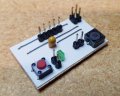
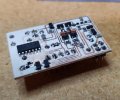
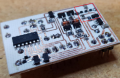
Here's a pic of the circuit, in case you're curious:
SMT... Looks professional. Excellent job!
1590444148515.png

ADDED:
What are doing these giant glass balloons inside FET bridge?
Zeners? Very bad idea!
FETs already protected by body diodes.
Sensor circuit protected by 3 diodes.
But these zeners are eating most of useful EMF current and decrease
sensor sensitivity
.
 
Last edited:

Thread Starter

cmartinez

Joined Jan 17, 2007
8,768
SMT... Looks professional. Excellent job!
View attachment 208127

ADDED:
What are doing these giant glass balloons inside FET bridge?
Zeners? Very bad idea!
FETs already protected by body diodes.
Sensor circuit protected by 3 diodes.
But these zeners are eating most of useful EMF current and decrease
sensor sensitivity
.
Those are 6V zeners connected back to back. They're there to protect the H-bridge ... And no, according to the sim, they're not affecting the circuit in any way. I always place either a TVS, or a couple of zeners as shown in all of my H-bridge circuits. Time and again, they have proven to be better protection than the Fet's body diodes alone.

BTW, I had to change the 47nF cap (C1) to a 220nF one because the circuit was behaving slightly unstable. That is, the circuit was sometimes detecting a false motor stall and stopping prematurely. As soon as I changed said cap, the problem was solved.

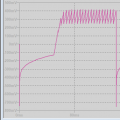
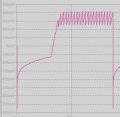
Here's what the signal at the transistor's gate on the sim looks like with and without the zeners.

01.PNG 02.PNG

As you can see, there's absolutely no difference.
 

Thread Starter

cmartinez

Joined Jan 17, 2007
8,768
In the meantime - some numbers:
1. Voltage of 4 alkaline cells in series is from 6.6V to 5.6V.
2. Zeners - for example 6V zener 1N5233.
It has current 20mA @ 6V (25°C).
I think 1N5236 (20mA @ 7.5V) will fit this application.
Yes, I had already considered that. And funny enough, a few weeks ago I bought the exact same 7.5V zeners you've mentioned to replace the 6V ones because they were too close to the threshold, as you've just implied. :)

On a side note, I've tested the circuit all the way down to 4V, and it works perfectly. So there's a chance my device could work with just three batteries. That's if the motor doesn't lose too much power with said lower voltage.
 
Last edited:

Danko

Joined Nov 22, 2017
2,169
On a side note, I've tested the circuit all the way down to 4V, and it works perfectly. So there's a chance my device could work with just three batteries. That's if the motor doesn't lose too much power with said lower voltage.
Using PWM and with 4 cells battery you can dramatically increase lifetime with RPM control.
Indeed, concept of sensor should be changed in such case.
 

Thread Starter

cmartinez

Joined Jan 17, 2007
8,768
Using PWM and with 4 cells battery you can dramatically increase lifetime with RPM control.
Indeed, concept of sensor should be changed in such case.
I understand. But in this very specific case, it's preferable that the motor always runs at 100% power. So pwm will never be necessary.
 

Danko

Joined Nov 22, 2017
2,169
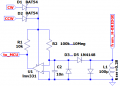
High sensitive circuit:
1590603335815.png
EDIT:
In attached simulation average power of EMF pulses train decreased 6 times
(6 times lowered RPM in motor model).
Notice that value of capacitor is 10nF only.
 

Attachments

Last edited:
Top