Guitar amp hum no signal

Thread Starter

Rabbitbreth

Joined Jan 22, 2019
188
If you don't want to go to the trouble of removing the two transistors, remove and replace the four diodes (1N4001-1N4007) and two capacitors (1000μF/50V). Make sure you get the orientation of the diodes and capacitors correct.

Of course, you cannot test the amplifier with no power and no fuse.

View attachment 304753
thanks. but I dont have replacement caps and diiodes yet so i will remover the transistors first
 

Dodgydave

Joined Jun 22, 2012
11,395
If you're reading across the C/E terminals then one of them is blown if it's reading 0.25V on diode test. They should read open circuit both ways.
 

Dodgydave

Joined Jun 22, 2012
11,395
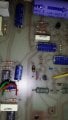
so I powered up with the transistors disconnected and re-connected the diodes which I had clipped to test . it blew a resistor . see centre of pic .
There might be other things wrong with this, check the other transistors, don't power it up until you have checked the other transistors and small diodes. The resistor looks like 100 ohms?
 

MrChips

Joined Oct 2, 2009
34,911
Like I said, replace the four diodes and the two capacitors.
Also replace the two transistors, 2N3055. But do not install the transistors until we give you the go ahead.
 

Thread Starter

Rabbitbreth

Joined Jan 22, 2019
188
There might be other things wrong with this, check the other transistors, don't power it up until you have checked the other transistors and small diodes. The resistor looks like 100 ohms?
ok . will order those parts and get back. thanks for all the help today
 

Ian0

Joined Aug 7, 2020
13,158
so I powered up with the transistors disconnected and re-connected the diodes which I had clipped to test . it blew a resistor . see centre of pic .
Did you have the speaker connected? If so that wasn't a good idea as it would try to power the speaker through the resistors that used to be across base and emitter of the power transistors.
 

Tonyr1084

Joined Sep 24, 2015
9,744
If the hum sounds to be 50 / 60 Hz I would be looking at the filter caps and yes a schematic would be nice.

Ron
If the speaker is pulling in all the way I'd expect to find the transistor (amp) shorted. The hum may be coming through due to heavy loading on the amp circuit. The filter cap is worth replacing possibly due to simple aging. But until we solve the shorting issue the hum should be a secondary consideration (my opinion).
ok . dave . so I will try and replace those first off . thank you
Word of caution - don't replace anything until you fully diagnose the problem. You could end up blowing out new components if whatever caused the initial failure has not been rectified.
If these are the diodes you are testing, then it sounds like they are faulty, i would remove one end of each diode and check to confirm it.
Yes - definitely pull one lead from each diode before testing. Testing "In Circuit" often yields false information.
They shouldn't blow without the transistors connected, .
I suspect this to be true, but I've blown fuses because of a shorted bridge rectifier (the cube type). Replaced that after being certain there was no other issues with MY amp.
ok will order one of those . thank you
Again, fully diagnose the problem before you start throwing parts at it.

As MrChips said:
•••replace the four diodes and the two capacitors.
Also replace the two transistors, 2N3055. •••
Replacing just one blown transistor will likely lead to the second one blowing out a week after you've fixed everything and you think things are good from there out. Like tires on a car, you don't replace just one unless you don't care about reliability. Caps get old. Diodes can get hurt. Transistors can fail with age. Starting fresh with those items is highly recommended. Both by MrChips and by myself.
 

Thread Starter

Rabbitbreth

Joined Jan 22, 2019
188
Did you have the speaker connected? If so that wasn't a good idea as it would try to power the speaker through the resistors that used to be across base and emitter of the power transistors.
no speaker was connected when it blew the resistor .
 

MisterBill2

Joined Jan 23, 2018
27,694
so I snipped the diodes . got readings one way of . 0.63 0.67 0.67 0.684.
Those readings would be forward drop in a diode check with a DMM. That tells me that the diodes were probably OK, which is what I suspected. I also suggest not immediately putting in tyhe fuses and switching the power on, because it will pop the replacement fuses just as fast. Jumper the fuse connections with a couple of 1K resistors, after removing the output transistors. But there will need to be diodes, maybe the snipped ones can be re-connected. Then the supply voltages can be checked.
 

Thread Starter

Rabbitbreth

Joined Jan 22, 2019
188
If the speaker is pulling in all the way I'd expect to find the transistor (amp) shorted. The hum may be coming through due to heavy loading on the amp circuit. The filter cap is worth replacing possibly due to simple aging. But until we solve the shorting issue the hum should be a secondary consideration (my opinion).
Word of caution - don't replace anything until you fully diagnose the problem. You could end up blowing out new components if whatever caused the initial failure has not been rectified.
Yes - definitely pull one lead from each diode before testing. Testing "In Circuit" often yields false information.
I suspect this to be true, but I've blown fuses because of a shorted bridge rectifier (the cube type). Replaced that after being certain there was no other issues with MY amp.
Again, fully diagnose the problem before you start throwing parts at it.

As MrChips said:

Replacing just one blown transistor will likely lead to the second one blowing out a week after you've fixed everything and you think things are good from there out. Like tires on a car, you don't replace just one unless you don't care about reliability. Caps get old. Diodes can get hurt. Transistors can fail with age. Starting fresh with those items is highly recommended. Both by MrChips and by myself.
ok. thanks for that . would those diodes be the same spec . just buy four of the same ? where's a good place to buy components these days ..just on ebay ?
 

Thread Starter

Rabbitbreth

Joined Jan 22, 2019
188
Those readings would be forward drop in a diode check with a DMM. That tells me that the diodes were probably OK, which is what I suspected. I also suggest not immediately putting in tyhe fuses and switching the power on, because it will pop the replacement fuses just as fast. Jumper the fuse connections with a couple of 1K resistors, after removing the output transistors. But there will need to be diodes, maybe the snipped ones can be re-connected. Then the supply voltages can be checked.
ok. thanks . have resolded the diodes back in .
 
Top