Guard Ring

nsaspook

Joined Aug 27, 2009
16,330
@bloguetronica @nsaspook
I should be very, very interested to see an authoritative source for the claims you make respecting the use of solder mask with guard rings. It would help your case considerably if you can cite any studies or reputable, well-known sources for such claims. (I suggest that a thread with title such as "Guard rings: Use solder mask or not?" be started for any further responses.)
https://www.analog.com/en/technical-articles/layout-for-precision-op-amps.html
Board leakage can be minimized by encircling the input connections with a guard ring operated at a potential very close to that of the inputs. The ring must be tied to a low impedance node. For inverting configurations, the guard ring should be tied to the potential of the positive input (+IN). For non-inverting configurations, the guard ring should be tied to the potential of the negative input (–IN). In order for this technique to be effective, the guard ring must not be covered by solder mask. Ringing both sides of the printed circuit board may be required.
 
Triax cables are a good example of the use of guard. The outer shield is ground. The inner shield is at the potential of the inner conductor, hence guard. If you are measuring a small current, say picoamps, and the center conductor and the surrounding inner shield is at the same potential, then there should be no leakage or error in the current measured.

If you can understand that concept, you can easily extrapolate it to a ring.
 

nsaspook

Joined Aug 27, 2009
16,330
@nsaspook
Thank you for your prompt response!
Is it unfortunate that the author gives no explanation for why covering the copper guard ring with solder mask causes a problem.
You asked for an authoritative source, authoritative sources don't need to explain their answers.:D Surface-charge effects from solder masks, matching exposed pin solder pads, divert x caused leakage current, etc ... take your pick how it prevents leakage currents on the PCB surface.

Almost every vendor recommends bare-metal guards.
 

TeeKay6

Joined Apr 20, 2019
573
You asked for an authoritative source, authoritative sources don't need to explain their answers.:D Surface-charge effects from solder masks, matching exposed pin solder pads, divert x caused leakage current, etc ... take your pick how it prevents leakage currents on the PCB surface.

Almost every vendor recommends bare-metal guards.
@nsaspook
You replied. I thanked you. We disagree about authoritative; for me an authoritative source is a source that CAN and WILL explain their statements. In any case, I have downloaded more than 25 links to guard rings and solder mask info and I am still in the process of reviewing them but am finding mostly opinions, no testing or experimentation results or supporting documentation. Most commenters say nothing about solder mask. I am a firm believer in the efficacy of using guard rings; I have designed boards successfully using guard rings since about 1975 and did extensive study of them at that time. The question for me is purely what is the effect of having (or not having) solder mask over the copper of the guard ring. If I find relevant info that appears trustworthy, I'll let you know. Otherwise, thanks again for your initial response.
 

nsaspook

Joined Aug 27, 2009
16,330
@nsaspook
You replied. I thanked you. We disagree about authoritative; for me an authoritative source is a source that CAN and WILL explain their statements. In any case, I have downloaded more than 25 links to guard rings and solder mask info and I am still in the process of reviewing them but am finding mostly opinions, no testing or experimentation results or supporting documentation. Most commenters say nothing about solder mask. I am a firm believer in the efficacy of using guard rings; I have designed boards successfully using guard rings since about 1975 and did extensive study of them at that time. The question for me is purely what is the effect of having (or not having) solder mask over the copper of the guard ring. If I find relevant info that appears trustworthy, I'll let you know. Otherwise, thanks again for your initial response.
I think we would all love to see the results of your research. Just remember, Solder mask is not to be considered an insulator or a stable dielectric so it's removal reduces one source of random manufacturing variations in the quest to reduce leakage.

Much like EMC, very low leakage design is a "Black Magic Topic". The physics of the countermeasures is solid but the rational for using specific methods in X case was born from extensive trail and error of experiment to reduce errors instead of being precisely engineered in a deterministic manner. This Monte Carlo method is perfectly valid in science and engineering if it produces good results.
 
Last edited:

bloguetronica

Joined Apr 27, 2007
1,544
That implies that this charge being absorbed is made of up free electrons moving about in the air next to he board. I've never seen anything that indicates that this is a significant source of noise in most electronic circuits.

It also goes counter to the common use of guard rings in integrated circuitry where leaving it as bare metal simply isn't an option.
You don't have to have free electrons in order to have charge. Think of a capacitor. The guard ring is a very effective way to shield from the interference of nearby conductors.

As for not using solder mask, look for guard ring examples on the web. You'll see that a good and effective guard ring is bare metal.

@bloguetronica @nsaspook
I should be very, very interested to see an authoritative source for the claims you make respecting the use of solder mask with guard rings. It would help your case considerably if you can cite any studies or reputable, well-known sources for such claims. (I suggest that a thread with title such as "Guard rings: Use solder mask or not?" be started for any further responses.)
You can see many sources here. Any professionally made PCB will serve as a good guideline. Notice that I've only googled only for "guard ring electronics" and didn't included the terms "no soldermask" or "bare copper", so my search results wouldn't be biased towards what I'm defending.

In fact, you should see this excellent article from Analog devices. They know what they are doing. Refer to the link below:
https://www.analog.com/en/technical-articles/layout-for-precision-op-amps.html

Or see this article (notice the layout image with the caption "Image 3: Red Solder Mask" - although they do not tell you explicitly to leave out the solder mask):
https://www.ourpcb.com/pcb-guard-ring.html

I hope these sources will be of any use to you.

Kind regards, Samuel Lourenço
 

WBahn

Joined Mar 31, 2012
32,878
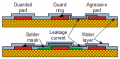
While the Analog devices article says to not have a soldermask over the guard ring, it doesn't say why not. But a little digging revealed the answer and it's pretty simple. One of the sources of leakage current into a high impedance node is current flowing along the surface of board through the layer of surface contaminants. The solder mask, even if it were a perfect insulator, would thus provide a path over the top of the guard ring. With a bare metal guard ring that surface flow gets interrupted.
 

TeeKay6

Joined Apr 20, 2019
573
You don't have to have free electrons in order to have charge. Think of a capacitor. The guard ring is a very effective way to shield from the interference of nearby conductors.

As for not using solder mask, look for guard ring examples on the web. You'll see that a good and effective guard ring is bare metal.


You can see many sources here. Any professionally made PCB will serve as a good guideline. Notice that I've only googled only for "guard ring electronics" and didn't included the terms "no soldermask" or "bare copper", so my search results wouldn't be biased towards what I'm defending.

In fact, you should see this excellent article from Analog devices. They know what they are doing. Refer to the link below:
https://www.analog.com/en/technical-articles/layout-for-precision-op-amps.html

Or see this article (notice the layout image with the caption "Image 3: Red Solder Mask" - although they do not tell you explicitly to leave out the solder mask):
https://www.ourpcb.com/pcb-guard-ring.html

I hope these sources will be of any use to you.

Kind regards, Samuel Lourenço
@bloguetronica
Thank you for posting the list of links. Most were already on my list, but those that were not I will add.
 

nsaspook

Joined Aug 27, 2009
16,330
While the Analog devices article says to not have a soldermask over the guard ring, it doesn't say why not. But a little digging revealed the answer and it's pretty simple. One of the sources of leakage current into a high impedance node is current flowing along the surface of board through the layer of surface contaminants. The solder mask, even if it were a perfect insulator, would thus provide a path over the top of the guard ring. With a bare metal guard ring that surface flow gets interrupted.
That's pretty close to what I was told a long time ago by some very experienced TI engineers (my authoritative source) in school.
 
Top