Ground Planes: PGND, and 2 AGND for audio?

Thread Starter

rpschultz

Joined Nov 23, 2022
834
I have a 4 layer board (signal, power, ground plane, signal) used for audio, with a 15v DC-DC converter. I've read to keep the DCDC primary on PGND (along with 9v DC jack and filter caps) and the secondary on AGND along with all the audio stuff. AGND and PGND are connected with a 0 ohm resistor R0. I've also seen suggestions about splitting the AGND into 2 sections, Power and Quiet. The secondary and any filter caps would be on the Power portion, while all the rest of the circuit (op amps, resistor network, caps, etc. would be on the Quiet portion. Then connect these two by 1 fat lead.

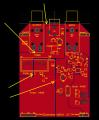
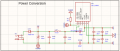
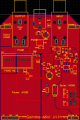
I don't understand if this is necessary or not. Any vias on AGND connect to the same inner ground plane. PGND only exists on the top, the bottom is all AGND and the inner ground plane is all AGND. Is this good practice? See picture below:
1781701379032.png
1781701517236.png
 
1. schematics is not readable.

2. schematics and PCB don't even match. (there is no IC1 or Q3 in schematics)

3. what 4 layers? your PCB image shows only one layer

4. i see no ground planes...

planes are supposed to spread around the circuits and have stiff low impedance from one point to another (any two points).

what you show if different.... it is a bunch of zones with hourglass waist - exactly what ground planes are supposed to eliminate.

think of a having someone with jingle bells on their limbs and you are trying to pin him down to silence him. that is what ground plane does. as long as one of the limbs is still free to wiggle and make noise, you are not done. if you want ground plane that works (despite Gulliver with loose "limbs"), you would want to use additional plane and then pin down everything (and that is where stitching vias come in - but i don't see you use this either).

1781711766532.png
 
Last edited:

Thread Starter

rpschultz

Joined Nov 23, 2022
834
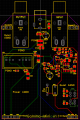
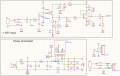
Sorry about the schematic. Also see PCB with ground planes turned off.
  • 4 layers: Red top, Blue bottom, green inner power, and inner ground plane.
  • The red in the post #1 picture is the top ground plane, shown in EasyEDA. When rectangular ground pours are overlapped in EasyEDA, it shows the overlap but JLC understands to just combine them into 1. So the top red ground plane is 2 planes on the top, connected by a 0 ohm resistor. AGND has an island called Power AGND, connected to the rest by a fat junction in the middle, you have an arrow pointing to it. I'm not sure if this is the way to go or not.
  • Stitching vias I've heard of, but never used for audio. I vaguely understand it's importance and willing to learn. For reference, the prototype I printed of this board alone has a THD of 0.009% so it's still reasonably good. But it could be better, possibly with more vias and other improvements.
  • This board, is 1 of 3.
    • Power board (shown), 9v input, 2 audio jacks, JFET and buffer circuit, DC-DC converter
    • Preamp board has 8 pots/knobs, 3 quad op amps and a bunch of RC filters for EQ
    • Footswitch board has two mechanical 3PDT's for switching: Bypass and Boost.
    • All tied together with headers/pins.
  • Disclaimer, I'm not an EE. I started learning about PCB design 3-4 years ago.

Thanks for the help!

1781720827652.png
1781720845022.png
 
What are C106 and C107 doing? I don't think you need them.

Does your DC power connector need to be between the input and output? I'd suggest putting it in a corner away from your amplifier and keeping D101, C101, C102, C103, L101 and the regullator (PS1) as close to the input connector as possible. I don't know how well regulated your input voltage is, but if it's got significant ripple that may bleed over to your input connector in your current configuration. Use 100 mil wide traces (or wider) on those parts and skip the ground plane. Only AGND needs a plane. You may want to avoid having the AGND plane under the regulator as it's got a 100 kHz oscillator inside.
 

Thread Starter

rpschultz

Joined Nov 23, 2022
834
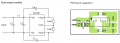
Traco Tec 2 series data sheet shows this for C106, C107
1781725287751.png

  • 9v DC jack is a mechanical layout decision I made. It's beneficial to have "top jacks" on guitar pedals, to have the audio jacks and DC jack all on top, nothing on the side of the pedal. I've used this arrangement before and it works great layout wise, but there may be downsides to it electrically.
  • Currently using 1/4mm signal traces and 1/2mm power traces. So you're suggesting 100 mil or 2.5mm power traces. Wow. OK I can look at that.
  • Skip PGND plane. I'll look at that.
  • There is not currently AGND under the regulator, it is a PGND plane.
 

Thread Starter

rpschultz

Joined Nov 23, 2022
834
FWIW, I measure about 155 mA @ 9.2v, that’s about 1.5W.
Also measure about 30 mA per 15v leg. It's rated for 67 mA per leg.
Online trace width calculators say 1 oz 6-10 mil wide is fine.
 
Last edited:
I would not split AGND into separate Quiet and Power regions if if already have a dedicated ground plane. A single solid AGND plane is usually the preferred solution. The more important issue is to make sure that the DC-DC converter's high-current and high-dV/dt loops remain localized. Design and manufacturing should be done in such a way that PGND is not accidentally connected to AGND in multiple places through vias or pours. Always get it printed by a dependable PCB manufacturer like NextPCB, Sierra or JLC depending on where you live.
 

Thread Starter

rpschultz

Joined Nov 23, 2022
834
I would not split AGND into separate Quiet and Power regions if if already have a dedicated ground plane. A single solid AGND plane is usually the preferred solution. The more important issue is to make sure that the DC-DC converter's high-current and high-dV/dt loops remain localized. Design and manufacturing should be done in such a way that PGND is not accidentally connected to AGND in multiple places through vias or pours. Always get it printed by a dependable PCB manufacturer like NextPCB, Sierra or JLC depending on where you live.
Good info. PGND has only 1 connection to AGND, through the 0 ohm resistor. No vias that connect (EasyEDA wouldn't allow it anyway).
I use JLC smda for manufacturing.
 
Top