Glad I'm not a passenger

WBahn

Joined Mar 31, 2012
33,348
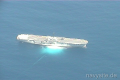
The sinking of the SS United States:


I hope to dive on it some day. It's always said when such a magnificent engineering marvel is lost, but at least she'll still continue to serve a purpose. I believe her engines are still there, but they are probably too deep for a non-technical dive.
 

nsaspook

Joined Aug 27, 2009
16,539
The sinking of the SS United States:


I hope to dive on it some day. It's always said when such a magnificent engineering marvel is lost, but at least she'll still continue to serve a purpose. I believe her engines are still there, but they are probably too deep for a non-technical dive.
Nice, my old ship went out with a bang.
1794623574824.png
COMSUBPAC ship sinking exercise (SINKEX) on 6 June 2002. The ship was sunk by a NUWC Keyport-built MK-48 Mod 5 ADCAP torpedo fired by USS PORTSMOUTH (SSN 707)
 

WBahn

Joined Mar 31, 2012
33,348
https://www.opb.org/article/2026/11...-air-traffic-control-communications-problems/

Flights halted at PDX, airports nationwide due to air traffic control communications problems

View attachment 373187
Some people may be wondering how a network infrastructure issue could cause such a major disruption to the ability to communicate with aircraft via radio. It's actually pretty easy to understand as soon as you realize that the radios are not co-located with the controllers (the way that they essentially are at an airport). There are 22 ARTCCs (Air Route Traffic Control Centers) in the U.S. and each one covers an area that is far too large to be able to talk to aircraft within their area of operations via radios located at the ARTCC. Each center uses a few dozen remote communication centers spread out over their region to actually transmit and receive radio signals, so if the network infrastructure connecting the ARTCC to these remote stations (known as Remote Communication Air/Ground -- RCAG -- facilities, of which there are about 750), then they've lost comms. Also, the same is true for radar facilities that feed data to the ARTCCs.

Aside from the air/ground and radar disruption, there is also the issue of inter-ARTCC comms needed to handoff aircraft as they move from center to center.

One thing that the news media overlooked -- the loss wasn't complete and there was still enough communications to permit military air defense and emergency services flights to continue. It was basically a case of severe load-shedding so that priority traffic could be serviced.
 

WBahn

Joined Mar 31, 2012
33,348
I've never hear the term "allision" before, but it makes sense that you want to distinguish the two types of events and I can definitely understand that the cruise ship folks are going to be very diligent about using that term.

I wonder if the tanker (is that the right descriptor for it?) let go the starboard anchor intentionally to avoid having the chain get tangled with the cruise ship, the people in the water, or the various vessels that were moving around to perform rescue operations.
 

nsaspook

Joined Aug 27, 2009
16,539
I've never hear the term "allision" before, but it makes sense that you want to distinguish the two types of events and I can definitely understand that the cruise ship folks are going to be very diligent about using that term.

I wonder if the tanker (is that the right descriptor for it?) let go the starboard anchor intentionally to avoid having the chain get tangled with the cruise ship, the people in the water, or the various vessels that were moving around to perform rescue operations.
Generally with an "allision" the moving vessel has presumption of liability but there is a loophole. If the stationary vessel shouldn't be there in the first place, (like some of the boats or a moored dredge in SEAsia we damn near hit because they were stopped fishing in the middle of a designated shipping channel) then you need to prove all possible measures to avoid were taken. Just because they are idiots you can't sink them. :rolleyes:
 

WBahn

Joined Mar 31, 2012
33,348
Generally with an "allision" the moving vessel has presumption of liability but there is a loophole. If the stationary vessel shouldn't be there in the first place, (like some of the boats or a moored dredge in SEAsia we damn near hit because they were stopped fishing in the middle of a designated shipping channel) then you need to prove all possible measures to avoid were taken. Just because they are idiots you can't sink them. :rolleyes:
I'm guessing that, in this case, the cruise ship operator isn't going to have too much trouble establishing that they had every right to be where they were, since they were docked at their assigned birth and were embarking passengers on their published schedule.
 
Top