Glad I'm not a passenger

nsaspook

Joined Aug 27, 2009
16,353
We have a saying down here that goes: "Les llueve sobre mojado" ... which translates into "It rains on top of their already being wet" ... My thoughts and prayers are with the great nation of Japan.
Reports the Coastguard aircraft was departing to Nagata to deliver earthquake aid. RIP those that died.
 

Thread Starter

cmartinez

Joined Jan 17, 2007
8,788

LEAVE YOUR LUGGAGE BEHIND!

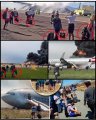
Today we underline the importance of one specific element of the pre-flight safety announcement. Besides the astonishing work of the JAL cabin crew, another great contribution to today's miraculous evacuatio was the passengers' disciplinary compliance with the crew's instructions, leaving behind belongings on the aircraft, in order to prioritize... life. This has unfortunately not been the case in many other recent aviation accidents, where people have been seen grabbing their belongings before exiting the aircraft, putting themselves and others at high risk. Today we witness results of the opposite action. We all bear a great responsibility in such situations. Please consider this and share the importance.

1704215270052.jpeg
 

nsaspook

Joined Aug 27, 2009
16,353
https://www.navytimes.com/news/your...arded-for-battling-houthi-attacks-in-red-sea/
USS Carney sailors awarded for battling Houthi attacks in Red Sea
Those receiving Navy commendation or achievement medals from Kurilla during December’s visit include two fire controlmen (Aegis) 3rd class, a fire controlman 2nd class, two fire controlmen (Aegis) 2nd class, one fire controlman (Aegis) 1st class, one chief operations specialist, one chief fire controlman, one chief cryptologic technician, two chief gunner’s mates, two chief fire controlmen (Aegis), one senior chief operations specialist, four lieutenants and two lieutenant commanders.

The ship’s commanding officer received a Bronze Star Medal for his efforts as well.
Bravo Zulu
 

Thread Starter

cmartinez

Joined Jan 17, 2007
8,788
Man found dead inside plane engine at Salt Lake City airport.

Somehow, his body was intact enough for responders to perform CPR.
Per procedure, paramedics are supposed to perform CPR even if the poor soul is patently and verifiably dead. I can attest to the sad case of a close friend of mine that died at the hospital while he was spending the night in observation prior to a surgery that he was scheduled to have in the morning regarding a severe and painful hernia that he had had for several years already.

Sadly, the next morning the nurses found his body already gone into rigor mortis (which meant more than 4 hours had passed since his death) and completely cold to the touch. But as per the hospital's policy they performed CPR on him anyway for several minutes .... I honestly find that sort of thing absurd ... I guess that nonsense is meant to protect the hospital's interests, legally-wise.
 

WBahn

Joined Mar 31, 2012
32,935
Per procedure, paramedics are supposed to perform CPR even if the poor soul is patently and verifiably dead. I can attest to the sad case of a close friend of mine that died at the hospital while he was spending the night in observation prior to a surgery that he was scheduled to have in the morning regarding a severe and painful hernia that he had had for several years already.

Sadly, the next morning the nurses found his body already gone into rigor mortis (which meant more than 4 hours had passed since his death) and completely cold to the touch. But as per the hospital's policy they performed CPR on him anyway for several minutes .... I honestly find that sort of thing absurd ... I guess that nonsense is meant to protect the hospital's interests, legally-wise.
Yes and no. The main purpose behind policies like that are the edge cases were people that are "obviously" dead are actually still savable. There's a saying in arctic operations that goes that you're not dead until you are warm and dead.

But, like so many things, administrators, lawmakers, and lawyers love blank and white absolute guidelines, so things get taken to extremes.
 

Thread Starter

cmartinez

Joined Jan 17, 2007
8,788
There's a saying in arctic operations that goes that you're not dead until you are warm and dead.
Very true about that artic scenario ...

But what I meant to say of course applies only to my home country (and State) particular legal system.
 

Alec_t

Joined Sep 17, 2013
15,124
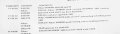
Judging by the recently released transcript of the ATC comms re that Japan Airlines crash, at time 17:43:26, it seems the Coastguard plane DAL276 did not have take-off clearance and was headed for runway 34R despite being instructed to go to holding point C1. A misunderstanding, although the crew acknowledged the direction to C1 ?
JALincident.jpg
 

nsaspook

Joined Aug 27, 2009
16,353
Judging by the recently released transcript of the ATC comms re that Japan Airlines crash, at time 17:43:26, it seems the Coastguard plane DAL276 did not have take-off clearance and was headed for runway 34R despite being instructed to go to holding point C1. A misunderstanding, although the crew acknowledged the direction to C1 ?
View attachment 311627
Is that the actual transcript?

Not an expert but I think perhaps (I heard an actual commercial pilot talk about this) the better term is hold 'short' (stopping before entering a runway area ) as C1 could actually be a point on the runway.
https://www.faa.gov/air_traffic/publications/atpubs/aim_html/chap2_section_3.html#:~:text=A runway holding position sign,operations or as a taxiway.

1704316611497.png

https://www.sheppardair.com/download/PHAK_Appendix1.pdf
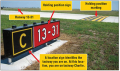
ATC Instructions—“Hold Short” The most important sign and marking on the airport is the hold sign and hold marking. These are located on a stub taxiway leading directly to a runway. They depict the holding position or the location where the aircraft is to stop so as not to enter the runway environment. [Figure 1-12] For example, Figure 1-13 shows the holding position sign and marking for Runway 13 and Runway 31.

When ATC issues a “hold short” clearance, you are expected to taxi up to, but not cross any part of the runway holding marking. At a towered airport, runway hold markings should never be crossed without explicit ATC instructions. Do not enter a runway at a towered airport unless instructions are given from ATC to cross, takeoff from, or “line up and wait” on that specific runway. ATC is required to obtain a read-back from the pilot of all runway “hold short” instructions. Therefore, you must read back the entire clearance and “hold short” instruction, to include runway identifier and your call sign. Figure 1-14 shows an example of a controller’s taxi and “hold short” instructions and the reply from the pilot.
 
Last edited:
Good luck with that!

I think a huge source of the problem comes down to people that insist on controlling others. They are not content with believing what they believe, the demand that others believe it to, or at least conform to living how they believe people should live. There is fundamentally no solution to this, because the core of a society is people conforming to societal norms of behavior, which means that people are being coerced to live by a set of beliefs whether they believe them or not. But since these beliefs are not objective, there will always be friction regarding what the societal norms should be and to what degree conformance should be enforced, which also means that there will always be those whose ideas of what those norms should be are in conflict with the majority, but they firmly believe that their norms ARE objective and therefore the majority must be forced to conform anyway.


nsaspook

Joined Aug 27, 2009
16,353
It's the alleged official transcript, off the Japanese TV news screen.
'C' would normally indicate a taxiway. Runways are designated by their orientation (340° in this accident case).
Agree, it should be implied for them to stay off the runway but I've seen several headlines they were told to explicitly 'hold short' but that's not on the official transcript.
https://www3.nhk.or.jp/nhkworld/en/news/20240103_07/
Source: Coast Guard aircraft ordered to hold short of runway

1704376768672.png
Stating the obvious: Dash 8 wreckage seems to be abeam C5 where it lined up and was waiting for clearance to take-off (they were waiting on the runway for almost 1 min before being hit) when hit. Somehow the crew of the CG plane was convinced that they were allowed to enter the runway. This will be an interesting investigation into human factors most likely.

https://airwaysmag.com/runway-incursions-causes-mitigation/
 

WBahn

Joined Mar 31, 2012
32,935
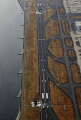
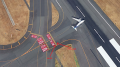
Here's the taxiway markings just before where the CG plane was hit:
1704387113052.png

The four lines going across the path (two solid, two dashed) tell the pilot that if they are approaching the lines from the dashed side, they may proceed without clearance, but the solid lines mean that they MUST hold UNLESS given permission to cross by the controllers. That permission can come in a couple of ways. If the runway is in use, it usually requires explicit, case-by-case authorization from the controller, with readback from the pilot required. Sometimes the recorded ATIS information will give blanket permission to cross all inactive runways in order to reduce unnecessary controller-pilot interaction. This is very common at smaller airports, but I don't know how common it is at large airports -- I can see arguments both ways.

The key phrases that the pilot is looking for are "Hold short" versus, "Taxi into position and hold" (sometimes shortened to just "position and hold"), or "Cleared for takeoff". The instruction is prefixed by the ID of the aircraft and usually suffixed by the runway designator, so something like, "United 411, hold short, runway 34-right." Hold short instructions are almost always required to be read back so that the controller can confirm that the intended aircraft received and understood the instructions. The former means that you are NOT to cross the hold-short marker, while the latter means you are allowed to cross the marker and taxi into takeoff position on the runway, but not start your actual takeoff run until you receive the magic words, "Cleared for takeoff."

It appears the pilot of the CG plane thought he had been instructed to taxi into position and hold. What will be interesting to see if the broader recordings of traffic on the various ATC frequencies that the plane might have been monitoring to see if there might have been a transmission intended for another aircraft that the pilot mistook as a clearance for him to cross the marker. It's also possible the pilot just brain farted, but with a copilot on board, on of the copilot's responsibilities is to be aware of what is going on and communicate mistakes or misunderstandings to the pilot, although the copilot has their own specific duties that they are attending to, as well.
 
Top