Glad I'm not a passenger

Thread Starter

cmartinez

Joined Jan 17, 2007
8,786

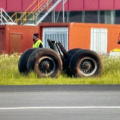
A Cargolux Boeing 747-400, registration LX-OCV performing flight CV-6857 from Luxembourg (Luxembourg) to Chicago O'Hare,IL (USA), was climbing out of Luxembourg's runway 06 when the crew stopped the climb at FL100 due to being unable to retract the landing gear. The aircraft returned to Luxembourg for a landing on runway 06 at 19:00L (17:00Z) about 50 minutes after departure, upon touchdown the right hand center gear wheel bogey separated however. The wheel bogey came to rest in front of the Cargolux Hangar, the aircraft rolled out without further incident and was disabled on the runway. There were no injuries, the aircraft sustained substantial damage.
 
The news report said the police heard the kid's BMW then clocked it going 176mph. Like most other kids' sports cars, this one probably had no muffler and also probably was lowered, had blackened glass and had its pollution controls removed. There are lots of these and more expensive cars parked at the university near my home, the kids driving them are from the other side of the world.

My first car had a maximum downhill speed of 90mph. Zoom.
 

Thread Starter

cmartinez

Joined Jan 17, 2007
8,786

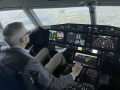
For our simulation modeled after an Airbus A320, which typically seats 140 to 170 passengers, our recruits had one objective: to successfully land the aircraft and save everyone onboard.
Venhuizen was in charge of rounding up the participants. He chose four men and two women, ages 19 to 67. Four people had zero pilot experience. However, three members of the group (Patrick Miller, Meloney Linder and Daku) had played around with flight simulators and one (Alexa Vilven) had watched YouTube videos of pilots landing planes.
 

nsaspook

Joined Aug 27, 2009
16,344
The emergency exit mechanics work at altitude? I always thought they were locked out.
So did I. But it seems to be only pressure related.
https://simpleflying.com/asiana-stops-selling-emergency-exit-row-seats/
Asiana Stops Selling Emergency Exit Row Seats Following Door Incident
How did it happen?
In the world of aviation, such incidents rarely occur. Opening an aircraft door mid-flight is generally considered impossible due to the high cabin pressure, which exerts a substantial force on the door due to pressurization.

However, as the aircraft descends, the pressure inside and outside the plane gradually equalizes, reducing the force exerted on the door. This gradual equalization allows the door to be opened in such situations. As previously reported by Simple Flying, an Asiana Airlines spokesperson commented on the incident, stating:

"The airplane is automatically set to adjust the pressure of the cabin according to the altitude of the aircraft. When the aircraft is high up in the air, it is impossible to open the door, but when the altitude is low and close to landing, the door can be opened."
 

WBahn

Joined Mar 31, 2012
32,929
The emergency exit mechanics work at altitude? I always thought they were locked out.
You don't want anything artificially locking out emergency exits. Far too great a chance of whatever is locking them out getting damaged in a crash and continuing to prevent the doors from opening. In fact, the opposite is true. It can be possible to lockout the doors on the ground (though this isn't usually done), but one of the checklist items that normally occurs before the aircraft pushes back from the gate is to arm all emergency exits and cross check them. This involves ensuring that the doors are ready for immediate use, per the instructions on the passenger safety card, and that any slide/raft that deploys when the door opens has its mechanism armed. The doors remain in this state until the aircraft has pulled into the gate at the destination.

Nearly all exit doors (emergency or otherwise) on pressurized aircraft have to be brought inward, at least initially, to open them. Very small aircraft, such as four- or six-passenger private airplanes, may deviate from this.

For a small exit door that is, say, 4' x 2', that's 1152 square inches, so with just a 0.1 psi difference in pressure, there's over a hundred pounds of force holding that door closed.

At sea level, the pressure drops by about 0.1 psi for every 200 ft of altitude.

But commercial aircraft do not pressurize the cabins to sea level, or even maintain the level at the elevation they took off at. Most pressurize the cabin to a pressure altitude of about 8000 ft above sea level (though the trend is lower for newer aircraft). So an airliner can allow the inside pressure to match the outside pressure below 8000' MSL, resulting in no pressure differential on the exit doors, allowing them to be opened in flight will little effort. But the inside air pressure doesn't match the ambient pressure all the way to 8000'. For fast climbing (or descending) aircraft, that could be very uncomfortable for passengers. Instead, the environmental systems but a limit on the rate at which the cabin pressure changes. When taking off, this means that the pressure differential will build up even while the aircraft is below 8000', but it won't be the full differential between ground level and the current altitude.
 
Top