Glad I'm not a passenger

nsaspook

Joined Aug 27, 2009
16,357
https://www.kptv.com/2025/02/13/owner-gold-tesla-cybertruck-says-he-is-target-threats-harassment/

Owner of gold Tesla Cybertruck says he is target of threats, harassment

WORCESTER, Mass. (WBZ) – The owner of a gold Tesla Cybertruck in Massachusetts said he has been experiencing bullying and threats over his vehicle choice.
...
Jaroje is also worried about other drivers on the road trying to cause a collision.

“Somebody tried to cut me off while I’m driving with my kids, and three guys came out of the car. And just pointed the middle finger and start screaming at me,” he said.

 

nsaspook

Joined Aug 27, 2009
16,357

One likely casualty aboard the Truman, her Captain's career just crashed.

These choke points are insane. We would usually be under General Quarters during the critical points to have lookouts everywhere. Crashes between merchants happen all the time.


It's a madhouse!
arabian-sea-a-boatswains-mate-seaman-scans-the-horizon-with-binoculars-while-41ffe0.jpg
 
Last edited:

nsaspook

Joined Aug 27, 2009
16,357
To me, this is unacceptable in this day and age. Bad data, no data from barometric or pressure related sensors on the rotary aircraft but they are still, somehow, the primary measures of altitude in critical low clearance/separation operations with fixed wing aircraft. The radar altitude data is the only thing they are fairly sure is accurate but that's not useful because it's terrain height dependant instead of a common (that's critical but seems to have poor resolution, accuracy, precision and repeatability a low altitudes) measure to use for flight separation levels. The current systems are inadequate for instrument flying so they request visual separation by humans when human capabilities are inadequate for visual flying.

Only dumb luck was preventing this from happening earlier.

If I went into a ISO manufacturing audit for a life/safety qualified semi production process with the equivalent poor instrumentation and horrible calibration data, I would be and should be fired on the spot.
 
Last edited:

WBahn

Joined Mar 31, 2012
32,939
BZ to the RCAF
I wonder how difficult it would have been to get off the lee side of the ship and get over to the rocks and then work there way over to the beach area where the person videoing things was located? The ship looks like it was acting like a pretty effective breakwater. Certainly not a first choice, particularly for people that are already injured and given the cold water. But it seems like it might have been a viable last-ditch option if a helicopter rescue wasn't available. I also wonder how feasible it would have been to get very shallow draft craft or liferafts from the beach area over onto the lee side to take people off and then get them back around the bow of the ship onto the beach. It seems like it might be doable, but certainly not risk-free and certainly not fun.
 

nsaspook

Joined Aug 27, 2009
16,357
I wonder how difficult it would have been to get off the lee side of the ship and get over to the rocks and then work there way over to the beach area where the person videoing things was located? The ship looks like it was acting like a pretty effective breakwater. Certainly not a first choice, particularly for people that are already injured and given the cold water. But it seems like it might have been a viable last-ditch option if a helicopter rescue wasn't available. I also wonder how feasible it would have been to get very shallow draft craft or liferafts from the beach area over onto the lee side to take people off and then get them back around the bow of the ship onto the beach. It seems like it might be doable, but certainly not risk-free and certainly not fun.
That sea state, in that cold, with that crew? I would ride it out on that bucket to the end rather that get in the water. She's stuck on the rocks and is not sinking even if she cracks. Those waves are breaking up to the house level and there's likely one hell of a undertow on the lee side in those conditions. It only looks calm compared to the hell on the windward side.
 

WBahn

Joined Mar 31, 2012
32,939
That sea state, in that cold, with that crew? I would ride it out on that bucket to the end rather that get in the water. She's stuck on the rocks and is not sinking even if she cracks. Those waves are breaking up to the house level and there's likely one hell of a undertow on the lee side in those conditions. It only looks calm compared to the hell on the windward side.
I would agree that, if no other way was available for getting off, that staying on as long as possible would be the first option. It's a race against how long the weather can last versus how long the ship can -- and there's no telling who will win the race. But if she starts to break up, particularly if the weather was still like that when she did, I can easily imagine that she wouldn't stay together for long. I don't know what the safest place to be would be in that case. My guess would be toward the stern. But I'd sure be planning and preparing for the possibility of having to get off in as controlled a fashion as possible if the integrity of the vessel looked like it was giving way.

Another option would be trying to rig a zip line from the bow down to a suitable point on the beach. Given a bit of help from the beach, and sufficient line (even fairly light line), it should be possible to get a line from the ship to the beach, which can then be used to pull back heavier rope to the ship as well as any equipment that would be needed. That's not something that would all happen in an hour, so it's an option that could be considered if the forecast made it highly unlikely that the ship could remain intact long enough for the weather to break sufficiently to take them off some other way.

But aren't helicopters nice? The perfect tool, in the hands of some very skilled and courageous operators, to pull it off the way they did.
 

nsaspook

Joined Aug 27, 2009
16,357
I would agree that, if no other way was available for getting off, that staying on as long as possible would be the first option. It's a race against how long the weather can last versus how long the ship can -- and there's no telling who will win the race. But if she starts to break up, particularly if the weather was still like that when she did, I can easily imagine that she wouldn't stay together for long. I don't know what the safest place to be would be in that case. My guess would be toward the stern. But I'd sure be planning and preparing for the possibility of having to get off in as controlled a fashion as possible if the integrity of the vessel looked like it was giving way.

Another option would be trying to rig a zip line from the bow down to a suitable point on the beach. Given a bit of help from the beach, and sufficient line (even fairly light line), it should be possible to get a line from the ship to the beach, which can then be used to pull back heavier rope to the ship as well as any equipment that would be needed. That's not something that would all happen in an hour, so it's an option that could be considered if the forecast made it highly unlikely that the ship could remain intact long enough for the weather to break sufficiently to take them off some other way.

But aren't helicopters nice? The perfect tool, in the hands of some very skilled and courageous operators, to pull it off the way they did.
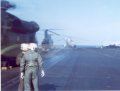
Aren't helicopters nice? Not a word I would use after spending years deploying on a USMC helo carrier on Westpac. I've seen brave cowboy's flying those things too close to eternity and watched a few go over the gate.

Amazing is the word I would use. Amazingly useful and dangerous.
https://forum.allaboutcircuits.com/threads/and-now-for-something-weird.124706/post-1260767

1739790013036.jpeg

I wasn't there for this one but this is a textbook version of the typical airborne assault we did. Only takes about 10 minutes for the full assault force to be on deck.
 
Last edited:

WBahn

Joined Mar 31, 2012
32,939
Indeed ... these incidents are becoming unusually frequent as of late
Are they? Or is it an expected statistical anomaly? Or the result of increased reporting in the wake of the first fatal scheduled airline crash in the U.S. in such a long time?

I don't know. Possible some combination of all of them.

Let's see if the numbers give us a clue.

Here is the data for 2023 for the U.S.:

Part 121:
Scheduled: 28 accidents in 8,816,063 departures (flights)
Unscheduled: 3 accidents in 214,513 departures (flights)
Part 135:
Commuter: 1 accident in 609,227 departures (flights)
On-demand: 36 accidents, number of flights unknown.

The definition of an "accident" means that there was serious injury or death to at least one person and/or substantial damage to the aircraft.

For simplicity, let's consider just accidents involving those flight categories that we have departure information for, which totals to 32 accidents in 9,639,803 departures.

Assuming that flights per day is uniform throughout the year (not a wonderful assumption, but good enough for our purposes), that's 26,410 flights a day.

An accident occurred once every 301,244 flights

So the odds of an accident happening on any given day are 1 in 11.4.

That sounded awfully high, but 32 accidents in 365 days is one accident every 11.4 days, so it is what it is.

The DCA crash happened on 30 JAN, the commuter aircraft in Alaska crashed on 06 FEB, and the crash in Toronto happened on 17 FEB. So that's three accidents in 19 days.

The medical flight crash in Philadelphia on 31 JAN was an on-demand flight, which is not included in the above data because I don't have information on how many such flights there are a year, though it should be possible to find an estimate of it pretty easily. But note that these operations accounted for more accidents than the other three categories combined (in 2023, they also accounted for all eight of the fatal accidents (though general aviation had an additional 191 fatal accidents). The crash in Canada today is being included because it departed from the U.S., and so I think it will be included in the comparable numbers for 2025.

Next, let's consider a super simple model in which one accident occurs every 11.4 days like clockwork. That means that time span from the first accident through the third is just 24 days. Since accidents do not happen at regularly spaced intervals, the time span for three accidents will vary, which means that some will be more than 24 days and some will be less. So expecting the smallest such interval to be 19 days or less doesn't seem at all unrealistic. In fact, it would seem like if you didn't see three accidents in under 20 days, especially over a multi-year time frame, that THAT is what would be unexpected.
 

WBahn

Joined Mar 31, 2012
32,939

"Normalisation of Deviance"
That's what it's looking like.

It would be very interesting, and I suspect the NTSB will be looking at, the chain of events that has resulted in the routes and procedures that were in place at the time. Specifically, what where they originally and how have they been altered over time and what were the reasons for those alterations.

The guidelines for setting up routes and procedures take into account instrument accuracy and precision, including things like how much they can vary due to differing meteorological conditions in both space and time in the area of interest. Above and beyond that, there are generous margins for error built into things. It certainly looks like the routes and procedures at the time of the accident fell far short of any reasonable guidelines that should have been in place. If not, then the guidelines need serious updating. But I suspect that the problem isn't the guidelines, but the deviation of local routes and procedures from those guidelines. Best guess is that they were probably in compliance with the guidelines at the time they were initially established. It's possible that the guidelines improved over time but the routes and procedures didn't get updated. More likely, my guess, is that various factors, such as noise complaints and demands from powerful people resulted in waivers to the guidelines being approved or, less formally, routine deviations from them being accommodated to the point where they became the norm.

I remember one time when I was transiting DIA's Class B airspace on a hot summer day with a lot of turbulence in a Cessna 172 at near max gross weight. After receiving clearance into the Class B, I was assigned an altitude. But I couldn't maintain it. Every time I'd get whacked with turbulence, I'd lose 25 or 50 feet and before I could get it back I'd get hit again. So I was steadily losing ground. I wasn't concerned (too much) about ending up all the way down at the ground because I had several thousand feet to work with, but I was doing my best. The controller called me on it twice. I explained that I was leaned for full power but couldn't hold the assigned altitude. He understood my situation, so tried to basically put a larger bubble around me. A bit later, he advised me of a King Air heading toward me at a lower altitude and very pointedly told me to maintain my altitude. I reported that I would do my best. At that point, the controller had had enough and ejected me from the Class B by giving me a vector directly away from DIA. He could have forgotten about me as soon as I exited the Class B, but instead he told me to fly a DME arc just outside of the airspace, but to remain on his frequency. He continued to work me just as though I was in his airspace, but by getting me out of it, he gave both of us an improved margin for safety. What the controller did was not routine -- routine wasn't working, so he made a conscious decision to deviate from the routine in the interest of safety. Yes, it added time to my flight, but I had plenty of fuel. Just before he handed me off, he thanked me for working with him. I appreciated it, though it's not like I had a lot of choice in the matter.

I think that that was what did not happen on this night. The ATC folks had been working with routes and procedures, whether official or defacto, that were on the hairy edge of safety as a matter of routine, and so didn't recognize that, on that night, that they had shifted, probably not my a lot, and crossed over into the very unsafe category. If, instead, the normal procedures had had a suitable safety margin built in, the controllers would have been far more likely to realize that things were deviating significantly and been more proactive about intentionally and deliberately breaking routine before things devolved to the point of an actual incident/accident.
 
Top