Giant Interactive LED Board

djsfantasi

Joined Apr 11, 2010
9,237
Sensacell has a very good point. It got me thinking. How about turning the panel into a large touchscreen?

A brute force method would be to have many pairs of IR LEDs and receivers (equal to the sum of the number of rows and columns of LEDs). Then by activating the LEDs one by one (rows, then columns) and determining which receivers don’t activate give you the coordinates where the user is touching. Or laser diodes and phototransistor pairs.

There are better solutions. Search for DIY Touch Screens. Here is one solution:
https://www.pinterest.com/pin/12687...eb_unauth_id=09955a9a761bf19bbfebb233dfd519c9
 

Thread Starter

Czexican1329

Joined Apr 23, 2018
57
The LED display part is relatively simple- nothing too scary there.

The sensor part is where you are going to have problems.

The sensor unit you have selected is crude, ambient light will cause mayhem, the multiplexing scheme will need to ensure that adjacent sensors will never be on at the same time. (in fact, nowhere nearby) Are you going to climb around this thing with a tiny screwdriver, tweaking 300 little pots?

You need a sensor designed for this, with digitally adjustable sensitivity and a way to communicate via a simple networked wiring scheme, not some point-to-point nightmare of individual wires.

This sensor is not going to be available as an off the shelf unit, you will meed to design and manufacture some custom hardware to solve this problem.
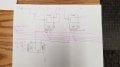
Yes, this does help a lot. I was talking with one of my professors, and we liked the first suggestion you had. From what you said, we understood that you would have a demultiplexer to select a multiplexer from a string of multiplexers that you would want to read from; then, you would read from that selected multiplexer to another multiplexer that sends data to the Pi on a single pin. Then we would cycle through this process until all pins are read. Below is a picture of this concept.

Is this what you meant?
 

Attachments

djsfantasi

Joined Apr 11, 2010
9,237
Yes, this does help a lot. I was talking with one of my professors, and we liked the first suggestion you had. From what you said, we understood that you would have a demultiplexer to select a multiplexer from a string of multiplexers that you would want to read from; then, you would read from that selected multiplexer to another multiplexer that sends data to the Pi on a single pin. Then we would cycle through this process until all pins are read. Below is a picture of this concept.

Is this what you meant?
This is basically the scheme I proposed in Post #18.
 

Thread Starter

Czexican1329

Joined Apr 23, 2018
57
We also researched using shift registers. We have looked at using at least two CY8C9560A 60-bit I/O Expanders to convert the parallel inputs of the IR sensors to serial data for the Raspberry Pi to read via the I2C protocol. We would have the sensors wired to the expander in a numbered/addressed layout that has the first sensor wired to the first input of the expander and the last sensor to the last input (the first sensor would be in the very top left corner, and the last sensor in very bottom right corner). The expander would continually scan for changes in the inputs, and once an input is triggered, an interrupt is activated. Then, based on which sensors are triggered, the Pi would take the new serial data from the input grid and output it to the LEDs to turn on the LEDs that are in the same addresses as the sensors triggered, as the LEDs would be numbered from 0 to n (with n being the max number of LEDs). What are your thoughts? Is this how it would possibly work?
 
Top