GFCI Keeps Tripping

Thread Starter

120volts

Joined Sep 26, 2014
62
Hello, Folks:

I'm working on a bathroom GFCI that keeps tripping. Very annoying.

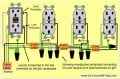
Layout: The circuit in question controls the GFI, two, 3-way light switches, garage ceiling lights, and one garage outlet that has an old frig plugged in.

What I have done:

1. Replaced GFI. This worked great for about 30 minutes. And I was working on another circuit outlet and was turning on and off the breaker, the new GFI would not stay on. Grrrrrr. It immediately shuts off. Yes, it does click on and off from test to reset; but it trips in a second or two.

2. Checked and redid all pigtails in the GFI junction box, the two switches and garage lights.

3. Thinking it might be either the frig outlet as it was old, I replaced that. Still trips. Checked all pigtails. I unplugged this appliance, and it still trips.

Now, in my haste I didn't check the load and line wires before I replaced the GFI as I usually do. I identified the load and line wires from the old GFI markings and applied that to the new GFI assuming they were correct. After all, the GFI was working but customer did report intermittent tripping.
I did notice the load and line wires were on opposing ends of the GFI outlet (top/bottom) on the new one. but didn't think much of it.

I was going to test the load/line wires and correct if wrong. I was also intending to temporarily swap out the circuit breaker and see if that's the culprit. Anything I should look at on the switches? All looks nice and tight on those and the switches work fine.

Any advice will be greatly appreciated!!
 

MrSoftware

Joined Oct 29, 2013
2,273
Does that circuit have any outside outlets? In two houses that I have lived in, for whatever reason the builder included 1 outside outlet on the same circuit as the bathroom GFCI circuits. Maybe they were trying to save $1 on another GFCI breaker? Anyway, in one of the houses when it rains a lot the outside outlet causes the GFCI breaker to trip. Check to see if you've got an additional outlet on the circuit that might be causing it to trip, possibly an outside outlet.
 

ifixit

Joined Nov 20, 2008
652
Time to check every inch (mm?) of the wire run itself. Start in the ceiling area where mice like to live and enjoy the warmth of the ceiling heat loss. Look for chewed wire, nail penetration and other damage. If you disconnect half the circuit and try it this will speed up locating the problem.

Good Luck
 

Reloadron

Joined Jan 15, 2015
7,850
Layout: The circuit in question controls the GFI, two, 3-way light switches, garage ceiling lights, and one garage outlet that has an old frig plugged in.
Refrigerators, especially old refrigerators tend to trip modern GFCI circuits. The problem is frequently the compressor motor having leakage as either capacitive or inductive leakage. When we figure a GFCI trip current can be as small as 4 or 5 mA it doesn't take much leakage and any older motors are capable of some leakage. Try the circuit less the fridge, maybe for a period run a separate extension cord for the refrigerator. See what happens.

Next, while I lean towards the fridge being the problem any outlet boxes with just a little moisture will also cause nuisance trips. Again, all it takes is a few mA.

Ron
 

Thread Starter

120volts

Joined Sep 26, 2014
62
Refrigerators, especially old refrigerators tend to trip modern GFCI circuits. The problem is frequently the compressor motor having leakage as either capacitive or inductive leakage. When we figure a GFCI trip current can be as small as 4 or 5 mA it doesn't take much leakage and any older motors are capable of some leakage. Try the circuit less the fridge, maybe for a period run a separate extension cord for the refrigerator. See what happens.

Next, while I lean towards the fridge being the problem any outlet boxes with just a little moisture will also cause nuisance trips. Again, all it takes is a few mA.

Ron
Sorry, I thought I already explained that. It is a very old refrigerator and I did leave it unplugged and GFI still trips so it's not that.
 

Reloadron

Joined Jan 15, 2015
7,850
Sorry, I thought I already explained that. It is a very old refrigerator and I did leave it unplugged and GFI still trips so it's not that.
My bad on that. :(

Next I start looking for a box with some moisture trapped in it. Somewhere there is a point where there is enough leakage current which is not being returned. Things like this can be a real pain to isolate.

Ron
 

MrChips

Joined Oct 2, 2009
34,626
I had a similar problem in a spanking new house (one year old).

First thing you need to do (as you have done) is to identify the entire circuit on the GFCI.
Next is to remove all loads on the circuit. If the problem still exists then you have to do a binary search on the circut.
In my case the GFCI tripped instantly. The fault was a short between EARTH and NEUTRAL behind one of the outlets.

Does it trip with or without loads connected?
 

spinnaker

Joined Oct 29, 2009
7,830
Does that circuit have any outside outlets? In two houses that I have lived in, for whatever reason the builder included 1 outside outlet on the same circuit as the bathroom GFCI circuits. Maybe they were trying to save $1 on another GFCI breaker? Anyway, in one of the houses when it rains a lot the outside outlet causes the GFCI breaker to trip. Check to see if you've got an additional outlet on the circuit that might be causing it to trip, possibly an outside outlet.

We must have had the same contractor because I had the same issue in my basement bathroom..

In the kitchen I problem with one tripping. Turns out it was operator error. :( I kept accidentally hitting the button when reaching around an appliance to unplug / plug in.
 
Not all GFCI's are created equal. Look for recalls for whatever brand your using.
Refrigerators are notorious for issues. (but you checked that)

COBWEBS. Any outlet in a wet environment (bathroom and garage) is prone to cobwebs. You can disconnect power at the source (breaker) and start looking for resistances to ground. You can also see if you can find the route and start bisecting. Disconnect half way. See if it occurs and then bisect the other half. You close on the problem very quickly.

Watch for shared neutrals.

If this is a AFCI/GFCI then loose connections can be an issue.

I think i would start by disconnecting N and L fom the breaker panel. Measure to ground from the disconnected stuff a voltage. If no voltage, then resistance. If resistance, start bisecting.

Outlet strips/surge suppressors and or anything with a switching power supply can do really bad things if a ground lets go. defective strips might have a bad ground. What can happen is that a filter in a switching power supply can place ~60V on the ground leg of the other devices.

Watch for outlets that don't have a good ground internally especially if made by P&S. I had 420 of their outlets be potentially BAD due to manufacturing. The ground was made by friction only. Plugging in two plugs and wiggling one, would cause the ground to "let go". Fortunately, I developed a test to identify. An outlet tester that had a light for grounds <1 ohms (guessing) could be plugged into one of the duplex outlests and an empty power cord plugged in the other. The cord was wiggled to see if the ground light went out.

It may not even be a GFCI symptom. I recently replaced a duplex outlet (say 6 months ago) and one day the fuse blew. I did the bisecting and because of known history, I was able to pull the outlet and keep it connected and make the problem go away.

There was another issue in the same circuit in a ceiling fan. Basically loose connections. I kept some loads running during the troubleshooting.
It was a medical alarm and the cordless phone system. It did take out 3 bedrroms.

What turned out, I think was the outlet design, but the manufacturer said it was the old box dimensions. Both are valid arguments, they said that a #12 wire on the side terminals should not touch the side when moving through the sliding space allowed. I said that there should be a shroud around the terminals preventing that. They disagreed. With plastic boxes, who cares. This was an old metal box. 58 years old.
 

BarryTron

Joined Nov 18, 2018
89
I had same problem couple years ago.

The fast way to go about it is to check if you have any load on the line that could be tripping it.

The second thing is to go buy a $10-15 GFCI and replace it. If the problem goes away - it was the GFCI going bad. If you still have the problem, then you will have to start thing each outlet that GFCI feeds and investigating (I would start with any outdoor outlets).

In my case just replacing the GFCI fixed the problem.
 

Thread Starter

120volts

Joined Sep 26, 2014
62
Wow. Thanks, folks!!

I actually had another idea. The circuit in question also includes the laundry room where I mentioned the two-3way light switches and a vent fan in addition to a light, both above the washer and dryer. Hmmm....moisture going up from the laundry room into the fan.or light causing corrosion and excess resistance...I didn't check these and will do so and hope it's it!!!

I don't hit the jobsite for a couple of weeks but will post an update around December 9 if anyone wants to check back.

@BARRY Tron: new GFI behaved identical to the new old. So what are the odds of two bad GFIs are probably unlikely. But I will consider this if I still can't find anything. Thanks.
 

BarryTron

Joined Nov 18, 2018
89
new GFI behaved identical to the new old. So what are the odds of two bad GFIs are probably unlikely. But I will consider this if I still can't find anything. Thanks.
Method of elimination. Start with the obvious and easiest: unplug everything. If you have replaced the GFCI and you still have the problem to go the next logical level: travel down the line from the GFCI and examine the wiring or the receptacles that the GFCI is feeding.

999.JPG
 

LesJones

Joined Jan 8, 2017
4,511
Have you done insulation test with an insulation tester. . (Megger.) If so what resistance readings reading did you get between earth and neutral and earth and live ? I did not ask this question before as I thought you where just the housholder but from post #13 you seem to be an electrical contractor so it is likely that you have an insultion tester,

Les.
 

Thread Starter

120volts

Joined Sep 26, 2014
62
No clue what an insulation test is. I'll research it. Sounds interesting and I always like to learn. I'm a handyman, a very good one, that does it all. I have a minor background in electronics and so love electrical work, as I do this website and all the contributors!!!

Thanks again, @BARRY Tron. I did open all the outlets and switches in question and everything was fine...no corrosion..tight pigtails, etc.

I will check the ceiling vent fan and ceiling light in the laundry room next time I'm there.
 

LesJones

Joined Jan 8, 2017
4,511
An insulation tester is basically an ohm meter designed to test resistance up to at least 50 Megohms. A test voltage much higher than a normal multimeter is used, In the UK where our mains voltage is 240 volts we would normally use a test voltage of 500 volts DC. I don't know what test voltage would be used in the US where the mains voltage is about 115 volts.

Les.
 

Thread Starter

120volts

Joined Sep 26, 2014
62
Hey, guys and gals: Sorry about the delay. I don't have any updates as of yet as this is a customer far away. But the good news is that I'll be definitely returning to work on it more in the next month or two and will update my work!
 

MisterBill2

Joined Jan 23, 2018
27,159
The very first question is "what all is the GFCI actually supposed to be protecting?" If it is only to prevent a shock hazard in the bathroom, then the solution is to remove all of the other circuits from the output terminals and instead tie them to the feed side. I had the same problem in one customer's home, the bathroom GFCI was always tripping. So I left it tripped and searched for whatever else in the house might be off, and causing the problem. Nothing was found. So I moved that circuit to the feed side terminals and no complaints in the five years since. Cheapskates who try to protect a whole $100K house with one $12 device often are the source of much grief. When only one outlet is in an area needing protection then it makes no sense to take the feed for the rest of the circuits through the GFCI, but some folks do it because they see the second set of terminals.
 

killivolt

Joined Jan 10, 2010
836
This is why I wish they had a layout of the electrical in the house, given to the homeowner. People will also add-on circuits without realizing the potential issues down the road or will add-on rooms without calculating the loads on each circuit. Locating these are difficult indeed, because they didn't do a home run back to the box just adding it to another circuit or not decreasing load elsewhere.

In my 1950's home both of these are an issue, to correct the problem I'm running a gas line to my range and dryer, I'll pickup 80 amps then divide these among my panel runs. Re-tighten all the grounds, it should illuminate my issues of popping breakers.

I'll add if it solved my issues or not after I run the gas line and rewire my 2 panels. Both have breakers so old they may also just be my only problem.

kv
 
Top