All you have to do is ask what help you need there are a lot of members here who would like to help you. Just have to ask. The more specific the question the better the answer you will get.
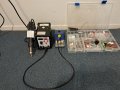
Yeah, the inventory shown is rather minimal, do you intend making circuit boards? Are you in need of a circuit drafting program?
What area of electronic circuits are you aiming for?
modern electronics is often used together with some sort of programmable device. this allows one to explore both electronics and programming. combining the two makes for much more flexibility and - more capable devices with fewer parts. there are tons of kits for every budget to consider.
You can avoid projects that require programming a device, because that requires a totally different skill set. And additional tools.
BUT, can you build a project just from a circuit drawing that has parts values???
I think he has a meter, but you do not need an oscilloscope to start with, that's for advanced users really. Also don't need a microscope but a decent magnifier glass might help if poor eyesight.
What area interests you specifically?
The subject area is quite wide !
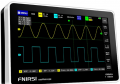
If you get to the point you think you need a 'scope, the portable FNIRSI range does it quite well & cheaply for beginners.
Maybe that is because you never were without one. I was without one when I first started out so I learned a lot of tricks to measure things with a meter. I think the first meter I got was a small panel meter for measuring current. I think it went up to 100ma or something, don't remember now. I didn't get a multimeter until sometime after that.
My first scope was only AC coupled ha ha. That was a pain in the neck to use. I had to build a switching circuit using an analog switch so I could actually measure AC riding on DC. It was junk but I got it for something like $20 USD used. My next scope was a decent CRT, then more recently a digital that can run on batteries too. Oh before that I got a $25 USD ARM based scope and actually used it to decode IR remote codes from several remote controls for TV and whatnot.
You can wire up an LED circuit without a scope. You can wire up as 555 timer with LED without a scope. You can wire up a lot of stuff without a scope really. You can even use Arduino dev boards without a scope. There are a lot of signals that you can't see with a scope too, and some that are very difficult to see.
on the bench one can have every tool imaginable. but once you are out in the field or closest one to the problem, you have to do with what you happen to have. sometimes it is only a DMM... or swiss army knife... or duct tape and a fork...
once i was doing on-site training for a large company. This included electrical maintenance. Normally we would do this inhouse or - send everything out but someone wanted to save on travel and shipping and offered to provide few sets of basic tools (list provided). Ok no problem... but when i got there, there was no tools at all. but then, in one of the nearby storage rooms they found good old Simpson VOMs so i made them use those. You should have seen shock and disbelief.... nobody in the group has ever used an analog multimeter... or understood why products without autoranging were ever created.
I did everything without a scope for the first seven or eight years that I was getting more seriously into electronics, starting in my junior year of high school (a span that included a break of three years while I served a call to active duty, but during which I still kept puttering around with electronics). I think that even at the time that I sold my first electronic design I hadn't yet actually used an oscilloscope -- if I had, it has been very minimally as part of a lab course. My big break came when the physics department chair approached me and asked if I was interested in a part time job as a building custodian. This wasn't a janitor job, but rather they rented/loaned out classroom space in the evenings and, mostly, on the weekends for various things and they needed someone to be physically present and, depending on the terms, provide them with things like overhead projectors and such. It had two huge benefits -- most of the time I just had to unlock the building and the rooms they were using and then relock them when they left. But, in the meantime, I had to be accessible in the building in case they needed something. So I got paid to do my homework. Second, it meant that I got the same key issued to me that the faculty got, which gave me access to the storerooms and elevator (which were what I really needed for the jobs) as well as the electronics lab and the research labs (which was not needed, but on the same submaster key). The department chair first told me that they were trusting me to not abuse that access, which strictly speaking meant not going into any room that I didn't need to for the job, but then made it clear that, as far as he was concerned, as long as no one could tell that I had been in a room, that it was a case of no harm no foul. Which I took to mean that I could use the equipment in the labs as long as I left everything as I had found it (and which, years later, he acknowledged was exactly the message he intended to send). At that point, I practically started living up in the electronics lab -- and other faculty routinely came in for one reason or another and none of them ever batted an eye.
So, yes, there are lots of interesting and worthwhile things you can do without a scope. For some of them, a scope brings little to nothing to the table. For others, you may not need a scope, but having one would sure make it a lot easier, quicker, and better. But there are also lots of projects that would be very difficult to nearly impossible without a scope, especially with a typical hobbyist-level skill set.
And let's not forget that there is a bit of a slope on the learning curve for using a scope or for what it actually shows us. Waveforms can be a lot more complicated than simply voltage or current levels. That's not to say that you should have have one though and I was very happy to finally get my first scope, even though it was the cheapest one you could ever imagine.
Now that I think back, way back that is, my first scope actually had a VTVM built into the same case as the scope. It was a pretty large case made of thick steel.
but you do not need an oscilloscope to start with, that's for advanced users really. Also don't need a microscope but a decent magnifier glass might help if poor eyesight.
Yes you can live without a scope, but without doing things seriously. Soon or later you will need one..
When you need to solder SMT components (through hole ICs are about to definetly disappear), you will need a microscope.
Maybe that is because you never were without one. I was without one when I first started out so I learned a lot of tricks to measure things with a meter. I
Of course, and when a scope cost two weeks salary I did the same. But now, you can get a capable little portable LCD storage scope for a couple of hours at minimum wage. It would be a waste of many hours learning such tricks.
I think anyone starting now should start with a multimeter, variable power supply and a cheapo scope, all of which can be had for the price of a dinner out for two (in the US). And I suggest buying the romantic partner some flowers or other gift to make up for the lost date night.

 Facebook
 Google
 GitHub
 Linkedin