Facebook
 Google
 GitHub
 Linkedin

hello,
i am working through the voltage divider worksheet. i got to question 20 and couldn't figure out how to calculate it. i got most of the previous questions correct.
there are three pots in series that make up a voltage divider. the top and bottom pots are 5k with the middle pot 100k, the outputs of the 5k pots are connected to the inputs of the 100k pot. the setting for the pots is measured in percentages,
Note that the upper 5 kΩ potentiometer is set to its 20% position (m = 0.2), while the lower 5 kΩ potentiometer is set to its 90% position (m = 0.9), and the 100 kΩ potentiometer is set to its 40% position (m = 0.4).
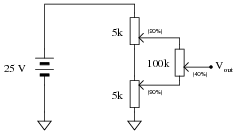
so i figured that the top resistor was 4000 ohm before the 100k and 1000 ohm in parallel with the 100k. the bottom 5k has 500 ohms in parallel with the 100k and 4500 ohms to ground. the 1000 and 500 in parallel with 100k is 1477.8 ohms this is then in series with the 4500 ohms making 5977.8 ohms, this is R2. this is where i am getting stuck. i cant get the correct answer. i add the 5977 to the top 4000 and get 9977.8 which is almost the total resistance answer which is 9978 ohms. the voltage part is the problem. the 100k is in parallel with the 1500 ohms but does the 40% affect the total parallel value, or does it affect the 100k on its own.
question 21
Which voltage divider circuit will be least affected by the connection of identical loads? Explain your answer.
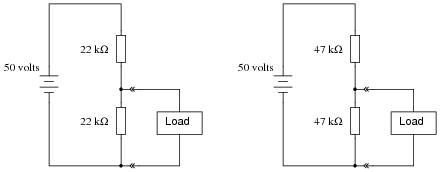
What advantage does the other voltage divider have over the circuit that is least affected by the connection of a load?
for this i thought that the current through the first divider would be higher and the load would not affect the circuit too much. but the answer states that the second divider wastes less energy? i am not sure why this is?
any help would be great!
thanks
simon
i am working through the voltage divider worksheet. i got to question 20 and couldn't figure out how to calculate it. i got most of the previous questions correct.
there are three pots in series that make up a voltage divider. the top and bottom pots are 5k with the middle pot 100k, the outputs of the 5k pots are connected to the inputs of the 100k pot. the setting for the pots is measured in percentages,
Note that the upper 5 kΩ potentiometer is set to its 20% position (m = 0.2), while the lower 5 kΩ potentiometer is set to its 90% position (m = 0.9), and the 100 kΩ potentiometer is set to its 40% position (m = 0.4).
so i figured that the top resistor was 4000 ohm before the 100k and 1000 ohm in parallel with the 100k. the bottom 5k has 500 ohms in parallel with the 100k and 4500 ohms to ground. the 1000 and 500 in parallel with 100k is 1477.8 ohms this is then in series with the 4500 ohms making 5977.8 ohms, this is R2. this is where i am getting stuck. i cant get the correct answer. i add the 5977 to the top 4000 and get 9977.8 which is almost the total resistance answer which is 9978 ohms. the voltage part is the problem. the 100k is in parallel with the 1500 ohms but does the 40% affect the total parallel value, or does it affect the 100k on its own.
question 21
Which voltage divider circuit will be least affected by the connection of identical loads? Explain your answer.
What advantage does the other voltage divider have over the circuit that is least affected by the connection of a load?
for this i thought that the current through the first divider would be higher and the load would not affect the circuit too much. but the answer states that the second divider wastes less energy? i am not sure why this is?
any help would be great!
thanks
simon