Getting AC from a laptop CCFL inverter

Thread Starter

seanspotatobusiness

Joined Sep 17, 2016
210
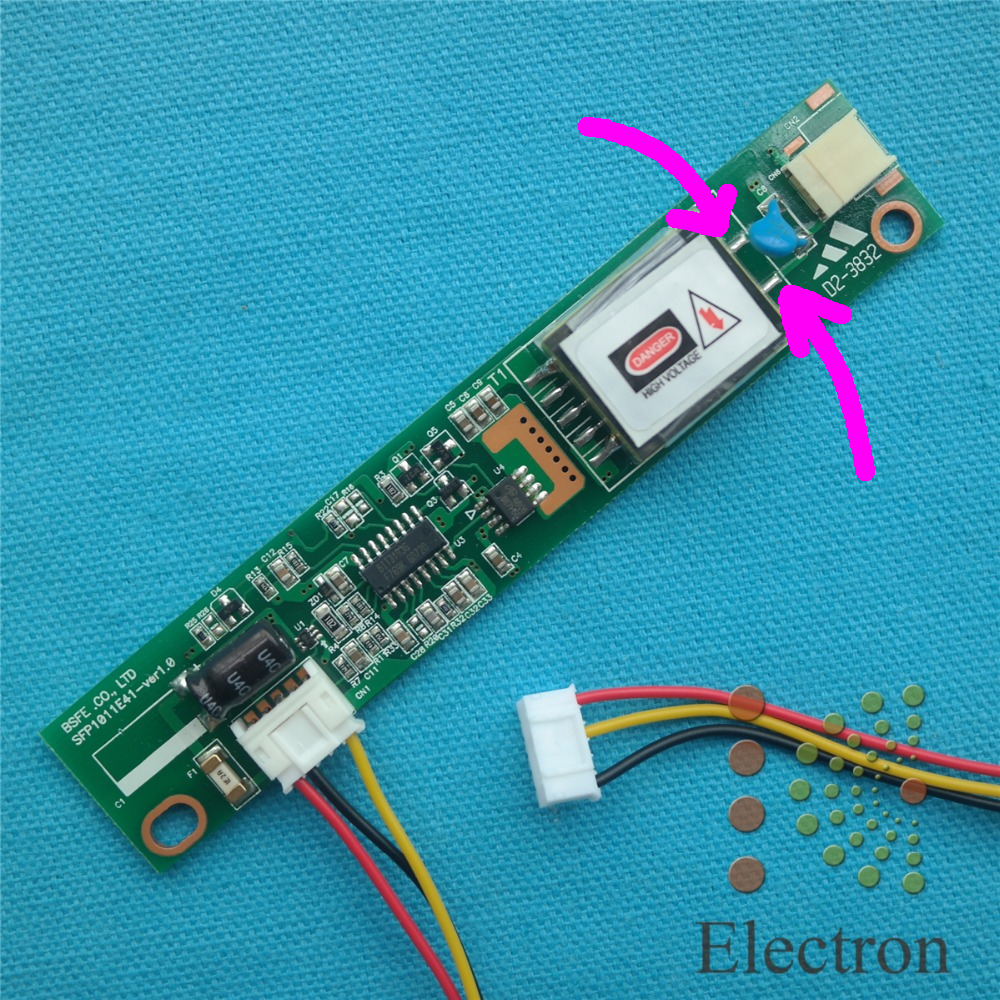
I would like to power a neon indicator lamp which I heard can be done using a laptop CCFL inverter. The problem is that these inverters output DC which means that only one filament in the indicator lights up. I was wondering, can I just bypass the capacitor/resistor at the end and connect directly to the transformer? Can I limit the current? I think if I just put a resistor there, the inverter will increase the voltage to force the same amount of current through.

The image below is just a random picture I found and not the design I will necessarily use (I don't know exactly what example I will use yet).

Edit: I tried again and this time both filaments illuminated even when only one end of the lamp was connected. I think I can use the brightness adjust pin to reduce the current applied to the lamp.

 
Last edited:

ian field

Joined Oct 27, 2012
6,536
I would like to power a neon indicator lamp which I heard can be done using a laptop CCFL inverter. The problem is that these inverters output DC which means that only one filament in the indicator lights up. I was wondering, can I just bypass the capacitor/resistor at the end and connect directly to the transformer? Can I limit the current? I think if I just put a resistor there, the inverter will increase the voltage to force the same amount of current through.

The image below is just a random picture I found and not the design I will necessarily use (I don't know exactly what example I will use yet).

Edit: I tried again and this time both filaments illuminated even when only one end of the lamp was connected. I think I can use the brightness adjust pin to reduce the current applied to the lamp.


The current is sort of limited anyway - typically CCFL tubes need about 1200V to strike, and ionise at around half that.
 

Thread Starter

seanspotatobusiness

Joined Sep 17, 2016
210

Alec_t

Joined Sep 17, 2013
15,111
The CCFL tubes have a thick wire and a thin wire.
The CCFLs shown here use AC and don't have thick and thin wires.
If the output is AC then this cannot be correct, right?
It can be correct for AC or DC. If one terminal of a supply is at ground potential then it doesn't need to be insulated from anything else at ground potential; however, the other terminal does need to be insulated.
 
Last edited:

Thread Starter

seanspotatobusiness

Joined Sep 17, 2016
210
Thanks for everyone's responses. I have designed this circuit which reroutes the output of the inverter to a resistor when the lamps are not lit to prevent the inverter producing a very high voltage when the lamps are not lit. I actually have two circuit designs but I don't know whether one is better than the other, other than the first using fewer components.

 
Last edited:

tcmtech

Joined Nov 4, 2013
2,867
I'm pretty sure your NPN transistors are not going to do anything good being fed AC power.

As for snubbing your extra voltage when you're indicators are off you could just stack two neon bulbs in series to work as a voltage snubber that is double the other neons rung voltage.
 

Thread Starter

seanspotatobusiness

Joined Sep 17, 2016
210
I'm pretty sure your NPN transistors are not going to do anything good being fed AC power.

As for snubbing your extra voltage when you're indicators are off you could just stack two neon bulbs in series to work as a voltage snubber that is double the other neons rung voltage.
Thanks for your response!

What about this change with an inverted transistor to allow the current in the reverse direction?


Would my solution to snub extra voltage when the indicators are off not work (when modified as above to allow the reverse current)?
 

Alec_t

Joined Sep 17, 2013
15,111
That arrangement won't work :(. The base-emitter junction of a bjt has a reverse breakdown voltage of only around 5 or 6 Volts.
I second tcmtech's suggestion to use a couple of neons stacked to act as a voltage clamp. That would also make selection of any switching device less critical.
 

Alec_t

Joined Sep 17, 2013
15,111
Now we're cooking!
The first circuit will have problems because the NPN can't control in both half-cycles.
The second circuit looks more promising but would need a dropper resistor between the transformer and the stacked neons.
The MOC3010 has an off-state voltage of only 250V. It also seems to be non-stocked by major suppliers so may well be obsolete.
I don't know what frequency your CCFL inverter operates at, but LTspice is telling me some neons may not like operating at a frequency much higher than mains frequency.
 

tcmtech

Joined Nov 4, 2013
2,867
The opto triac systems could work in theory, however given the high frequency the tiny inverter output operates at there is a good chance it still wont work being most common opto-triacs are designed to work at power line frequencies to maybe a few hundred Hz at best.

As for the neons, they won't care what frequency the power is at.
 

Alec_t

Joined Sep 17, 2013
15,111
The NPN in the latest circuit still can't control the triac in both half-cycles. Also, 5V and 1meg will allow only 5uA through the triac gate.
As for the neons, they won't care what frequency the power is at
Maybe, maybe not. The only Spice model I have implies there is a ~100uS time constant involved in the discharge process, but I've no idea which particular neon the model relates to or if the model is correct.

If it were me I think I'd just strip the guts from a retro-style panel-mount neon indicator and replace them with a LED :D.
 
Last edited:

tcmtech

Joined Nov 4, 2013
2,867
Maybe, maybe not. The only Spice model I have implies there is a ~100uS time constant involved in the discharge process, but I've no idea which particular neon the model relates to or if the model is correct.
Neon bulbs will light up at RF frequencies so that says they can take frequencies well beyond what a CCFL inverter puts out. I've never seen a real life neon bulb of any design that wasn't RF sensitive.

It's also why I don't trust simulator programs one bit. They're too limited on determining what reality can do Vs what they say reality cant do even when it easily can.
 

ian field

Joined Oct 27, 2012
6,536
Neon bulbs will light up at RF frequencies so that says they can take frequencies well beyond what a CCFL inverter puts out. I've never seen a real life neon bulb of any design that wasn't RF sensitive.

.
There was a fad for sticking a neon on the end of CB whips.
 
Top