Generic 40V battery will not work on my Hart Lawn Mower?

Thread Starter

davidpsr

Joined Jan 12, 2026
8
The makers of cordless tools and appliances seem to be putting more resources into designing for brand incompatibility than they do improving the product or offering more or better features for their brand. Virtually 100% of major manufacturers of cordless power tools and lawn and garden equipment have made changes to their batteries and chargers to make them incompatible with each other. The driver for these changes is, or course. money. Why would I make equipment that is compatible with every other charging system when I can make mine unique enough that it takes more than a simple jumper wire to by-pass my security circuitry?

And if the cost of doing so is significant, guess who pays for it. Just tack it onto the selling price and no one is the wiser. Which brings me to my current (no pun intended) project: Create an adapter to allow my Hart 40V mower to be powered by FAR less expensive Greenworks or Ryobi or almost any other 40V power supply. At the outset, I assumed I'd simply duplicate the configuration of Greenwork's charging block with my 3D printer, bring the 40V current out through 12 Ga AWG wire and connect them to the Hart mower's 40V input circuit and mow away.

Turns out, I must have been born and raised in some purchasing agent's dream world. I should have suspected something before I even cranked up the 3D printer. It requires only two wires to complete a 40Vdc circuit. The Hart connecting block has four terminals. Ahhhhh... a connection to the start switch, I thought. Maybe that, but much more I quickly found out. Paramount among the features of my new mower is a 'BMS' or Battery Maintenance System which controls the flow of current from the battery to the mower's powerful 40V two-speed, no-brush motor. But also included in that tiny circuit board is a just as priority job of telling the mower that it is connected to a genuine Hart 40V battery.
 

MrChips

Joined Oct 2, 2009
34,700
Battery packs usually come with four or more more contacts. Two contacts are for power. One or two additional contacts are needed to measure battery temperature. This is a simple and essential way to monitor the health of the battery pack.
 

Thread Starter

davidpsr

Joined Jan 12, 2026
8
Battery packs usually come with four or more more contacts. Two contacts are for power. One or two additional contacts are needed to measure battery temperature. This is a simple and essential way to monitor the health of the battery pack.
The additional contacts do far more than measure temperature, although that is a very important part of the secondary function of the BMS. Temperature is usually measured as a function of resistance in the circuit, but duplication of the resistance across the secondary terminals does not give the BMS the go-ahead to allow current to flow on the primary circuit leads.
 

davescan

Joined Jan 16, 2026
1
Actually, the two inside contacts (mower side) are for temperature sensing. I found 2 different subjects about it online.
A fella hooked 40K resistor to them on the mower, wired in a Ryobi battery and it ran.
 

Ya’akov

Joined Jan 27, 2019
10,226
The additional contacts do far more than measure temperature, although that is a very important part of the secondary function of the BMS. Temperature is usually measured as a function of resistance in the circuit, but duplication of the resistance across the secondary terminals does not give the BMS the go-ahead to allow current to flow on the primary circuit leads.
Welcome to AAC.

In fact in many designs the only connection between the battery and tool (mower in this case) aside from the power is to a thermistor and the normal value must be present before the the tool will operate. This is much more common than any sort of serial data communications between battery and tool.
 

MisterBill2

Joined Jan 23, 2018
27,316
Certainly temperature sensing is important, both during charging and during use. So that explains at least one of the connections.

DID the TS get an original battery when they bought the mower?? Working or not, an OEM battery will contain enough information to (probably) see what the other terminals must do. Substituting a resistor of a similar value should allow normal operation. The temperature sensor may possibly use the fourth terminal as well.
 

Thread Starter

davidpsr

Joined Jan 12, 2026
8
Certainly temperature sensing is important, both during charging and during use. So that explains at least one of the connections.

DID the TS get an original battery when they bought the mower?? Working or not, an OEM battery will contain enough information to (probably) see what the other terminals must do. Substituting a resistor of a similar value should allow normal operation. The temperature sensor may possibly use the fourth terminal as well.
TS bought the mower new, with a new OEM 40Ah battery. However, resistance measurement across the center two terminals and across the Neg (-) terminal and either of the center terminals yields a value of 0 ohm on a k-ohm scale. I suspect the BMS takes the measurable resistance across the center terminals to zero with no load on the battery. I tried connecting the center terminals to a known good battery to emulate the value the BMS wants to see and still get a 3 second surge on the power terminals, then drops to 0. The same as if there was nothing connected to the center terminals.
 

MisterBill2

Joined Jan 23, 2018
27,316
Of course the situation could also be like the one with HP batteries for a while, back a few years. The computer would only charge an OEM HP battery at anything close to a reasonable rate. Others would get a low trickle charge at best. So we were stuck spending more than twice as much for the HP battery, if we did not want to spend two days charging the less costly one.
 

Thread Starter

davidpsr

Joined Jan 12, 2026
8
The amount of data that a tiny microprocessor can hold is enough to perform any number of tasks, including recognition of whether a battery is 'genuine' or not. I am convinced that Hart uses that capability to determine whether the connected battery is genuine Hart or not. I'm also convinced that Greenworks uses the same or similar technology to determine whether the battery connected to their hardware is 'genuine' Greenworks, and if not will not allow current to pass through the power terminals. In the case of Greenworks, they allow a three or four second surge to pass to test the battery under load and if it determines that the battery is not a genuine Greenworks, opens the circuit path and stops current flow.
 

Thread Starter

davidpsr

Joined Jan 12, 2026
8
The amount of data that a tiny microprocessor can hold is enough to perform any number of tasks, including recognition of whether a battery is 'genuine' or not. I am convinced that Hart uses that capability to determine whether the connected battery is genuine Hart or not. I'm also convinced that Greenworks uses the same or similar technology to determine whether the battery connected to their hardware is 'genuine' Greenworks, and if not will not allow current to pass through the power terminals. In the case of Greenworks, they allow a three or four second surge to pass to test the battery under load and if it determines that the battery is not a genuine Greenworks, opens the circuit path and stops current flow.
I'm finished with my attempts to modify batteries and circuits to use other than 'name brand' batteries in various hardware devices. I inadvertently connected a battery to my Greenworks device in reverse polarity and fried both the battery and the device. :-( My mistake, but one that's too easily made.
 

Thread Starter

davidpsr

Joined Jan 12, 2026
8
Welcome to AAC.

In fact in many designs the only connection between the battery and tool (mower in this case) aside from the power is to a thermistor and the normal value must be present before the the tool will operate. This is much more common than any sort of serial data communications between battery and tool.
On the other hand, some manufacturers make it difficult , if not impossible to determine the value(s) of the thermistor which converts temperature readings to resistance values. It doesn't take an engineering genius to write a routine to prevent someone from using a simple VOM to read the resistance values of an onboard thermistor. Possibly a given resistance value is all that is needed to emulate the onboard thermistor, but if no one knows how to read that value, the simplicity in replacing it with a known resistance value is lost.
 

Ya’akov

Joined Jan 27, 2019
10,226
On the other hand, some manufacturers make it difficult , if not impossible to determine the value(s) of the thermistor which converts temperature readings to resistance values. It doesn't take an engineering genius to write a routine to prevent someone from using a simple VOM to read the resistance values of an onboard thermistor. Possibly a given resistance value is all that is needed to emulate the onboard thermistor, but if no one knows how to read that value, the simplicity in replacing it with a known resistance value is lost.
I have never seen nor heard of a thermistor being obfuscated to prevent mimicry. Thermistors come in a set of common values, and most packs I have come across use either a 10kΩ NTC or 47kΩ NTC device for the cost of the part and the generally suitability to the temperature range.

You can try those two values (and 100kΩ which seems much less common but has appeared) or you could use a 100KΩ pot and find a value that works, then replace it with a fixed resistor. Simply measuring the T pin with an ohmmeter will almost certainly work, though—making sure the device is at ~25°C, which is the common rated temperature for the nominal value.

If a manufacturer really wanted to prevent casual bypassing they would use a digital device and serial communications. It would actually be difficult to obscure the value of the T pin since it has be be read by the tool and it would greatly increase the BoM for no real advantage.
 

Ya’akov

Joined Jan 27, 2019
10,226
The amount of data that a tiny microprocessor can hold is enough to perform any number of tasks, including recognition of whether a battery is 'genuine' or not. I am convinced that Hart uses that capability to determine whether the connected battery is genuine Hart or not. I'm also convinced that Greenworks uses the same or similar technology to determine whether the battery connected to their hardware is 'genuine' Greenworks, and if not will not allow current to pass through the power terminals. In the case of Greenworks, they allow a three or four second surge to pass to test the battery under load and if it determines that the battery is not a genuine Greenworks, opens the circuit path and stops current flow.
It wasn't hard to find the information about this.

Hart is made by TTI, who also make Ryobi and Milwaukee among others. Hart batteries are based on Ryobi batteries though they are apparently not identical.

Unlike Milwaukee, Hart and Ryobi batteries do not use digital communications between the tool and battery. They use a 10kΩ NTC thermistor and in some cases an additional fixed resistor that signals a pack ID (capacity, type, &c.).

So, if there is an additional pin (ID), it also needs to be present and of the proper value for the tool to operate, otherwise, a 10kΩ resistor on the T pin will make it work.
 

MisterBill2

Joined Jan 23, 2018
27,316
This thread has totally validated my choice to avoid battery powered power tools in favor of mains powered tools that use electric motors and mains power. The benefits I see are: First, never needing to recharge batteries, nor ever replace them, and second, more power available during the operation of the mower, the leaf blower, and the trimmer.. The third benefit is not having to store the batteries inside during freezing weather, since batteries must not be allowed to freeze.
Also, mains powered tools tend to be less expensive than battery powered ones.
In addition, all power cords appear to be universally interchangeable among the different tools.
 

Ya’akov

Joined Jan 27, 2019
10,226
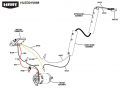
A little further research suggests that the temperature sensor is not used by the tool, but, and cleverly, it appears to use the BMS MOSFETS for power switching based on this parts diagram.


1768739773780.png
 

Ya’akov

Joined Jan 27, 2019
10,226
This thread has totally validated my choice to avoid battery powered power tools in favor of mains powered tools that use electric motors and mains power. The benefits I see are: First, never needing to recharge batteries, nor ever replace them, and second, more power available during the operation of the mower, the leaf blower, and the trimmer.. The third benefit is not having to store the batteries inside during freezing weather, since batteries must not be allowed to freeze.
Also, mains powered tools tend to be less expensive than battery powered ones.
In addition, all power cords appear to be universally interchangeable among the different tools.
On the other hand, battery powered tools are now more powerful than mains powered versions (when needed). They are far more portable. Removable batteries allow short downtime for battery swaps, and some things—such as lawnmowers—are impractical for most users when a cord must be used.

All of my power tools, with the exception of a couple of hold out cases (e.g.: angle grinder, stationary table saw) are battery powered. Though I do have battery powered versions of these as well. The very small, strangely powerful drills, drivers, saws, and the like that are currently available are very compelling.

The battery life is excellent and the power exceeds the ~1800W of the wall outlet (and even less when you throw a 100FT extension on the tool). And recently, I am using 12V tools for most things, and only have a small number of 18V tools that fill roles the 12V versions can't.
 

MisterBill2

Joined Jan 23, 2018
27,316
Certainly "Y" makes a valid point. My experiences with battery yard tools is not current, and based mostly on doing work helping out others who were no longer able to d the work themselves. My conclusion was made quite a few years ago.
But still, especially for mowers, the plug-in types have been very good, although none of them lasted more than ten years. I have worn out three of the plug-in mowers since I started using them. The funny part is that the first one came from an individual who had repeatedly cut the cord while mowing. When I got that first electric mower, i asked about the cord to go with it, he said "You don't want it". It had been patched and repaired quite a few times. He was right.
 

Thread Starter

davidpsr

Joined Jan 12, 2026
8
I have never seen nor heard of a thermistor being obfuscated to prevent mimicry. Thermistors come in a set of common values, and most packs I have come across use either a 10kΩ NTC or 47kΩ NTC device for the cost of the part and the generally suitability to the temperature range.

You can try those two values (and 100kΩ which seems much less common but has appeared) or you could use a 100KΩ pot and find a value that works, then replace it with a fixed resistor. Simply measuring the T pin with an ohmmeter will almost certainly work, though—making sure the device is at ~25°C, which is the common rated temperature for the nominal value.

If a manufacturer really wanted to prevent casual bypassing they would use a digital device and serial communications. It would actually be difficult to obscure the value of the T pin since it has be be read by the tool and it would greatly increase the BoM for no real advantage.
Thank you for your input, Ya'akov. I'm simply going to stop experimenting with battery brand switching since I've spent enough money on various stuff to pay for a lifetime supply of Hart batteries and then fried my most used Greenworks battery and edger/trimmer by accidentally applying reversed polarity 40V current to it.
 
Top