Gathering temperature/humidity data from dozens of closely spaced spots.

Thread Starter

sgbotsford

Joined Nov 8, 2024
10
I want to monitor temperature and humidity on a per tray basis in a seed drier, on a per jar basis in storage, and in a per bag basis in pre-processing.

I want to do this cheaply.

Idea 1. Something like a raspberry pi and a data bus that works in a way similarly to the way these addressable light strips work. Minimum wiring. Each device stores state, and when queried, sends it's two numbers back. Everyone else on the bus knows to keep quiet and listen for their moment to shine.

Idea 2. Still use the RPi for collection, but instead of wires, each device is on either bluetooth or wifi. The win for this is that I can drop 1 to 4 devices in each tray, and not have to deal with stringing wires. (Even when it's not the printer cable, it's the printer cable....)

Downside here is that they need some form of energy storage.

I don't need rapid data collection. Once every 10 minutes would be fine.

Perhaps there is a commercial device that already does this and doesn't cost the earth.
 

MrChips

Joined Oct 2, 2009
34,626
Bluetooth is attractive but as you say, each sensor needs to be powered.
If I were to do this, I would choose the DHT11 temperature and humidity sensor. It uses three wires, power, ground, and data.
The problem with this is that it is not addressable.

You can use a different pin of the microcontroller for each sensor. I would prefer to use a single-wire bus where each sensor has a unique address. In order to implement this scheme, I would use a small 8-pin MCU at each sensor to handle the bus interface. This will require MCU programming knowledge and experience on your part.

For a large greenhouse operation, I would go with a RS-485 bus. This would require four wires, power, ground, and two data wires. It would handle just about the largest greenhouse you can manage.
 

MisterBill2

Joined Jan 23, 2018
27,159
My guess is that also the implementation should be toward the cheap side, and that is in conflict with what I see as needing a bunch of sensors that are both accurate and repeatable as well as cheap, and do not require much calibration effort. Certainly wired and multiplexed could be cheaper but probably a pain. And wireless demands that each sensor point have an identity AND a transmitter of some kind. and now the whole concept has become both complex and not cheap. Is there some sort of budget that we should know about???
 

Thread Starter

sgbotsford

Joined Nov 8, 2024
10
My guess is that also the implementation should be toward the cheap side, and that is in conflict with what I see as needing a bunch of sensors that are both accurate and repeatable as well as cheap, and do not require much calibration effort. Certainly wired and multiplexed could be cheaper but probably a pain. And wireless demands that each sensor point have an identity AND a transmitter of some kind. and now the whole concept has become both complex and not cheap. Is there some sort of budget that we should know about???
I don't have a budget yet. At this point I'm spitballing, and learning. I'm leaning toward some form of modular system, with a cluster of sensors hanging off an RS435. My limited experience is that wire is trouble. A dead simple micro controler that plugs into power, and has 10-20 sensors.

Total sensors:

This is for process and storage monitoring in cone processing.:

Pre-process storage: Initially: 1 sensor at center and at edge of storage container. (usually a 2 cubic foot mesh bag. Once I verify that cones don't heat up when stored in mass will likely reduce to 1 sensor per batch of cones. (Batch = whjat was collected in a given day.

Drying rack: Cones are dried on a stack of bread tray currently with a heater underneath. Temps ideally are between 35 and 40 C. sensors on the surface and center of the resulting block. I'll fool around, but initially 9 sensors on bottom and top rack, and 5 on intermediate racks. Stack is 6-10 racks high.

Baking rack: Some cones require a brief exposure to temperatures of about 65-80 C. For this my idea is to turn an old stand up freezer into low temperature oven. (Hmm. Maybe it would be better to use an oven as an oven. Much smaller volume. Ok. Different question.)

Sensors in a similar array to drying rack.

This is making the $6 commercial sensors look good, at least during this protyping stage.
 

MisterBill2

Joined Jan 23, 2018
27,159
For cheap sensors, silicon diodes have a forward voltage drop versus temperature relation that is fairly linear over a range. And low power diodes can be quite cheap, and several could be put in series to increase the temp coefficient. So that might possibly be alternative temp sensor.
 

JohnSan

Joined Sep 15, 2018
121
The Xiaomi devices suggested earlier will be hard work.
There doesn't seem to be any stock and you will have a lot of work to do in re-flashing the firmware, on each device, to work with an ESP32 or RasPi.

If you need temperature and humidity:-
I suggest you try Sonoff devices.
None of these devices have 'a probe'. You will just place the device where you need it. Bear in mind they are wireless, so it rules out any metal type boxes or cages. You will need to test for range connectivity as Zigbee is a relatively nearfield signal system. But you can get signal repeaters that extend the range.

I have three of their temperature & humidity displays - SNZB-02D - connected to a RasPi4, via a Zigbee 3.0 USB dongle, using Home Automation. There are cheaper versions of the device which provide the same data but with no integral display. Those models are SNZB-02 and a later version SNZB-02P. Prices vary widely upon supplier.

To connect them to the HA system:- it's a couple of mouse clicks, press the button on the back of the device, give it a name on HA system and that's it. You then add the values to a display or graph etc.

Depending on how you want the data to be presented, you could instead use a ZBBridge-P and use their 'eWeLink' app on your phone to display the data on that. The bridge will also connect to (your) Wifi router, so I believe you could access the data from anywhere you have wifi, on your phone. I haven't used their phone app and ZBBridge so you'll need to check it's suitability.

If you use a RasPi:-
Home Automation is a free package you can install, which supports many other smart devices/systems, as well as Sonoff stuff.
It's totally customisable so you can present the data in any format you care to think up. Numerial. Graphs.
It is also totally programmable - say, to give notifications when a sensor data reaches particular values.
It's a bit of a learning curve initially, but there is a Forum and community online to help sort things out.
It might also be useful to add your live energy consumption data into it ?

Sorry for the long post.
 

nsaspook

Joined Aug 27, 2009
16,249
The Xiaomi devices suggested earlier will be hard work.
There doesn't seem to be any stock and you will have a lot of work to do in re-flashing the firmware, on each device, to work with an ESP32 or RasPi.

If you need temperature and humidity:-
I suggest you try Sonoff devices.
None of these devices have 'a probe'. You will just place the device where you need it. Bear in mind they are wireless, so it rules out any metal type boxes or cages. You will need to test for range connectivity as Zigbee is a relatively nearfield signal system. But you can get signal repeaters that extend the range.

I have three of their temperature & humidity displays - SNZB-02D - connected to a RasPi4, via a Zigbee 3.0 USB dongle, using Home Automation. There are cheaper versions of the device which provide the same data but with no integral display. Those models are SNZB-02 and a later version SNZB-02P. Prices vary widely upon supplier.

To connect them to the HA system:- it's a couple of mouse clicks, press the button on the back of the device, give it a name on HA system and that's it. You then add the values to a display or graph etc.

Depending on how you want the data to be presented, you could instead use a ZBBridge-P and use their 'eWeLink' app on your phone to display the data on that. The bridge will also connect to (your) Wifi router, so I believe you could access the data from anywhere you have wifi, on your phone. I haven't used their phone app and ZBBridge so you'll need to check it's suitability.

If you use a RasPi:-
Home Automation is a free package you can install, which supports many other smart devices/systems, as well as Sonoff stuff.
It's totally customisable so you can present the data in any format you care to think up. Numerial. Graphs.
It is also totally programmable - say, to give notifications when a sensor data reaches particular values.
It's a bit of a learning curve initially, but there is a Forum and community online to help sort things out.
It might also be useful to add your live energy consumption data into it ?

Sorry for the long post.
+1

HA is great if your sensor has data in a format usable by some plugin or general method like MQTT and JSON. I run HA from computer ranging for HPE enterprise servers to a Orange PI 3. I also design my own sensor systems to be compatible with HA.
1733421943811.png
GW1100B Soil Temperature 1
 
Last edited:

LesJones

Joined Jan 8, 2017
4,511
I played with DHT11 sensors but found that that the readings on different devices did not agree with each other. I changed over to using BME280 sensors and they seem much better. I use them together with a PIC12F1840 and HC12 (433 Mhz tranciever module.) I collect the data on a PC with another HC12 connected to a serial port. It requests data by sending out a few characters which contan the address of each sensor unit.

Les.
 

nsaspook

Joined Aug 27, 2009
16,249
I played with DHT11 sensors but found that that the readings on different devices did not agree with each other. I changed over to using BME280 sensors and they seem much better. I use them together with a PIC12F1840 and HC12 (433 Mhz tranciever module.) I collect the data on a PC with another HC12 connected to a serial port. It requests data by sending out a few characters which contan the address of each sensor unit.

Les.
+1

The BME280 is an outstanding sensor.
https://forum.allaboutcircuits.com/...tter-for-this-application.193257/post-1823342
 

LesJones

Joined Jan 8, 2017
4,511
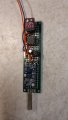
Here is a picture of one of my remote BME280 sensing units. (The 8 pin IC is a PIC12F1840)
20241209_174827.jpg
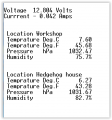
Below is a screen capture of received data from two BME280 sensors and one INA219 (Voltage and current sensor.)
This is just manually requesting data by sending the address characters from Tera Term (Terminal emulator program.)
Screen Shot 12-09-24 at 05.58 PM.PNGThe first one is from a similar unit with an INA219 sensor. This was requiested by sending characters #G
The next two are from remore BME280 sensors. The first requested by sending #A The second by sending #B

Les.
 
Top