Gallien Krueger 2000 CPL

Thread Starter

pilau

Joined Mar 12, 2025
6
Novice here. Looking into 80s rack preamp GK 2000 CPL. It has a single input, 2 switchable channels, stereo outputs, and built in compressor, reverb & chorus. It sounds killer. I'm trying to answer the question: where in the circuit does this amplifier turn from mono into stereo, and what exactly is the stereo effect/content - i.e. how are the left & right channels different.

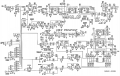
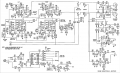
Attached are the preamp's schematics. As far as I can tell, the whole guitar signal chain (first page), incl. the compressor, up to and not including the FX is all mono. The signal lead labelled "D" feeds into a four circuits (2nd page): dry-lo, dry-hi, chorus, and reverb that all end in a kind of stereo mixer. Signal lead "E" feeds the reverb gate circuit.

Observations/questions - correct me if I've misunderstood anything:
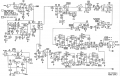
  1. I can't figure out the difference between dry-lo and dry-hi. Really curious about that split. Is that a frequency split or a volume split?
  2. Unless I'm missing something, the chorus seems to operate entirely in mono, which is different than i.e., the ADA MP1, a popular comparable preamp from the same era, where the original signal is split into 2, one gets mixed with the chorus signal, and the other as well but with its chorus component phase shifted by 180°. I couldn't tell if there's any phase shift on the L or R channels of the chorus on the 2000CPL.
  3. The reverb seems to be the only circuit doing actually doing something in stereo. It seems that the 6 taps of the MN3011 BBD chip (each providing a different timing window) are divided between the left and right channels. I am not an expert but maybe that gives an expanded stereo reverb image.
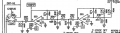
  4. But then later, in page 3, we can see both balanced and unbalanced sets of outputs have a mono/stereo switch each. I am not familiar with their symbol for switch, and can't really figure out what happens with either switch in mono mode.
  5. Beyond that, it seems the output circuits of either L/R channel are identical in both balanced/unbalanced circuits. I couldn't identify if there's any kind of phase shifting or other shenanigans going on.
Any input is greatly appreciated!

1741816681939.png

1741816702543.png

1741816728981.png
 

Attachments

MrChips

Joined Oct 2, 2009
34,629
Welcome to AAC!

You cannot go from mono to stereo. You can go from stereo to mono.
Input at J1 is mono source.
Stereo input is at J3.

MN3007 and MN3011 create CHORUS and REVERB effects and drive Left and Right channels from the mono source.
After that, L and R channels are separate. They can be joined by the STEREO/MONO switch to produce the same content at LINE OUTS.
 

Thread Starter

pilau

Joined Mar 12, 2025
6
You cannot go from mono to stereo. You can go from stereo to mono.
Input at J1 is mono source.
Stereo input is at J3.
Thanks so much for taking a look. Please don't judge me if I misuse any terminology. What I meant is that the amp has a single input and 2 outputs (that are labelled stereo, but that's besides the point).

MN3007 and MN3011 create CHORUS and REVERB effects and drive Left and Right channels from the mono source.
Yes I have figured that out as per my basic analysis. I'm particularly interested in the chorus. For instance, we can see in the final section of the chorus (below), that it the dual channel chorus switch mixes the mono chorus signal with the DRY-HI signal. Why would they do that? Also earlier in that circuit there's a capacitor/resistor network, between the two opamps/buffers (not sure what they are), with 47K resistors and 222(?) caps. What do you reckon this network is for?
1741818382890.png

After that, L and R channels are separate. They can be joined by the STEREO/MONO switch to produce the same content at LINE OUTS.
By joining does it mean that both channels are combined and sent to each output? And is it the same behavior in both balanced and unbalanced sets?
 

MrChips

Joined Oct 2, 2009
34,629
Capacitor marking of 222 means 2200 pF.

47kΩ resistor and 2200 pF capacitor constitute a 1st-order low-pass filter with a corner frequency of about 1.5kHz.
Cascading two filters creates a 2nd-order low-pass filter with a lower corner frequency and sharper cut-off.

Joining the LEFT and RIGHT channels results in both channels receiving the same signal. Hence any stereo separation is lost.

Balanced and unbalanced signalling mean something else. Balanced signals are intended to minimize noise pickup from external interference.
 

Thread Starter

pilau

Joined Mar 12, 2025
6
Capacitor marking of 222 means 2200 pF.

47kΩ resistor and 2200 pF capacitor constitute a 1st-order low-pass filter with a corner frequency of about 1.5kHz.
Cascading two filters creates a 2nd-order low-pass filter with a lower corner frequency and sharper cut-off.

Joining the LEFT and RIGHT channels results in both channels receiving the same signal. Hence any stereo separation is lost.

Balanced and unbalanced signalling mean something else. Balanced signals are intended to minimize noise pickup from external interference.
Thanks for explaining what the network is doing. I also know what balanced and unbalanced means - just to clarify, I was asking if the mono/stereo behavior is identical on both the balanced and unbalanced output sets :)

So what you're saying is, there's no evidence that there's any special stereo processing/effect in the chorus circuit? That's very interesting, because the knobs & switches for the chorus & reverb are labelled together as "Stereo Effects" on the front panel
 

MisterBill2

Joined Jan 23, 2018
27,187
What I see is that the microphone circuit is stereo, and so the MIC portion is stereo. And both of the earlier modified instrument channels are mixed into both MIC channels. And the modified instrument channels can be fed differently to the stereo outputs.
I am not aware of any "stereo" electric guitars, although I once discussed a scheme for multiple piezo pickups in a hollow body guitar with a custom guitar builder, back in 1982. So if you see a "Herald" guitar claimed to be stereo, it may actually have stereo outputs.
 

MisterBill2

Joined Jan 23, 2018
27,187
@MisterBill2 what do you mean by microphone circuit? This is a guitar preamp. Thanks!
OK, you are right! my error. I was confused by the STEREO AUX IN portion. So there is indeed a true stereo portion of the circuit shown. And it is not fake stereo, as it arrives at an actual two channel input. SO THAT is why I guessed that it was a microphones input.
 

Thread Starter

pilau

Joined Mar 12, 2025
6
Well, there is no stereo input, there is a single guitar input and you can switch between low gain and high gain channels, but can't used them simultaneously
 

MisterBill2

Joined Jan 23, 2018
27,187
On the left side , about the middle, of the second page of the posted schematic, is "J3" described as a "Stereo Aux In" , and that is what I referred to. Following that circuit thru, at the upper right corner of the third sheet are "Left and right" balanced outputs, which appear to be XLR types of connectors.
So while certainly the GUITAR INPUT is a single input to the guitar signal portion, there is indeed a stereo section.

Aside from that , I have a guitar amplifier that has a stereo configuration inside. It is an earlier FENDER "Chorus" amp. It does have two power amps and two separate speakers. AND certainly the guitar inputs are single channel.
 

Thread Starter

pilau

Joined Mar 12, 2025
6
@MisterBill2 thanks for the input mate. I have the actual preamp on hand so I can see and use all the inputs & outputs. You are reading the schematic correctly :) But that's not the focus of my question. My question was is there anything in the guitar signal chain the introduces a difference between the L & R output channels.

After testing I can confirm the entire chain, incl. compressor & chorus is all mono. The only stereo component in the guitar signal chain is the reverb which imparts a stereo effect. However, the stereo reverb is mixed with a mono guitar signal, either wet or dry, duplicated to L & R channels.

I did a null test of the L & R channels in opposite phase with everything in the guitar signal chain enabled except for reverb, and it completely cancelled out, and that's the answer I needed.
 
Top