You can't just substitute 10^6 for s in the 3 gain subexpressions. Remember, s = jω. Then, you have to calculate the modulus (ABS on my calculator) of each of the subexpressions.
Ok, so now I understand this better. We approximate the three stages with a dominant pole (p1 = 238.1 kHz) and as long as the frequency is close to p1 we can use transfer function for 1st order LPF to find the gain magnitude. That's why our whole circuit can be analogous to a simple inverter circuit... Otherwise, if the frequency is too far away from p1 we use the entire transfer function? So, my mistake was that I did not take the magnitude of the transfer function... Another question that I have is finding the GBP of the 3 stage circuit. I keep fiddling around with the numbers but cannot get to the 4.2 MHz frequency which seems to be the answer. Any help with that would be appreciated!
If we approximate by the p1 dominant pole frequency we get something close...
,
Now, if we do this at 1MHz = 6.28E6 radians/s we get,
The approximation by the dominant pole method is pretty bad once we evaluate at 10^9 rad/s...
So, now my next question is at what frequency is the GBP for the circuit? I keep getting different values from 4.2 MHz.
We could also do one stage at a time. If we calculate the gain for that stage then we can multiply them all together later. In this way we can concentrate on ONE stage only and get that right before proceeding.
Alternately, choose one and work with that to get it right any way you can, then take that idea to the three stages.
Basically whatever you do for one stage you have to do for all three anyway, so might as well get one stage of any design right before making things more complicated by going to 3 stages before knowing how to do one stage by itself
In other words, it is harder to learn this if you have to work with 999 stages, and easier to learn if you first work with only one stage and then go from there. I am surprised that you were not given a signal stage question first, or where you...
Hey, I just realized you must have not read my post #8 or didnt understand it.
I had written this formula:
A useful formula is:
Vout/Vin=w1/sqrt(w^2*G^2+w1^2)
where
w1 is the gain bandwidth product (like 1000000 for example),
G is the set gain of the stage (like 10 for example),
w is the operating frequency.
All you need to do is use that formula three times once for each stage gain G, and multiply the result by the product of the three gains. That is because they are all in tandem.
Your w1 would be 5e6*2*pi, and for 1MHz w would be 2*pi*1e6.
For stage 1 the gain G is 5, stage 2 is 1, stage 3 is 20, and adjust for sign.
This is nothing more than the more common:
w1/sqrt(1+w^2/(w1/G)^2)
however these are both estimates (and pretty good i think).
The more exact formula is:
G/sqrt((w^2*G^2)/GBW^2+(2*w^2*G)/GBW^2+w^2/GBW^2+1)
and this is written out in the second form so you can easily compare it to the more common estimate form, and see there are two extra terms under the denominator radical. This form usually isnt necessary because the open loop gain is always somewhat of a variable too, being high but not being exactly defined. Since the GBW is defined but the open loop gain is not, we assume the open loop gain is perfect, which means it is at infinity. The GBW still controls the response however.
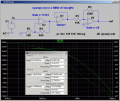
Nice simulation there
I try to encourage members to use a simulator to check their results, but i think some of them dont like simulators or something, or cant spend the time to learn how to use one like LT Spice, which is fairly decent.
Your simulation shows 0db very close to 4.2MHz. I'll try to duplicate this using my formulas.
That's after modifying the formula for a non inverting stage and including two gain factors like that and one for inverting.
So the formula for the inverting is:
(G*GBW)/sqrt(GBW^2+w^2*G^2+2*w^2*G+w^2)
and the formula for the non inverting stages is:
(G*GBW)/sqrt(GBW^2+w^2*G^2)
Because there are two non inverting stages and one inverting stage we have to use the first formula once and the second formula twice in order to arrive at an exact figure for this setup.
The funny thing is, doing it this way we get a gain of 16.059994 at 1MHz.
After a redo, the single stage approximation comes to to around 23 or 24 depending on which formula you use above. The simulation shows closer to 16 however.
Thank you very much for the help! Now, all I need is you as my day-to-day electronics tutor
MrAl, please refer to some text where these formulas are derived/applied as this is the first time I saw them and would like to have a better background on them...
Anyway, this is what I got when I used the formulas provided:
I like to encourage members to use simulators but also to learn circuit analysis in depth. Some things we have to be told or else it would take us a long time to figure them out, but so many things can be discovered just by using circuit analysis with just a little extra work on our part. We also need to learn how to utilize circuit analysis for discovery, even though we might already know how to analyze circuits. When we use it this way we are after something new that we never knew before or perhaps forgot. We apply the basic principles and then take it from there using circuit analysis.
In this case, it is a matter of applying circuit analysis in order to figure out what it is we are after. We are after the frequency response of a three op amp circuit. Before we do that though we need to know how to model an individual op amp and then to analyze that single op amp so that we can later combine more op amps together and then get the results we are after.
So to start, we need to select an op amp model. From the problem description it sounded like they want to use a single pole op amp described by the GBW but not to specify the open loop gain. Because they did not specify the open loop gain that usually means it should be infinite, although a high open loop gain would probably work just as well -- one such as we might find in a real op amp. But lets assume infinity for now because that simplifies the solutions.
The single pole op amp can be modeled by using a voltage controlled current source VCCS in combination with a resistor R in parallel to a capacitor C at the output. The output of the VCCS feeds the RC parallel combo. The output of the "op amp" is the output taken across the RC network. In particular, R is made very low to keep the output impedance low, such as 1 ohm. This also simplifies the formula for the value needed for the capacitor:
C=Aol/GBW/2/pi
So now we have the op amp model ready for use. The input to the VCCS is just the input of the op amp, so we ground the non inverting input (+ sense input) and use the inverting input (- sense input) for the feedback node for the inverting stage and using two resistors for the gain. For the non inverting stage we apply the input to the non inverting input and use the inverting input for the feedback node as usual. The gain is G+1 for the non inverting stage and G for the inverting stage.
All we do now is simply analyze the circuit, which gives us an output expression or a transfer function in the frequency domain. Using a few equalities we get the form we need. For example, for the inverting stage we get rid of the two resistors R1 and R2 by first making R2 equal to R1*G, then take the limit as R1 approaches infinity, and this way we get rid of both resistors and substitute the gain G, which is the form we need, and this also makes the output look like a perfect voltage source which it was not before and this simplifies the analysis also. For the non inverting stage we need to make R2=(G-1)*R1 instead because the ratio R2/R1 is equal to G-1 not G. We then let Aol approach infinity and that gets rid of Aol too. By this time we end up with a form that we wanted that contains only the variables we want to work with. This was the goal all along. Since we only need the amplitude for this problem (this is not always the case though) we can come up with an amplitude expression and that is the end formula(s).
We could go through this whole process i guess if you like, but you might try doing this yourself first and see what you end up with. It's a good example of applying circuit analysis with the aim of obtaining a certain kind of result.
please refer to some text where these formulas are derived/applied as this is the first time I saw them and would like to have a better background on them...

 Facebook
 Google
 GitHub
 Linkedin