Function Generator

AnalogKid

Joined Aug 1, 2013
12,142
https://wiki.analog.com/university/courses/electronics/electronics-lab-12sg

By the way, does this mean that the differential cascade is so nonlinear that it creates a signal of a different shape from a signal of one shape?
Such cascades are widely used, so how is their linearity achieved?
How is linearity achieved? Usually with negative feedback, which this circuit intentionally does not have.

Note that the signal levels in this circuit are in the millivolt region, when a transistor's "transfer curve" is its most non-linear. The circuit exploits that non-linearity.

Also, the circuit is quite finicky. It requires an input signal with a specific amplitude and tweaked DC offset, plus a balance control, plus very tightly matched transistors. Definitely a lab circuit, not one for the real world.

ak
 
Last edited:

MisterBill2

Joined Jan 23, 2018
27,557
Changing a square wave into an actual linear ramp (triangle wave) requires a constant current scheme charging and discharging a capacitor.
Changing a square wave into an RC-curve wave is simple and easy. and not close to linear.
Changing an R-C curve wave into a symetrical wave with curvy peaks and valleys is not very difficult. BUT that is not a sine wave.
 

tonyStewart

Joined May 8, 2012
237
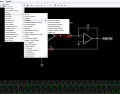
For simple design simulation, you may enjoy Falstad's interactive browser based version.
Turn off the current dots from >options > show current (toggle off)
Explore the standard designs.
Modify values with mouse wheel , add plots for anything , V, I, P
It is slow motion and time sample rate is under >options > other options > step size is for 2k data points per sweep. But in plots you can zoom in an out with wheel. Also save links with a tinyurl https://tinyurl.com/29ae36g5 then bookmark it. Active parts are ideal voltage sources so add Rs for realism and LC parts as well add ESR, DCR for realism. Plots can be edited to display Vmax, Vmin, avg, rms , f, d.f or floated up to screen and resized.
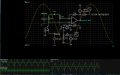
1746137334829.png
 

tonyStewart

Joined May 8, 2012
237
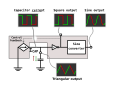
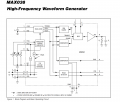
Intersil then Maxim's copy now obsolete created the sine, square, triangle in one IC .
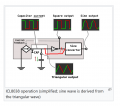
1746139726490.png The Sine shaper used compression to create the sine from a triangle which is the integral of a square wave easily created with a hysteresis Schmitt Trigger and RC integrator. A current source is more linear and varying the current creates a variable f.1746138647366.png


https://www.analog.com/media/en/technical-documentation/data-sheets/max038.pdf
 
Last edited:

Futurist

Joined Apr 8, 2025
765
For simple design simulation, you may enjoy Falstad's interactive browser based version.
Turn off the current dots from >options > show current (toggle off)
Explore the standard designs.
Modify values with mouse wheel , add plots for anything , V, I, P
It is slow motion and time sample rate is under >options > other options > step size is for 2k data points per sweep. But in plots you can zoom in an out with wheel. Also save links with a tinyurl https://tinyurl.com/29ae36g5 then bookmark it. Active parts are ideal voltage sources so add Rs for realism and LC parts as well add ESR, DCR for realism. Plots can be edited to display Vmax, Vmin, avg, rms , f, d.f or floated up to screen and resized.
View attachment 348237
What a truly great tool!

The chaotic circuits are fascinating.
 
Last edited:

MisterBill2

Joined Jan 23, 2018
27,557
The block diagram of theMAX038 device, shown in post #24, provides a hint that creating an actual sine wave is not simple. IN FACT, doing it with very low distortion is not even close to simple.
 

tonyStewart

Joined May 8, 2012
237
The block diagram of theMAX038 device, shown in post #24, provides a hint that creating an actual sine wave is not simple. IN FACT, doing it with very low distortion is not even close to simple.
Indeed not simple at all.

1. The triangle is simple to generator from a Schmitt sq.wave oscillator, but the amplitude defined by the supply voltage and hysteresis thresholds . The supply voltage and attenuator Vpp amplitude must be laser trimmed < 0.01%. not hard, not simple.
2. A discrete differential amplifier with an unusual negative feedback inverts the input voltage as it compares the input currents so both collectors have the identical signal with the virtual null of a Diff. Op Amp.
3. The constant current sink of the Diff Amp affects the gain so that must be laser trimmed as well if you want a regulated output but the current slightly affects Vbe slightly and thus the small input voltage that gets compressed on the peaks to convert the triangle into a sine. It must also be temperature compensated.

My quick and dirty sim. https://tinyurl.com/2dd24r4x

This was manually tuned to 65mVp error on 2Vp sine output or about 3% harmonic distortion.


Not simple at all.

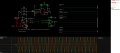
1746336458591.png

I provided a 1Vp triangle attenuated to 84.57 mVp (169.64 pp) and a 2Vp sin to compare the output after synchronize phase..
 

MisterBill2

Joined Jan 23, 2018
27,557
What could probably produce a fairly good sine wave from a 555 timer is to use short pulses to make a "high-Q" L-C tuned circuit ring, like a good class "C" RF amplifier output, when it is adjusted correctly. BUT that would be a single frequency arrangement, not conveniently tuned over a wide frequency range. And that might be an over-simplification on my part, those amplifiers are often fed with a fairly good sine wave .
 

AnalogKid

Joined Aug 1, 2013
12,142
In post #1 there is no frequency requirement stated, and no time scale in the scope shot. The output lowpass filter corner freq is 3.2 kHz. At that freq, a tuned class-C type circuit is not automatically a problem for a single frequency. In round numbers, 5 uF and 500 uH.

ak
 

tonyStewart

Joined May 8, 2012
237
For any tuneable frequency, < 1Hz to > 1MHz or more +/-5V fixed Sine, Square, Triangle out using R2R OA's

I arbitrarily chose 3 caps to select every 2 decades and Pot has a 200:1 R range for tuning f. This uses the Vbe quadratic feature with negative feedback to compress the gain on peaks.. For adjust Vout, add whatever you like with variable AC, DC.

Pros: uses
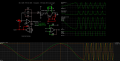
1746391064206.png

switch down from 1 MHz to 10 kHz

1746396092995.png

This is not a finished design but works ok for a couple hours work.
 
Top