Facebook
 Google
 GitHub
 Linkedin
Hi everyone,
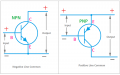
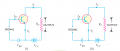
I’m having trouble understanding the basics of the second transistor schematic (the PNP circuit). My professor said I need to get familiar with how to control a bipolar transistor in an ideal setup.
1. The NPN transistor (circuit 1) is straightforward: the base–emitter voltage is driven by the voltage source Ue, and the base current is set by the series resistor. Easy to visualize and control.
2. The PNP transistor (circuit 2) is where I’m stuck. According to my professor, you can’t control it with a simple voltage source - you need a current source. But why?
Can someone help me understand this more clearly? My main goal is to see how we can use the transistor not just as a simple on/off switch, but as a controlled element in its linear region.
Thank you! Thor
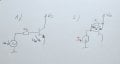
I’m having trouble understanding the basics of the second transistor schematic (the PNP circuit). My professor said I need to get familiar with how to control a bipolar transistor in an ideal setup.
1. The NPN transistor (circuit 1) is straightforward: the base–emitter voltage is driven by the voltage source Ue, and the base current is set by the series resistor. Easy to visualize and control.
2. The PNP transistor (circuit 2) is where I’m stuck. According to my professor, you can’t control it with a simple voltage source - you need a current source. But why?
- Control still happens between emitter and base, but the resistor between base and emitter is doing what? Is it acting as a pull up? Since the base is always tied to a current source, there shouldn’t be any floating node.
- How do I establish the base-emitter-voltage to control the transistor (besides controlling the base current via the current source)? A current source doesn’t fix the potential at 0.6 V below Vcc, so where does the necessary voltage drop come from?
Can someone help me understand this more clearly? My main goal is to see how we can use the transistor not just as a simple on/off switch, but as a controlled element in its linear region.
Thank you! Thor