Fractals: Problem with understanding log

Thread Starter

zulfi100

Joined Jun 7, 2012
656
Hi,
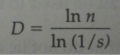
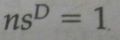
I am studying fractals. It uses natuaral log. I cant understand how the author developed the second equation from the first. The first equation is:
Zufi100_fractal-eq1.png
And the second equation is:
Zufi100_fractal-eq2.png
Can some body please guide me how to obtain the second equation. I tried the following:
ln ns^D = ln (1)
ln(n) + ln(s^D) = 1
ln(n) + Dln(s) = 1
Dln(s) = -ln(n)
D = -ln(n)/ ln(s)

Some body please guide me.

Zulfi.

Moderators note: removed white space from picture and changed contrast and brightness
 
Last edited by a moderator:

Thread Starter

zulfi100

Joined Jun 7, 2012
656
Hi,
Thanks for your response. I can tell you about ln(1/s). Its :
ln(1) - ln(s).
Please guide me how to obtain 2nd equation from 1st equation as i posted in #1.
Zulfi.
 

Thread Starter

zulfi100

Joined Jun 7, 2012
656
Its 1. Also tell me if the above is correct or not? If its correct then it means that if we convert ln(s) into ln(1/s) we will get a negative sign. So now we have :

ln ns^D = ln (1)
ln(n) + ln(s^D) = 1
ln(n) + Dln(s) = 1
Dln(s) = -ln(n)
D = -ln(n)/ ln(s)
D= ln(n)/ln(1/s)

Is the above correct?

Zulfi.
 

WBahn

Joined Mar 31, 2012
32,823
Its 1. Also tell me if the above is correct or not? If its correct then it means that if we convert ln(s) into ln(1/s) we will get a negative sign. So now we have :

ln ns^D = ln (1)
ln(n) + ln(s^D) = 1
ln(n) + Dln(s) = 1
Dln(s) = -ln(n)
D = -ln(n)/ ln(s)
D= ln(n)/ln(1/s)

Is the above correct?

Zulfi.
If the ln(1) = 1, then that means that e^1 = 1. Is that correct?

What must the base, e, be raised to in order to get a result of 1?

In your work, how do you justify the following step:

ln(n) + Dln(s) = 1
Dln(s) = -ln(n)

Where did the 1 go?
 

Thread Starter

zulfi100

Joined Jun 7, 2012
656
Hi,
Okay. I got my mistake.
ns^D = 1
ln(ns^D) = ln(1)
ln n + ln s^D = ln (1)
ln s^D = ln (1) - ln n
D = ( ln 1 - ln n) / ln s
D = (0 - ln n)/ln s
D= ln n / ln (1/ s)
Is this correct now???
What must the base, e, be raised to in order to get a result of 1?
I got the answer from google : ln (1) is actually zero.

Please guide me.

Zulfi.
 

WBahn

Joined Mar 31, 2012
32,823
That you had to Google what the ln(1) is does not bode well for you. You need to understand these fundamental concepts. Not memorize them, not be able to Google them, but to understand them.

Your work is correct now, but rather convoluted. It can be presented much more cleanly as

n·s^D = 1
ln (n·s^D) = ln(1)
ln(n) + D·ln(s) = 0
D·ln(s) = -ln(n)
D = - ln(n)/ln(s)
D = ln(n)/ln(1/s) = ln(1/n)/ln(s)

Unless (1/s) has some particularly meaning, I would probably leave it as the next to last line.
 
Top