Foldback current limiting

Thread Starter

criton4u

Joined Apr 14, 2021
6
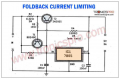
Hi I am trying to design a foldback current limiting circuit with a current limit of 30A. I was searching for reference designs online and found this MOSFET Current Limit Circuit. Is this foldback current limiting technique? I am a newbie so could you please explain in simple words.

Many thanks,
CJ
 

Ian0

Joined Aug 7, 2020
13,131
You need a resistor between R1 and the base of Q1, then another resistor from the base of Q1 to the drain of Q2.
By changing the two resistors, you can set the amount of foldback. In extremis, you can make it latch in the shutdown state until the power is removed.
 

crutschow

Joined Mar 14, 2008
38,503
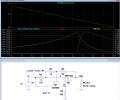
Below is the LTspice sim of an example foldback limit circuit:
The load current (yellow trace) drops above the limit value as the load resistance (green trace) goes to zero.
The MOSFET dissipation (blue trace) is limited to about 1.8W maximum and drops to a little over a watt with the output shorted (would be over 5W without the foldback).
Note that the component values may not be optimum for your particular requirements.

1731599194835.png
 
Last edited:

Thread Starter

criton4u

Joined Apr 14, 2021
6
No, that appears to be a standard limiter.
You need to search for "foldback current limiter".
Hi,
Many thanks for the clarification. I found the attached circuit for foldback current limiting circuit. From my understanding I should be using a Buck converter as my input would be close to 70V and output should be 60V. Now my question can I design a similar current foldback circuit using MOSFETS instead of transistors as my Current requirement is high?

Please comment your views and suggestions.

Kind regards,
CJ
 

Attachments

Thread Starter

criton4u

Joined Apr 14, 2021
6
Below is the LTspice sim of an example foldback limit circuit:
The load current (yellow trace) drops above the limit value as the load resistance (green trace) goes to zero.
The MOSFET dissipation (blue trace) is limited to about 1.8W maximum and drops to a little over a watt with the output shorted (would be over 5W without the foldback).
Note that the component values may not be optimum for your particular requirements.

View attachment 335783
Thank you for the detailed expalnation. much appreciated. @
crutschow
@
Ian0
 

Ian0

Joined Aug 7, 2020
13,131
Hi,
Many thanks for the clarification. I found the attached circuit for foldback current limiting circuit. From my understanding I should be using a Buck converter as my input would be close to 70V and output should be 60V. Now my question can I design a similar current foldback circuit using MOSFETS instead of transistors as my Current requirement is high?

Please comment your views and suggestions.

Kind regards,
CJ
No real point using foldback on a buck converter as it doesn't get into a high dissipation situation when it is overloaded.
Over current protection for buck regulators is not the easiest, as there is no supply that it can easily be connected to.
You don't say what your current requirement is but if you find a buck converter IC it will probably include some overload protection.
 

Thread Starter

criton4u

Joined Apr 14, 2021
6
Below is the LTspice sim of an example foldback limit circuit:
The load current (yellow trace) drops above the limit value as the load resistance (green trace) goes to zero.
The MOSFET dissipation (blue trace) is limited to about 1.8W maximum and drops to a little over a watt with the output shorted (would be over 5W without the foldback).
Note that the component values may not be optimum for your particular requirements.

View attachment 335783
Below is the LTspice sim of an example foldback limit circuit:
The load current (yellow trace) drops above the limit value as the load resistance (green trace) goes to zero.
The MOSFET dissipation (blue trace) is limited to about 1.8W maximum and drops to a little over a watt with the output shorted (would be over 5W without the foldback).
Note that the component values may not be optimum for your particular requirements.

View attachment 335783
Hi @
crutschow
Could you please explain how this works?
 

Thread Starter

criton4u

Joined Apr 14, 2021
6
You need a resistor between R1 and the base of Q1, then another resistor from the base of Q1 to the drain of Q2.
By changing the two resistors, you can set the amount of foldback. In extremis, you can make it latch in the shutdown state until the power is removed.
Hi Ian, As you mentioned I tried simulating the circuit with different values of R1 and R2 and had different transient responses. So did you mean to say by changing the values of R1 and R2 can change the foldback curve ( ranging from sharp to smooth).

I look forward for you comments.

Many thanks,
cj
 
Top